News & Insights
What Is 5G RedCap? Private 5G and Enterprise IoT

How Reduced Capability 5G fills the space between low-power IoT and full-performance 5G—and why it matters for Private 5G.
5G is often discussed through its extremes: higher speeds, lower latency and support for increasingly demanding applications.
Enterprise connectivity, however, is not a choice between maximum-performance 5G and sensors transmitting only a few bytes of data.
Many operational devices sit somewhere in between.
Industrial sensors, surveillance cameras, wearables, handheld terminals, asset trackers and connected equipment may need more capacity, mobility and responsiveness than traditional low-power IoT technologies provide. At the same time, equipping every device with a full-capability 5G modem can add unnecessary cost, complexity and power consumption.
5G RedCap was created to address this middle ground.
What Is 5G RedCap?
RedCap stands for Reduced Capability.
Also referred to as NR-Light, it was introduced in 3GPP Release 17 as a new class of 5G device designed for applications that require meaningful 5G performance without the complete capabilities of a high-end smartphone, router or industrial gateway.
The “reduced capability” refers to the device—not to the quality or capabilities of the entire network.
A RedCap device still communicates using 5G New Radio. However, its radio design can be simplified through measures such as:
Narrower channel bandwidth
Fewer transmit and receive antennas
Reduced maximum data rates
Optional half-duplex operation
Lower device processing requirements
Power-saving capabilities
Under the Release 17 profile, RedCap supports channel bandwidth of up to 20 MHz below 7 GHz and targets peak rates of approximately 150 Mbps downlink and 50 Mbps uplink, depending on the implementation, spectrum, network configuration and radio conditions.
That is substantially lower than the potential performance of a full-capability 5G device—but considerably more than many enterprise and industrial applications actually require.
Filling the Connectivity Gap
Different connected devices have very different requirements.
A utility meter may transmit a small reading several times per day. A wearable device may continuously exchange positioning and operational information.
A surveillance camera may send a steady uplink video stream. An augmented-reality terminal may require substantially more throughput and processing capability.
Trying to serve all these applications with one device category creates unnecessary compromises.
A simplified view of the connectivity landscape is:
Connectivity tier | Typical role |
NB-IoT and LTE-M | Small, intermittent data transmissions and long battery life |
5G RedCap | Moderate data rates, mobility and richer operational applications |
Full-capability 5G NR | High-throughput video, advanced terminals and demanding applications |
RedCap does not replace either end of this spectrum. It adds another option between them.
The practical question is no longer simply whether a device should connect through 5G. It is which level of 5G capability the application actually needs.

Why RedCap Matters for Private 5G
Private 5G allows an organization to design wireless coverage, capacity, security and traffic policies around a particular site and its operational requirements.
The economics of that network, however, also depend on the devices connecting to it.
If every sensor, camera or wearable requires a high-end 5G modem, device cost and power requirements can limit the number of applications that are practical to deploy.
RedCap can help align the device with the workload.
A RedCap device can use a simpler radio design while remaining part of the wider 5G environment.
Depending on the network and implementation, it can benefit from capabilities such as managed mobility, policy-based Quality of Service, traffic separation, local processing and integration with enterprise applications.
This makes RedCap particularly relevant to organizations that want to connect a broader range of devices through a common Private 5G architecture.
Potential Enterprise and Industrial Applications
Industrial Sensors
Connected sensors can transmit equipment condition, vibration, temperature, pressure and production information to local or centralized monitoring systems.
Some applications require more frequent reporting, lower latency or larger payloads than traditional low-power connectivity was designed to support, without requiring the capabilities of a full 5G modem.
Video Surveillance
Selected surveillance and operational cameras may be suitable for RedCap when their video quality, frame rate, encoding and uplink requirements fit within the available performance profile.
This could support safety monitoring, site security, equipment inspection and operational visibility.
High-resolution multi-camera systems or broadcast-grade production may still require full-capability 5G.
Wearables and Worker Devices
Connected wearables can support positioning, safety alerts, health information and access to operational applications.
RedCap’s combination of moderate throughput, mobility and reduced device complexity may make it suitable for devices that must remain compact and operate for extended periods.
Handheld Terminals and Scanners
Warehouses, campuses, factories, ports and logistics facilities depend on mobile terminals for scanning, inspection, maintenance, inventory and workforce coordination.
These devices may require more capability than simple IoT sensors but considerably less than a high-end consumer handset.
Asset Tracking and Mobile Equipment
RedCap can potentially support richer tracking and equipment information than basic location beacons, including operating status, diagnostics and more frequent updates as assets move across a site.
Gateways and Connected Infrastructure
Routers, controllers, displays, access systems and building infrastructure may also benefit when moderate 5G performance, managed mobility and integration with local applications are required.
RedCap Is Not the Answer for Every Device
Reduced complexity should not be confused with universal suitability.
RedCap may not be the right choice when an application requires:
Very high data rates
Multiple simultaneous high-resolution video streams
The lowest possible latency
Highly deterministic control
Advanced antenna capabilities
Extremely low data volumes and multiyear battery operation
A small meter transmitting occasional readings may remain better suited to NB-IoT or LTE-M. A demanding video, augmented-reality or industrial-control application may require full-capability 5G or a more specialized network configuration.
The application requirements should determine the connectivity technology—not the other way around.
What Must Be Evaluated Before Deployment?
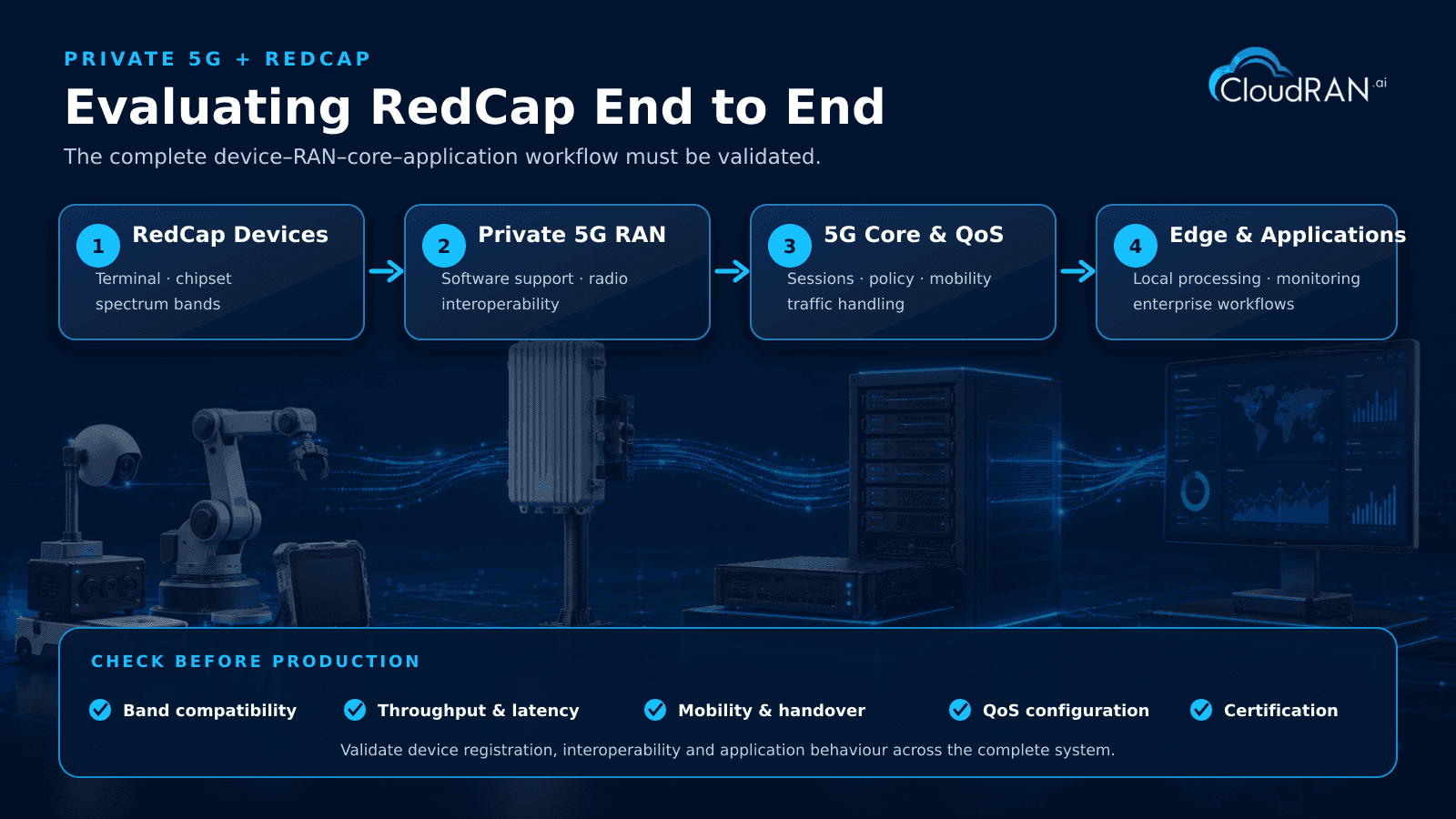
RedCap support cannot be assessed from the device alone.
The complete environment must be considered, including the terminal, chipset, supported spectrum bands, radio access network, 5G Core, software configuration and enterprise application.
Organizations evaluating RedCap should consider:
Whether the RAN software supports RedCap devices
Whether the device and network support the same spectrum bands
Required downlink and uplink performance
Latency and reliability requirements
Mobility and handover requirements
Battery-life expectations
Quality-of-Service configuration
Local edge and application integration
Device, spectrum and regional certification
Interoperability between the terminal, radio and core network
Testing the complete workflow is therefore important before committing to a production deployment.
From a Standards Capability to Practical Testing
CloudRAN.AI has implemented early stage RedCap support within its Private 5G base-station platform.
The current objective is to provide a practical environment in which RedCap terminals and applications can be evaluated as part of an integrated Private 5G architecture.
Potential evaluation areas include:
Device registration and session establishment
Terminal and radio interoperability
Application throughput and latency
Uplink and downlink behaviour
Mobility and handover
Quality-of-Service configuration
Core- and edge-system integration
Operational monitoring and management
Availability and functionality depend on the base-station configuration, software version, spectrum band, core network and RedCap device being tested.
CloudRAN.AI welcomes discussions with device manufacturers, module providers, operators, systems integrators and enterprises interested in testing compatible RedCap terminals or evaluating potential enterprise applications.
What Comes Next?
Release 18 extends the RedCap concept through enhanced RedCap, or eRedCap, targeting devices with even more modest data-rate and complexity requirements.
This creates a broader 5G device continuum—from low-complexity sensors to RedCap devices and full-performance 5G terminals—within an evolving standards-based ecosystem.
For enterprises, the significance of RedCap is not simply that it introduces another type of modem.
It makes it possible to match 5G capability more closely to the requirements of each device.
As Private 5G expands across manufacturing, logistics, utilities, mining, campuses and other operational environments, that ability to right-size connectivity could become important to making larger and more diverse device deployments technically and commercially practical.
Evaluate RedCap with CloudRAN.AI
Are you developing a RedCap terminal, module or enterprise application?
Contact CloudRAN.AI to discuss device compatibility, testing requirements and potential Private 5G evaluation scenarios.
Share This Event