News & Insights
Agentic BSS at MWC Barcelona: Governed Autonomy for Telecom Operations
Telcos are being asked to deliver more complex services (5G, IoT, enterprise SLAs) while reducing cost-to-serve and maintaining strict governance.
Agentic BSS is a governed execution layer: it turns intent into auditable actions across BSS/OSS systems—without bypassing controls.
Visit Cloudnet.ai at MWC Barcelona (Hall 6, Stand 6C44) to see how governed autonomy can reduce fallout, lower handling time, and improve first-contact resolution in high-volume journeys.
What is Agentic BSS?
Agentic BSS is an AI-native operating model and execution layer that transforms customer and operational intent into governed, auditable actions across telecom BSS and OSS platforms.
Unlike “assistant-only” approaches that focus on answering questions or drafting text, Agentic BSS uses specialized AI agents to coordinate workflows—such as product configuration, order fulfilment, billing operations, and customer care—through controlled APIs and event-driven triggers, while keeping the BSS/OSS as the system of record.
This is not a replacement for core platforms; it is a change in how work is executed.
Agents are applied where telecom workflows are exception-heavy and cross-domain: they translate intent into structured requirements, orchestrate tool calls, handle validation and exceptions, and produce traceable outputs that can be reviewed, approved, and committed under well-defined policies.
What Cloudnet.ai means by “Agentic”
Cloudnet.ai’s direction is Agentic BSS—our approach to building AI-native enterprise systems that don’t just assist work, but execute it.
Agentic BSS is an AI-native BSS where autonomous agents understand intent, reason over business context, and execute business processes end-to-end—with governance and human oversight where required.
Here, intent means the outcome a user wants in plain language—for example:
“create a new enterprise offer,”
“activate a new line,”
“resolve this order,” or
“generate a customer-ready quote.”
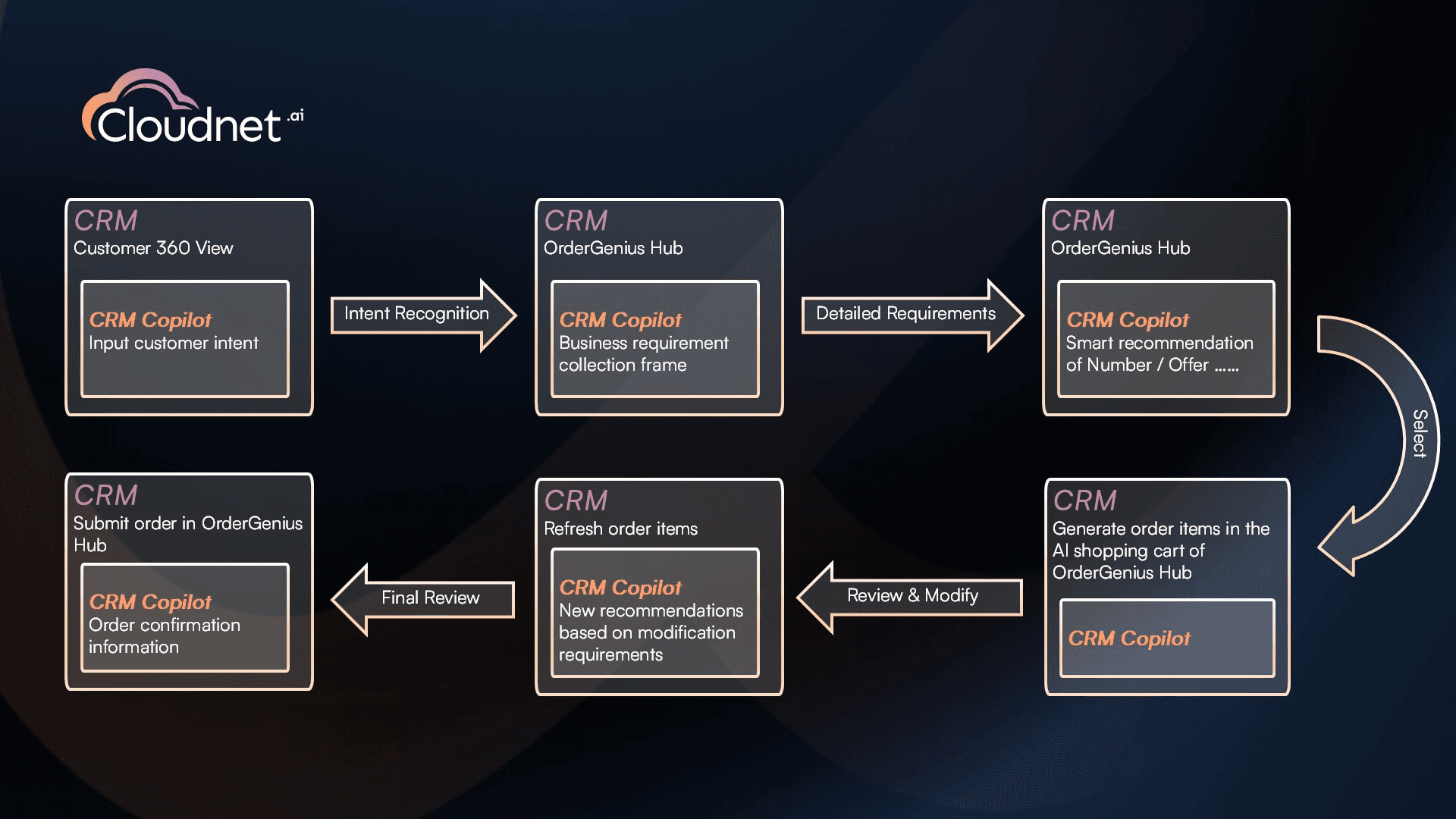
Instead of forcing teams to navigate systems step-by-step, agents translate intent into a structured action plan, call the right tools and APIs, track progress, and return a clear result a user can review—within defined business policies and boundaries.
In practice, this is the shift we’re bringing to telecom operations: moving beyond AI add-ons toward governed execution across real BSS/OSS workflows.
Below are a few concrete “before/after” examples of what governed execution looks like in frontline and back-office telecom workflows.
What changes in practice: “before / after” execution examples
Agentic BSS only matters when it changes how work gets done in real operations. Here are a few examples of what “governed autonomy” looks like in practice:
Ordering & fulfilment (reducing fallout)
Before: A Customer Service Representative (CSR) gathers requirements in free text, then jumps between CRM, catalogue, order management, and provisioning. Missing fields or inconsistent product rules trigger exceptions and rework.
After: An agent turns the request into validated structured data, checks eligibility and product rules, drafts the required write-backs, and routes only the approval moments to humans before committing changes via approved APIs.
Billing inquiry / dispute (reducing escalations)
Before: A billing issue requires manual evidence gathering across usage, policy, billing, and credits—often leading to escalations and long cycle times.
After: An agent assembles the evidence, proposes compliant resolution options (with policy checks), drafts adjustments, and submits them for approval—leaving a traceable audit record.
Assurance & SLA remediation (closing the loop earlier)
Before: Alarm noise and cross-domain handoffs delay remediation; SLA risks are discovered late.
After: Events trigger playbooks: an agent runs checks, recommends remediation, executes safe actions automatically, and escalates only when risk thresholds or approval policies require it.
Product/catalog change (reducing fear of “breaking downstream”)
Before: Change requests move slowly because teams fear unintended impacts across downstream systems.
After: An agent converts intent into a structured change plan, runs impact checks, supports staged rollout, and produces a clear audit trail of what changed, why, and who approved.
Why now?
The business case is tightening as industry economics and complexity collide. Operators face slow top-line growth alongside continual infrastructure investment—putting a premium on efficiency and faster monetisation of existing revenue flows.
At the same time, the architectural direction is clear: TM Forum’s Open Digital Architecture (ODA) positions a blueprint to simplify, modernize, and automate operations as systems become more complex.
Agentic AI is also moving from concept to priority. Many telecom leaders are now focused on scaling practical agentic use cases—especially in customer operations—while analysts continue to warn about “agent washing” and weak controls that fail in production.
The conclusion is simple: operators need AI that can execute real work across systems and prove it can be governed.
Cloudnet.ai’s Agentic BSS stack
At MWC Barcelona, Cloudnet.ai is showcasing an Agentic BSS stack designed around a control-plane / execution-plane separation—so autonomy can scale while governance remains explicit.
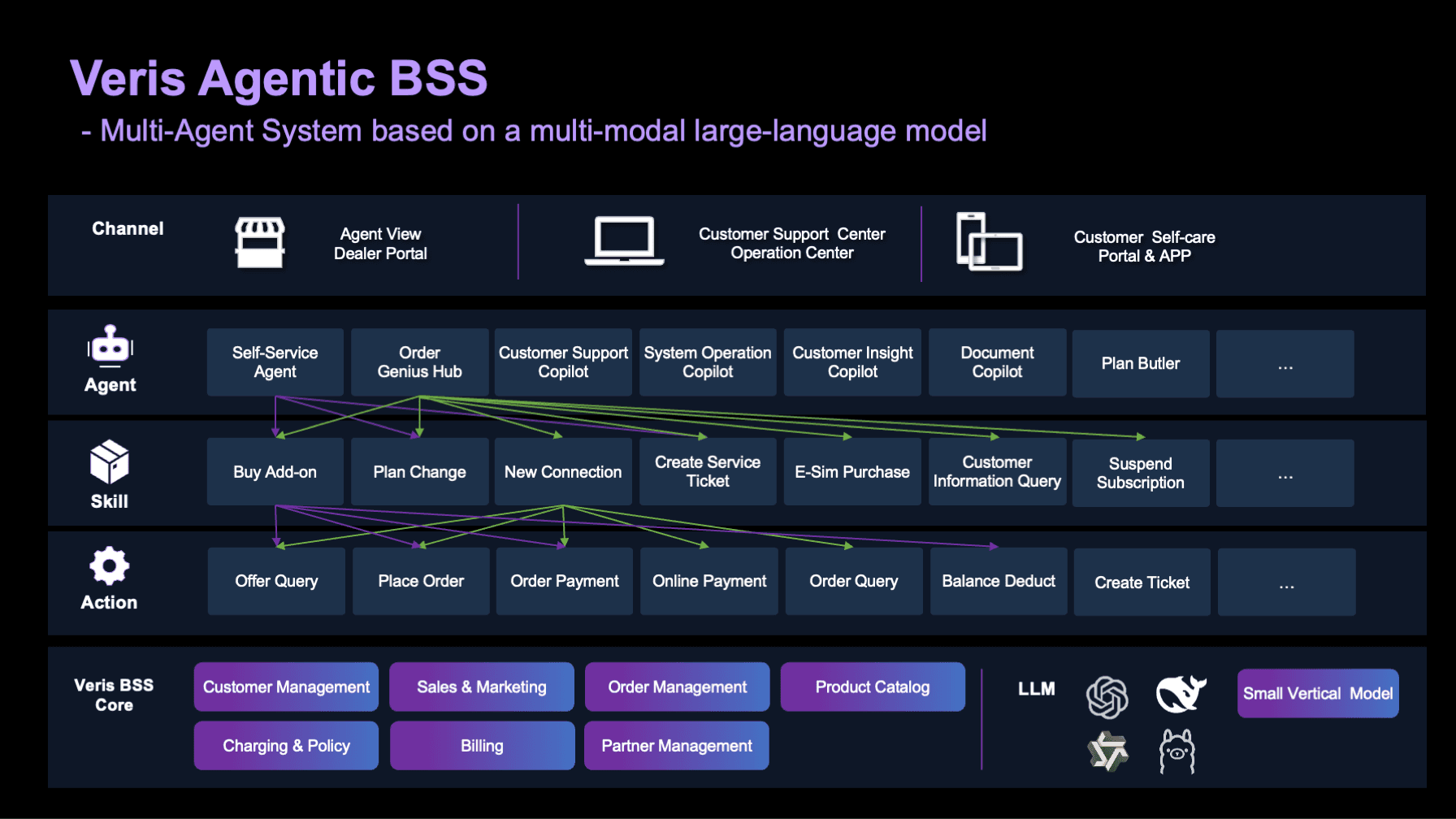
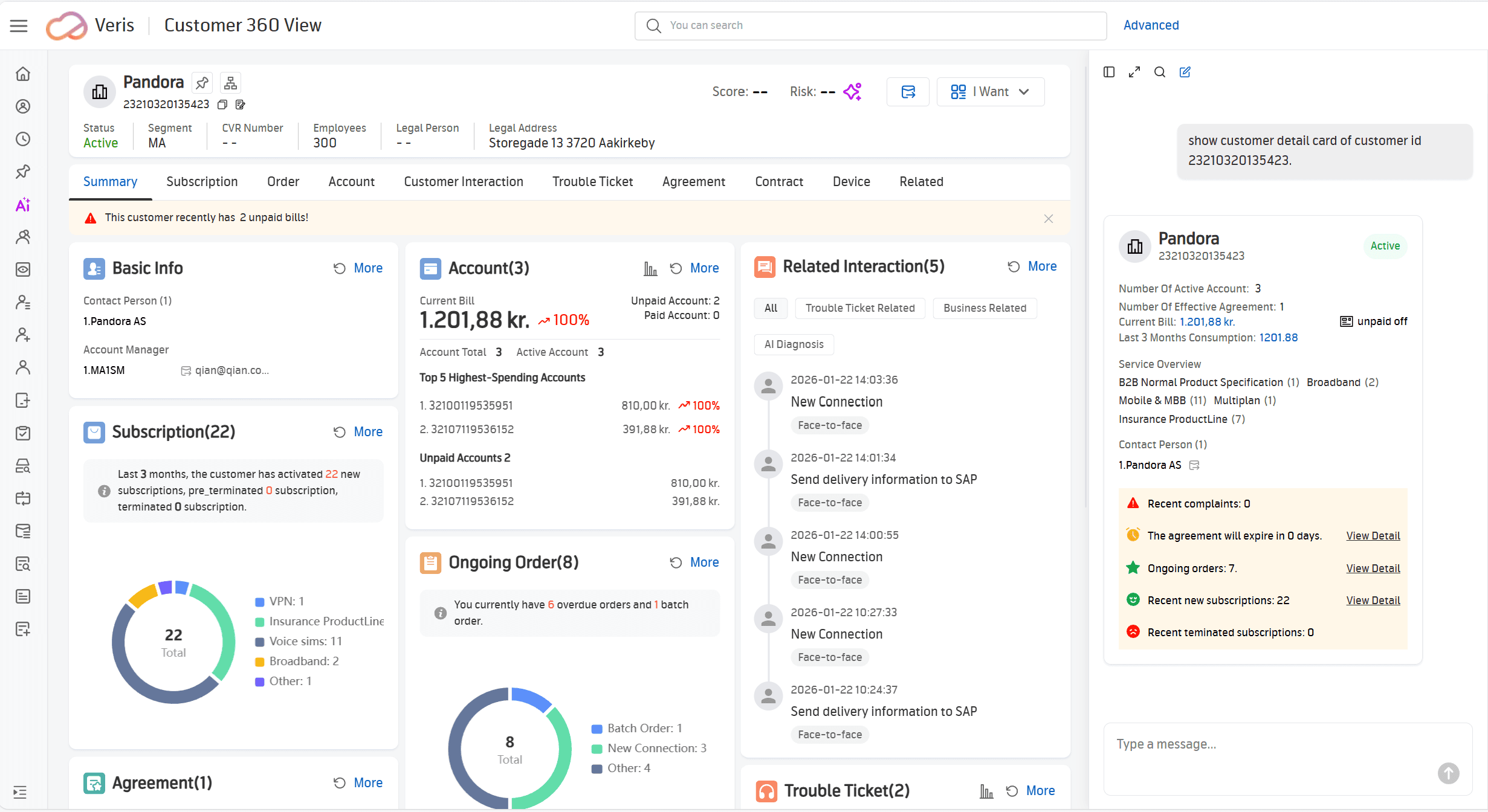
Veris Suite (execution plane / system of record). Veris Suite is the carrier-grade backbone for core BSS/OSS functions (customer, product, order, billing, assurance). It remains authoritative for transactional integrity: state changes, validations, and audit records live where they belong—inside the system of record.
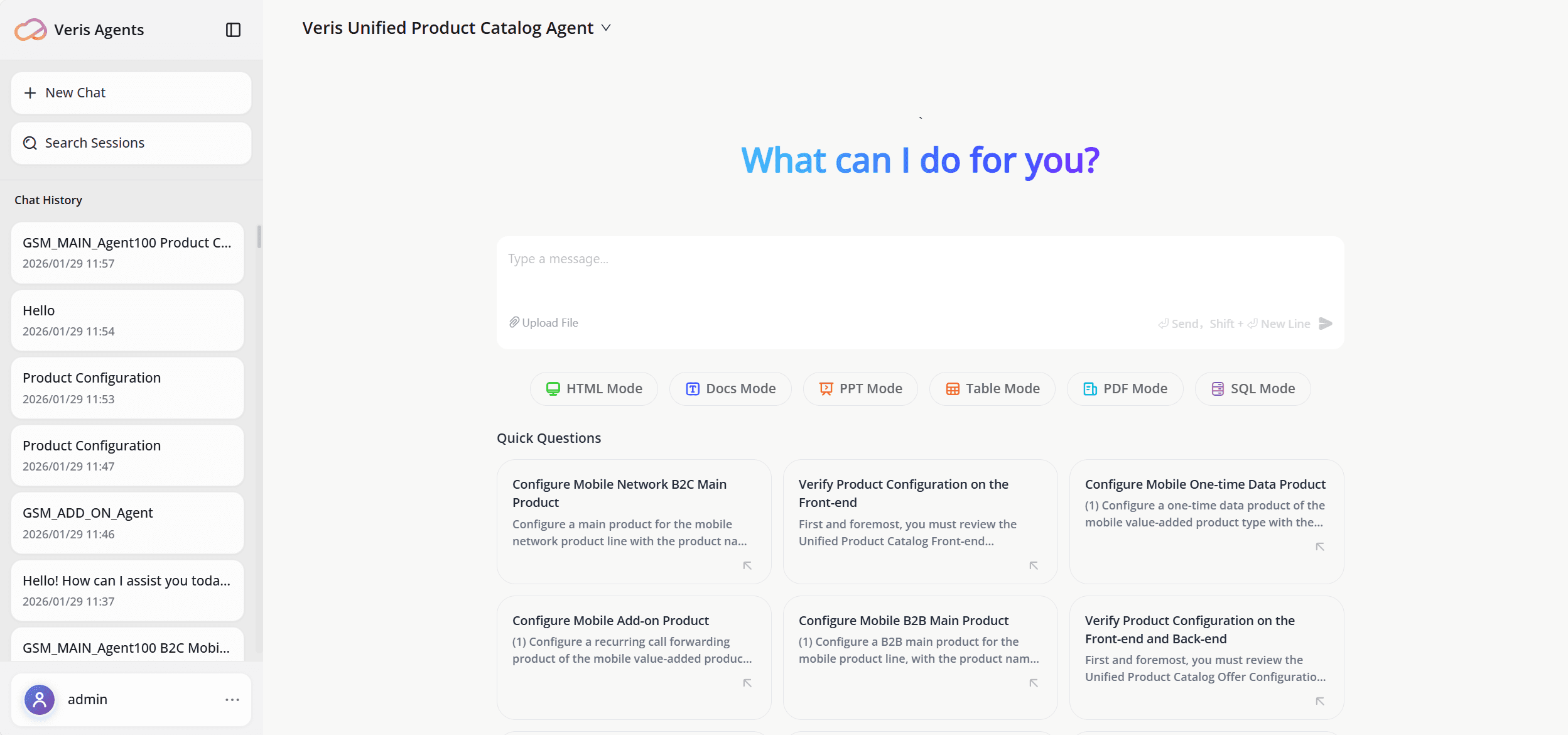
Veris Lite (control plane / agent orchestration). Veris Lite is the agent runtime that turns intent into structured requirements, routes journeys through configurable playbooks, orchestrates tool calls, and manages exceptions. It is where bounded autonomy is enforced: agents act through approved tools and events, not informal screen-scraping or opaque side channels.
Order Genius Hub (control surface / user experience). Order Genius Hub is the user-facing copilot experience for CSRs and operational teams. It guides structured capture, reduces system switching, and presents recommendations and draft write-backs in a way that supports operational trust and fast review.
CONTROL PLANE (intent → orchestration → governance)
Order Genius Hub → Veris Lite (agents + playbooks + policy gates)
EXECUTION PLANE (systems of record)
Veris Suite + operator BSS/OSS (order, billing, provisioning, assurance)
The “value waterfall”: mechanisms to measurable telco KPIs
Agentic BSS is only meaningful if it moves operator KPIs in production. Cloudnet.ai’s approach targets improvements through specific, observable mechanisms:
Structured capture → lower order fallout. Turning free-form intent into validated, complete data reduces exceptions and rework during fulfilment—improving throughput and revenue realisation.
Reduced system switching → lower AHT. Guided orchestration decreases the “swivel-chair” overhead between CRM, catalogue, order management, and billing screens—reducing average handling time and freeing frontline capacity.
Cross-domain execution → higher FCR. When agent workflows can invoke checks and actions across BSS/OSS domains in one governed journey, more issues complete within the first interaction—reducing repeat contacts and escalations.
Closed-loop remediation → fewer SLA breaches. Event-driven detection and playbook remediation can resolve exceptions earlier, reducing backlog and improving performance against time-bound commitments.
Governance you can audit: draft-first, human gates, policy enforcement
Telecom-grade autonomy must be transparent, reversible, and measurable. Cloudnet.ai emphasizes draft-first execution (draft → validate → approve → commit), with human-in-the-loop approvals for sensitive actions and explicit policy gates that separate deterministic constraints from probabilistic reasoning.
In practice, this means:
agents execute only through approved tools/APIs and recorded events,
every material write-back is traceable (what changed, why, and who approved),
and operators can set clear boundaries for what is automated versus what must be reviewed.
This aligns with system-level AI governance best practices: trust is built through accountability, transparency, safety, and operational controls—not by adding “AI” on top of brittle processes.
Meet us at MWC Barcelona; get the whitepaper after the show
MWC Barcelona runs 2–5 March 2026 at Fira Gran Via, Barcelona. Visit Cloudnet.ai / CloudRAN.AI at Hall 6, Stand 6C44 to see an AI-assisted order journey demo and how control-plane governance supports automation at scale.
If you can’t attend in person, we’ll publish the full Agentic BSS whitepaper immediately after MWC. To get it first—or to request a briefing—reach out via our website contact form and we’ll follow up with a copy and a meeting slot.
Share This Event