News & Insights
What Comes After Private 5G? From Connectivity to AI-Native Enterprise Networks

Private 5G has already moved beyond early experimentation.
Across industrial sites, logistics environments, ports, campuses, energy facilities, broadcast operations, live events, and remote locations, enterprises are using dedicated wireless networks to solve practical connectivity challenges that traditional Wi-Fi and public mobile networks were not always designed to handle.
The first stage of Private 5G has been about proving that dedicated cellular connectivity can deliver real operational value.
Reliable coverage.
Stronger uplink.
Better mobility.
Lower latency.
More control.
Greater security.
Faster deployment in environments where fixed infrastructure is difficult, slow, or expensive to build.
That foundation matters. But the next phase of Private 5G will not be defined by connectivity alone.
As enterprises become more digital, more automated, and more data-driven, the role of the network is changing. The network is no longer just a way to connect devices. It is becoming part of how enterprises sense their environment, move data, process information, support decisions, and automate operations.
This is where Private 5G begins to evolve into something larger: AI-native enterprise infrastructure.
Private 5G Today: A Dedicated Network for Real-World Operations
At its core, Private 5G gives an enterprise a dedicated cellular network environment designed around its own operational needs.
Unlike a shared public mobile network, a Private 5G network can be configured around specific sites, devices, applications, coverage requirements, performance targets, and security policies. Unlike traditional Wi-Fi, it is built for wide-area mobility, controlled radio performance, high device density, and more predictable service quality across challenging indoor and outdoor environments.
This is why Private 5G has gained traction in industrial and enterprise scenarios where wireless connectivity is not just a convenience, but part of the operating model.
A factory may need stable connectivity for AGVs, machine vision, sensors, control systems, and production monitoring.
A port may need coverage across cranes, yards, vehicles, handheld terminals, cameras, and logistics systems.
A live event may need reliable uplink for broadcasting, payments, access control, staff communication, and temporary operations.
A mining site or remote energy facility may need connectivity where traditional infrastructure is limited or unavailable.
A robotics fieldlab may need a controlled wireless testbed to validate mobile robots, remote-control workflows, and multi-robot coordination before production rollout.
In these cases, the value of Private 5G is not only higher speed. It is the ability to provide a dedicated, secure, and controllable wireless layer for operational workloads.
That is the foundation. But enterprise transformation does not stop at connectivity.
The Current Enterprise Challenge: Fragmented Systems
Most enterprises are not lacking technology. They are surrounded by technology.
They have networks, cameras, sensors, industrial systems, cloud platforms, edge servers, applications, databases, dashboards, security systems, automation platforms, and analytics tools.
The problem is that these capabilities are often fragmented.
Connectivity is handled by one layer.
Sensing happens through another layer.
Compute is deployed somewhere else.
AI is added through separate platforms.
Enterprise applications operate in their own silos.
The result is a gap between what enterprises want to achieve and what their infrastructure can easily support.
A site may have connected cameras, but the video data may not be processed locally.
A factory may have robots and sensors, but the network may not provide the mobility, latency, or traffic separation needed for advanced automation.
A remote site may generate operational data, but backhaul limitations may make real-time processing difficult.
An enterprise may want to deploy AI, but it may not have enough structured, real-time operational data to build useful models.
A network may carry information, but it may not understand what is happening in the environment it serves.
This is the central challenge for the next phase of enterprise infrastructure: Connectivity, sensing, computing, intelligence, and applications need to work together.
Private 5G is one of the strongest foundations for this convergence because it already sits at the point where enterprise devices, operational systems, edge compute, and real-time data flows meet.
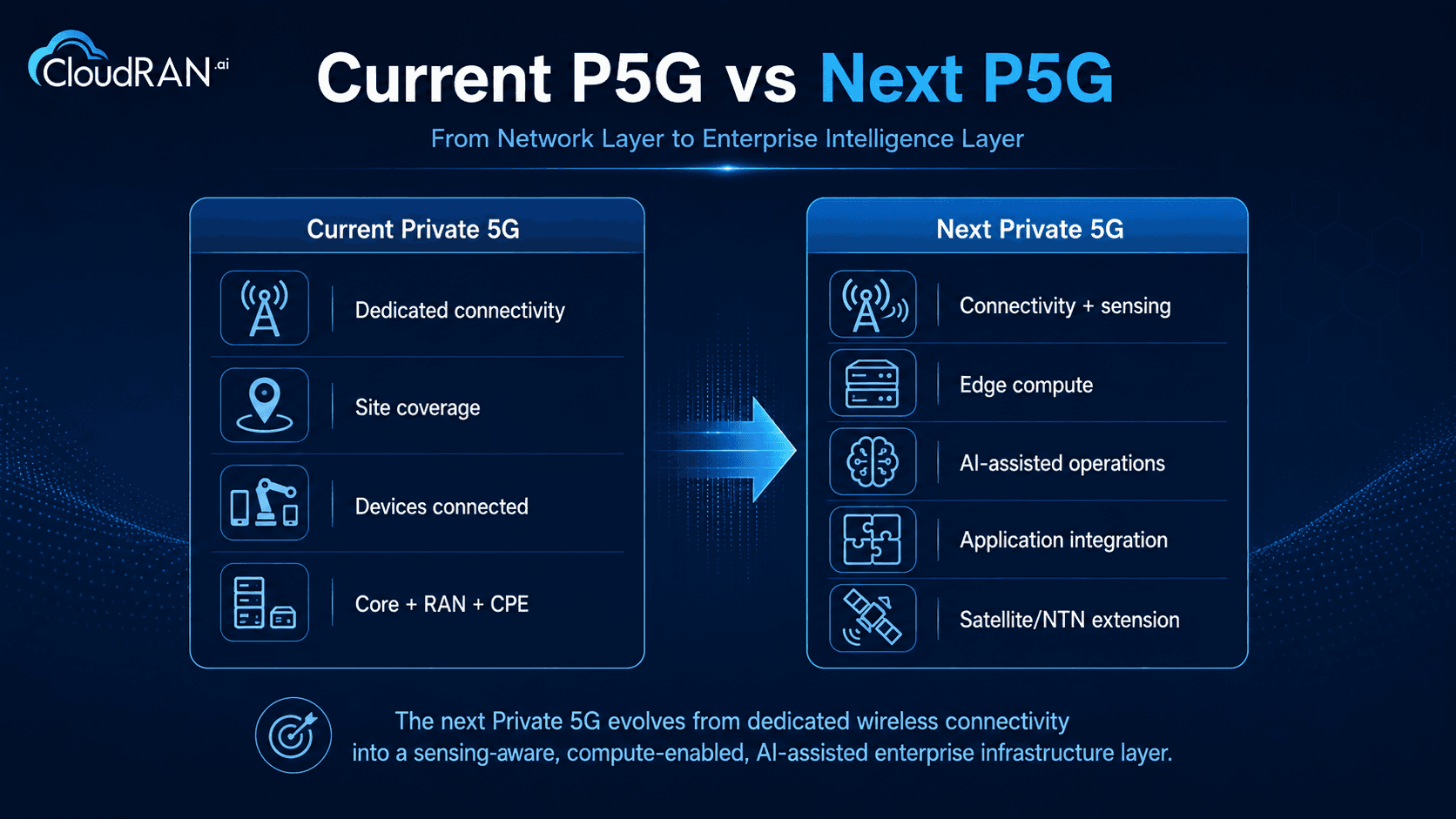
The Next Private 5G: From Network Layer to Enterprise Intelligence Layer
The next evolution of Private 5G will be shaped by a broader question:
What if the enterprise network could do more than connect devices?
What if it could help sense what is happening across the site?
What if it could support local computing close to machines, cameras, robots, workers, and vehicles?
What if AI-assisted tools could help plan, deploy, monitor, optimize, and troubleshoot the network?
What if the network could become part of an intelligent operating environment rather than remaining a passive transport layer?
This is the direction we see for the next generation of Private 5G.
It moves from a dedicated wireless network toward an AI-native enterprise network — an infrastructure layer that brings together:
enterprise connectivity;
real-time sensing;
edge computing;
AI-assisted operations;
application integration;
and future-ready network intelligence.
This does not mean every enterprise needs futuristic 6G capabilities today.
It means that Private 5G should be designed with a clear path forward: from reliable connectivity now, toward intelligent, sensing-aware, compute-aware, application-aware enterprise networks over time.
A Useful Framework: Nervous System, Nervous Endings, and Enterprise Brain
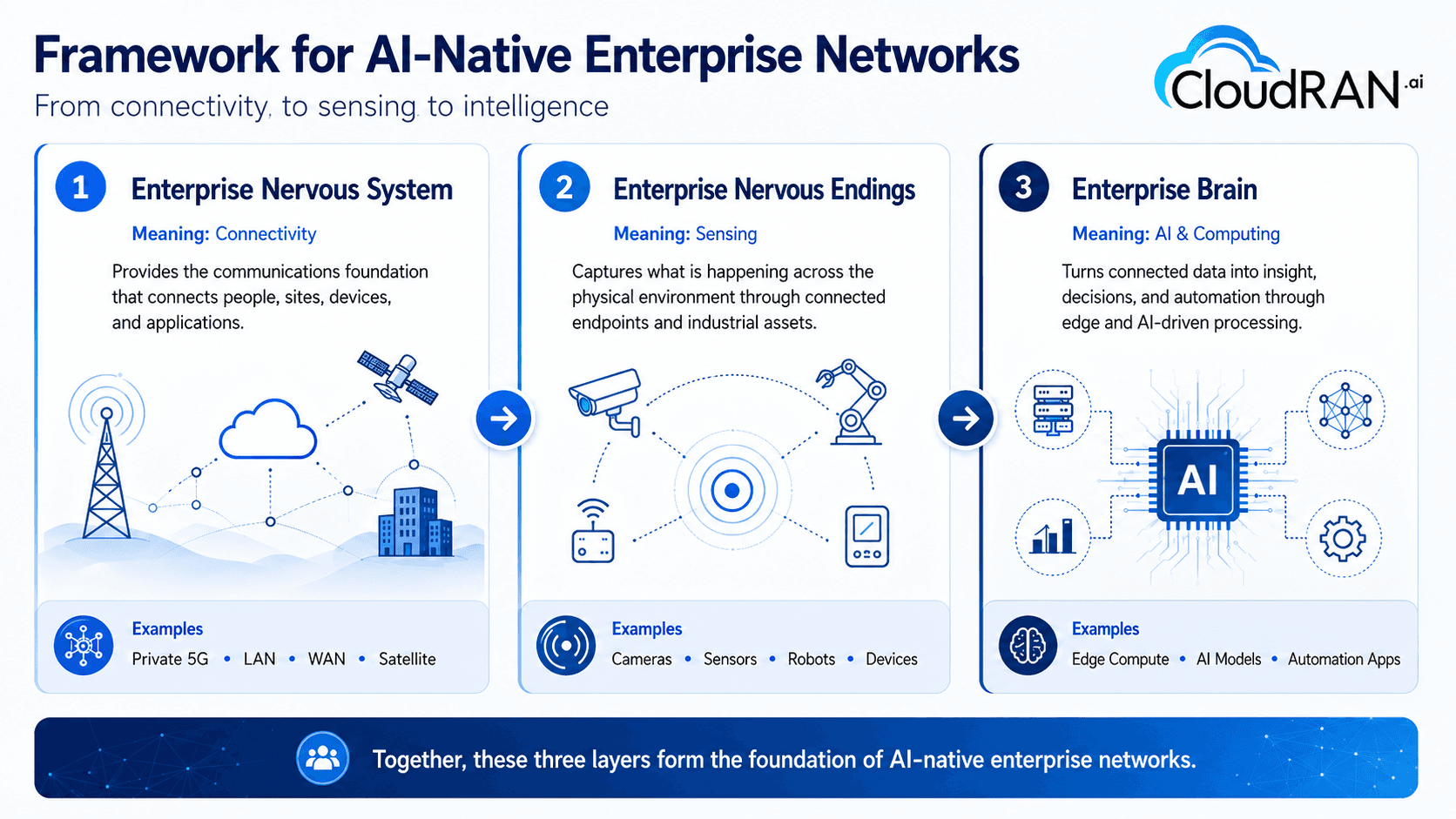
One way to understand this evolution is to think of the enterprise network as becoming more like a living system.
1. The Enterprise Nervous System
The first layer is connectivity.
This is the role Private 5G already plays today: connecting people, machines, sensors, cameras, robots, vehicles, handheld devices, industrial systems, and applications across the enterprise environment.
But future enterprise connectivity will need to unify more than one network type.
Enterprises may rely on Private 5G, LAN, Wi-Fi, WAN, fiber, satellite, public networks, and future non-terrestrial networks. The challenge is not simply deploying another access technology. The challenge is creating a more open, decoupled, and unified connectivity layer that can support different environments and operational needs.
In this model, Private 5G becomes part of the enterprise nervous system: the infrastructure that allows signals, data, instructions, and operational information to move reliably across the organization.
2. The Enterprise Nervous Endings
The second layer is sensing.
Modern enterprises increasingly depend on real-time awareness.
Cameras observe production lines.
Sensors monitor temperature, pressure, vibration, motion, location, and equipment status.
Robots and AGVs move through dynamic environments.
Workers use connected devices and terminals.
Drones, vehicles, and industrial machines generate continuous operational data.
The network of the future should not only connect these endpoints. It should help enterprises collect, transport, and structure the data that describes what is happening across the physical environment.
This is where sensing becomes a strategic part of the network architecture.
Integrated sensing and communication will become increasingly important as enterprises look for infrastructure that can support both connectivity and environmental awareness.
In practical terms, this means networks that are better able to support cameras, positioning, industrial sensors, autonomous systems, monitoring platforms, and operational intelligence applications.
3. The Enterprise Brain
The third layer is intelligence.
Once enterprises can connect devices and collect operational data, the next question becomes: where is that data processed, and how is it used?
For many industrial and enterprise use cases, sending everything to a distant cloud is not always practical. Latency, bandwidth cost, data sovereignty, reliability, and operational continuity all matter.
That is why edge computing, local breakout, MEC, and on-site processing are important to the future of Private 5G.
The enterprise brain is the intelligence layer built on top of connectivity and sensing. It can include AI models, analytics applications, digital twins, optimization engines, automation workflows, and eventually enterprise-specific AI agents or private LLM-based applications.
In this direction, Private 5G becomes more than a network. It becomes part of the data and intelligence infrastructure that allows enterprises to observe, understand, and act.
Why AI-Native Does Not Mean “AI-Washed”
AI is becoming part of almost every technology conversation. But not every AI message is useful.
For Private 5G, the opportunity is not to simply attach AI language to existing network products. The real opportunity is to identify where AI can make the network easier to plan, deploy, operate, optimize, and integrate.
This can happen in several practical areas.
AI-assisted planning
Private 5G deployment still depends on site-specific factors: coverage targets, building layout, spectrum conditions, device types, uplink requirements, latency targets, installation constraints, and operational use cases.
AI-assisted planning tools can help accelerate the early design process by guiding coverage planning, product selection, configuration choices, and deployment templates.
This does not replace engineering expertise. It helps make expertise more repeatable.
AI-assisted deployment
Enterprise Private 5G should become easier to bring online.
For many customers, the biggest barrier is not understanding why they need better connectivity. The barrier is complexity: radio planning, core configuration, SIM provisioning, device onboarding, QoS settings, integration with enterprise systems, and troubleshooting.
AI-assisted deployment can help reduce that complexity by turning validated documentation, configuration rules, and deployment experience into guided workflows.
The goal is not “autonomous magic.” The goal is faster, more consistent deployment.
AI-assisted operations
Once a Private 5G network is live, AI can support monitoring, optimization, anomaly detection, troubleshooting, and service assurance.
For example, an operations team may need to understand why a camera stream is unstable, why a device has poor signal quality, why uplink performance has dropped, or whether network changes are affecting application performance.
AI-native operations can help connect network data with operational context. That is where Private 5G can become more valuable over time: not only connecting devices, but helping enterprises understand how connectivity affects business operations.
Edge Computing: Bringing Intelligence Closer to the Operation
Many of the most important Private 5G use cases depend on local data processing.
Industrial cameras generate large video streams.
Robots require responsive control paths.
AGVs need reliable mobility and fast decision support.
Safety systems may need local analytics.
Live broadcasting depends on strong uplink and real-time transmission.
Mission-critical communications need predictable performance and priority handling.
These workloads cannot always depend entirely on centralized cloud infrastructure. This is why the future of Private 5G is closely connected to edge computing.
A modern Private 5G architecture can support local breakout, MEC, and on-site application processing, allowing enterprises to keep critical traffic close to the operation.
This matters for latency. It matters for bandwidth efficiency. It matters for resilience.
It also matters for AI, because enterprise AI becomes more useful when it can work with live operational data close to where that data is generated.
The future direction is not simply “5G plus cloud.” It is a more flexible architecture where connectivity, edge compute, and enterprise applications are designed together.
Computing-Native Networks: A Deeper Evolution
Looking further ahead, enterprise networks may begin to use network infrastructure itself as part of the computing fabric.
Traditional architecture treats networking and computing as separate layers. The network transports data. Servers process data.
But as radio systems, baseband units, distributed units, centralized units, edge platforms, and MEC environments become more software-defined, the boundary between network resources and compute resources becomes more flexible.
This opens the door to computing-native networks.
In a computing-native model, network infrastructure can support both communication workloads and selected computing workloads. Resources can be pooled, scheduled, and orchestrated more intelligently across the network and edge environment.
This is especially relevant for enterprise sites where space, cost, power, and operational simplicity matter.
Instead of always adding more standalone servers for every new application, future architectures may reuse or coordinate compute resources already embedded in the network.
This is still an emerging direction, but it is important because it points to a broader shift:
Private 5G is not only about wireless access.
It is becoming part of a distributed enterprise computing architecture.
Integrated Sensing and Communication: Networks That Understand the Environment
Another important direction is integrated sensing and communication.
Today, networks mainly move information from one endpoint to another. Future enterprise networks will increasingly help collect information about the physical environment itself.
This could include positioning, motion awareness, asset tracking, environmental monitoring, equipment status, safety sensing, video intelligence, and machine perception.
For enterprises, this matters because the physical world is where operations happen.
Factories, ports, mines, warehouses, campuses, venues, farms, and remote industrial sites all depend on understanding the real-time state of people, machines, assets, vehicles, and environments.
When sensing and communication become more integrated, the network can become part of the enterprise awareness layer.
This does not require waiting for full 6G commercialization to be relevant.
The direction already matters today because enterprises are deploying more sensors, cameras, robots, and connected systems. Private 5G provides a strong foundation for transporting this data reliably and securely, while future sensing-aware capabilities can make the network even more valuable.
Satellite-Connected Private 5G: Extending the Enterprise Network Beyond Fiber
Many enterprise environments are not located in ideal connectivity conditions.
Remote energy sites, mining operations, maritime environments, rural production facilities, temporary event sites, emergency-response zones, and infrastructure projects may operate far from reliable fiber or dense public mobile coverage.
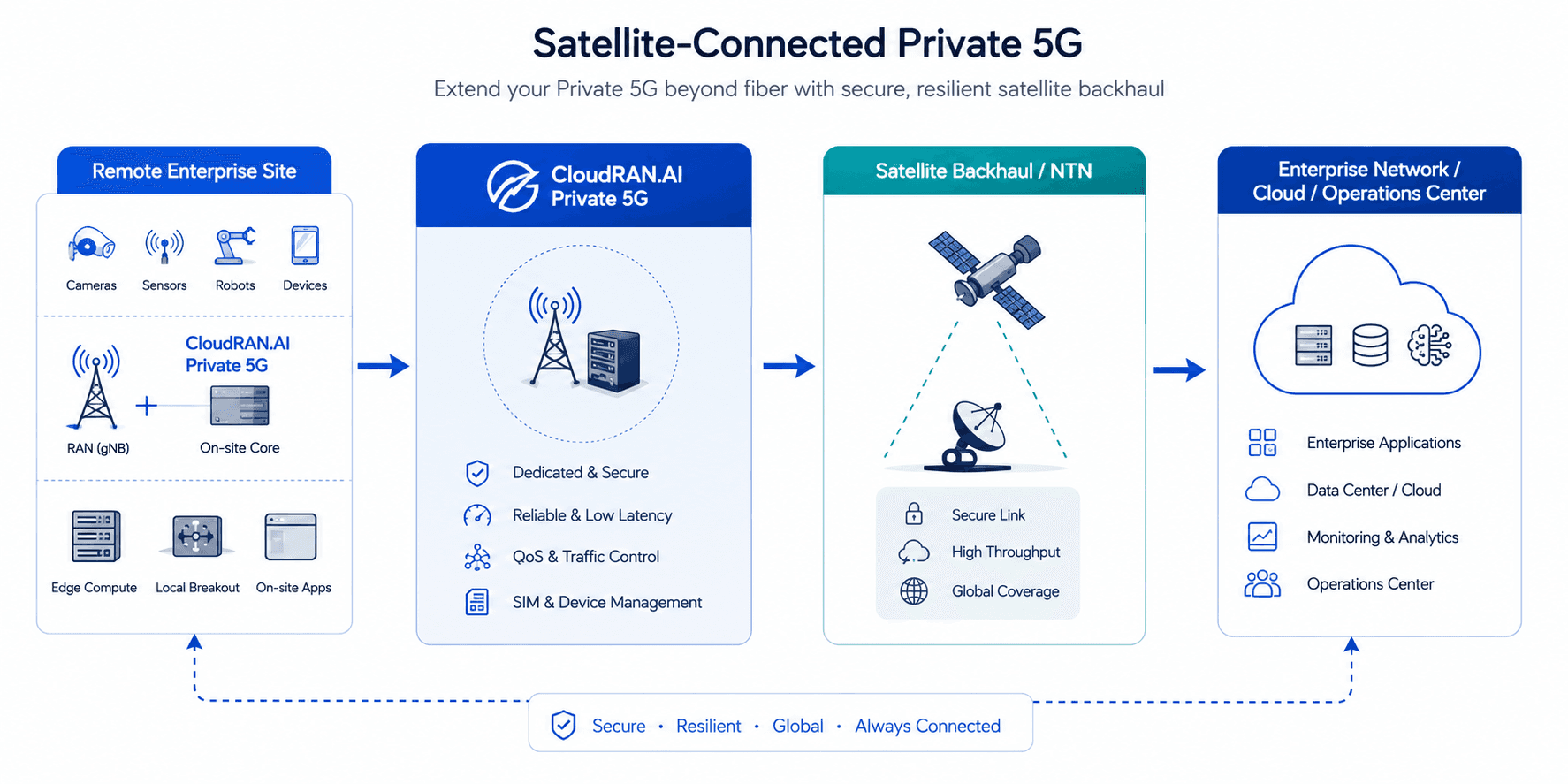
For these environments, satellite and non-terrestrial network integration will become increasingly important. The future enterprise network may combine terrestrial Private 5G with satellite backhaul, satellite-based access, and eventually more advanced NTN integration models.
This does not mean every Private 5G deployment needs satellite. It means the enterprise network should be able to extend beyond traditional fixed infrastructure when the use case requires it.
For remote and mobile environments, this is a natural evolution.
Private 5G provides the dedicated local wireless layer.
Satellite or NTN can extend the reach of that network beyond normal terrestrial limits.
Edge computing can keep critical processing local.
AI-assisted operations can help simplify deployment and management.
Together, these capabilities point toward a more resilient and flexible enterprise network architecture.
AI-RAN, 6G, and the Practical Path Forward
AI-RAN and 6G are becoming important industry topics. But for enterprise customers, the question is not whether a technology sounds futuristic.
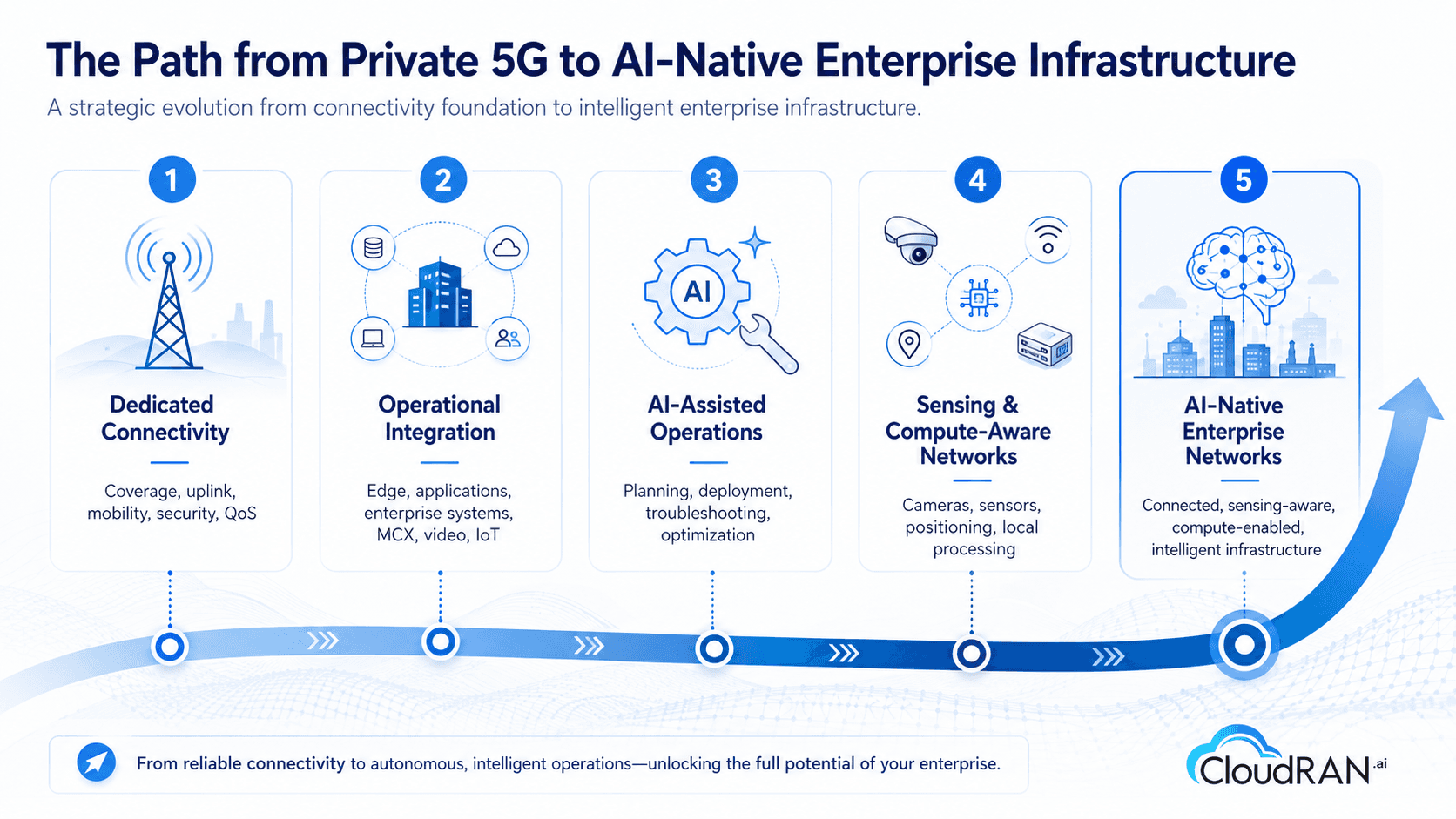
The question is whether it helps solve operational problems. That is why the path from Private 5G to AI-native enterprise networks should be practical and staged.
The first stage is dedicated connectivity: coverage, uplink, mobility, security, QoS, and control.
The second stage is operational integration: connecting Private 5G with enterprise systems, edge computing, video platforms, industrial applications, mission-critical communication, and monitoring tools.
The third stage is AI-assisted operations: planning, deployment, troubleshooting, optimization, and lifecycle management supported by validated data and automation.
The fourth stage is sensing-aware and compute-aware networking: infrastructure that not only connects the site, but also helps collect, process, and act on operational information.
The fifth stage is AI-native enterprise infrastructure: networks that become part of the enterprise intelligence layer, supporting more autonomous, adaptive, and context-aware operations.
This is how forward-looking network innovation becomes credible. Not by replacing practical deployments with abstract concepts. But by building from real deployments toward a more intelligent architecture.
Why This Matters for Enterprises
For enterprise decision makers, the evolution of Private 5G matters because digital transformation increasingly depends on infrastructure that can support real operations.
A manufacturer does not only need connectivity. It needs predictable production environments.
A logistics operator does not only need coverage. It needs visibility across assets, workers, vehicles, and workflows.
A venue does not only need guest internet. It needs payment systems, access control, security, staff communication, broadcasting, and operations to work during peak demand.
A remote site does not only need a network. It needs resilient connectivity where traditional infrastructure may not exist.
A robotics lab does not only need bandwidth. It needs a controlled environment to test mobility, video feedback, remote control, and automation.
In all of these examples, connectivity is the foundation. But the long-term value comes from what that connectivity enables:
real-time visibility;
operational control;
local intelligence;
automation;
safety;
faster deployment;
more resilient operations;
and new applications built on trusted enterprise data.
This is the deeper role of Private 5G. It is not simply another wireless option. It is a platform for building more intelligent enterprise environments.
CloudRAN.AI’s Vision: Practical Private 5G Today, AI-Native Enterprise Networks Tomorrow
At CloudRAN.AI, part of the Cloudnet.ai portfolio, we believe the future of Private 5G should be both practical and forward-looking. Enterprises need networks that work today.
They need solutions that can be deployed in real environments, support real devices, integrate with real operations, and deliver measurable value.
That is why practical deployment experience matters. Real case studies matter. Field-proven products matter. Operational simplicity matters.
But the direction of the industry is clear: enterprise networks will become more intelligent, more integrated, more software-defined, and more deeply connected with edge computing, sensing, AI, and applications.
The next Private 5G will not be defined by radio access alone. It will be defined by the ability to bring together:
dedicated wireless connectivity;
edge computing;
enterprise sensing;
AI-assisted deployment and operations;
application integration;
and future-ready network architecture.
This is the path from Private 5G to AI-native enterprise networks. A path where connectivity becomes the foundation for intelligence. A path where networks become easier to deploy, easier to operate, and more aligned with enterprise outcomes.
A path where Private 5G supports not only today’s operational challenges, but tomorrow’s intelligent enterprise infrastructure.
From Dedicated Connectivity to Intelligent Infrastructure
Private 5G has already proven its value as a dedicated enterprise wireless network. The next step is to expand that value.
The future is not just about connecting more devices. It is about connecting the physical environment to digital intelligence.
It is about giving enterprises the network foundation to sense, compute, analyze, automate, and act. It is about moving from isolated infrastructure toward a more integrated enterprise system.
Private 5G is the starting point. AI-native enterprise networks are the direction.
And the companies that can combine real deployment experience with a clear future architecture will be best positioned for the next phase of enterprise connectivity.
Share This Event