Case Study
Agentic BSS Use Case: Resolving a Delayed Broadband Installation
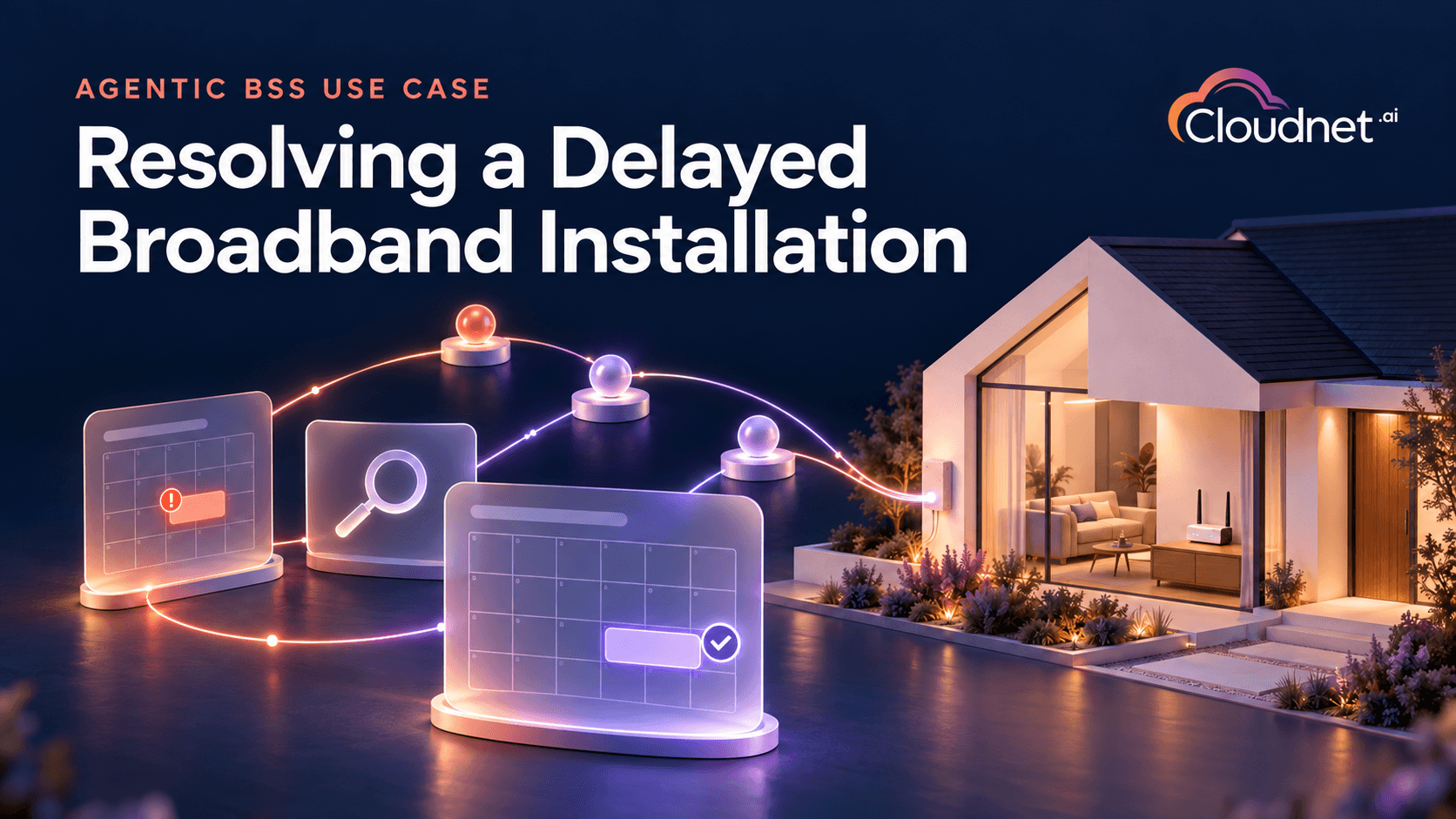
Agentic BSS Use Case: Resolving a Delayed Broadband Installation
A broadband installation has stalled. The customer wants a new date. Before promising one, the service representative needs to understand what is blocking the order, whether the necessary resources are available, and which changes the operator can authorize.
An Agentic BSS workflow can coordinate that investigation across order management, operational support systems (OSS), and appointment scheduling. In this example, specialized agents identify a technician scheduling conflict and prepare a recovery plan for the representative to review.
This illustrative use case is adapted from Cloudnet.ai’s Understanding Agentic BSS whitepaper.

Get the one-page use-case sheet
A quick reference to the workflow, controls, and evaluation measures.
Start with the stalled order
The workflow begins when an installation delay is detected or a service representative requests an investigation. The OrderDiagnosticsAgent retrieves the order status and customer context through approved tools, then initiates the relevant operational checks.
A delay status tells the representative that something has gone wrong. The investigation needs to establish why—and gather enough evidence to determine a feasible next step.
Identify the conflict and check recovery options
The OSSAgent checks resource availability. In this scenario, its findings identify a technician scheduling conflict.
The SchedulingAgent then checks available appointments against the relevant constraints. The workflow combines these findings into a proposed new date and an explanation of the delay.
The representative receives a recommendation supported by the investigation: what blocked the installation, which appointment is feasible, and any conditions that still need to be met.
Review, authorize, and update
The representative reviews the recommendation and follows the operator’s approval and customer-confirmation requirements before authorizing a change. Investigating the delay and preparing a recommendation do not themselves grant permission to change the appointment.
Once authorized, the change is submitted through approved interfaces. The workflow records the supporting evidence, approval, and resulting update.
This connects the investigation to a controlled operational action, with a record of how the decision was reached and what changed.
Escalate with the investigation attached
A feasible replacement appointment may be unavailable, or the issue may fall outside the configured playbook. The workflow then invokes a TroubleTicketAgent to create an escalation ticket containing the order ID, diagnostic findings, and customer context.
The receiving team can see what has already been checked and what still needs attention. Carrying the investigation into the handoff helps the next person continue the work without unnecessarily repeating the same checks or asking the customer to explain the issue again.
Connect the agents to governed BSS operations
In Cloudnet.ai’s reference architecture, Veris Agent Builder coordinates the agents, playbooks, and tool calls. Veris Suiteprovides authoritative BSS records and governed transaction processing.
The agent layer coordinates work across the connected systems through controlled interfaces. The operator’s configured permissions, validations, and approval requirements define which actions are allowed.
For the workflow to be auditable, its records need to connect the evidence retrieved, the recommendation made, the approval obtained, and the resulting update or escalation.
Evaluate the whole recovery process
Evaluate the workflow against the existing process. Useful measures include investigation time, repeat customer contacts, escalation completeness, human overrides, and update accuracy.
Successful rescheduling is one outcome. A well-supported escalation is another. In both cases, the question is whether the workflow helps the team reach an appropriate, traceable next step with less avoidable investigation and rework.
Explore the architecture and safeguards in Understanding Agentic BSS →