Case Study
Agentic BSS in Action: Governed Autonomy for Telecom Operations
How Cloudnet.ai Turns Customer and Operational Intent into Auditable Execution Across BSS/OSS Workflows
Telcos are being asked to deliver more complex services — including 5G, IoT, enterprise SLAs, private network services, and bundled digital offers — while reducing cost-to-serve and maintaining strict governance.
The operational problem is clear: telecom workflows are becoming more cross-domain, more exception-heavy, and more dependent on coordination between CRM, product catalog, order management, billing, provisioning, assurance, and customer care. Yet many frontline and back-office teams still work through manual handoffs, fragmented screens, ticket queues, and incomplete data capture.
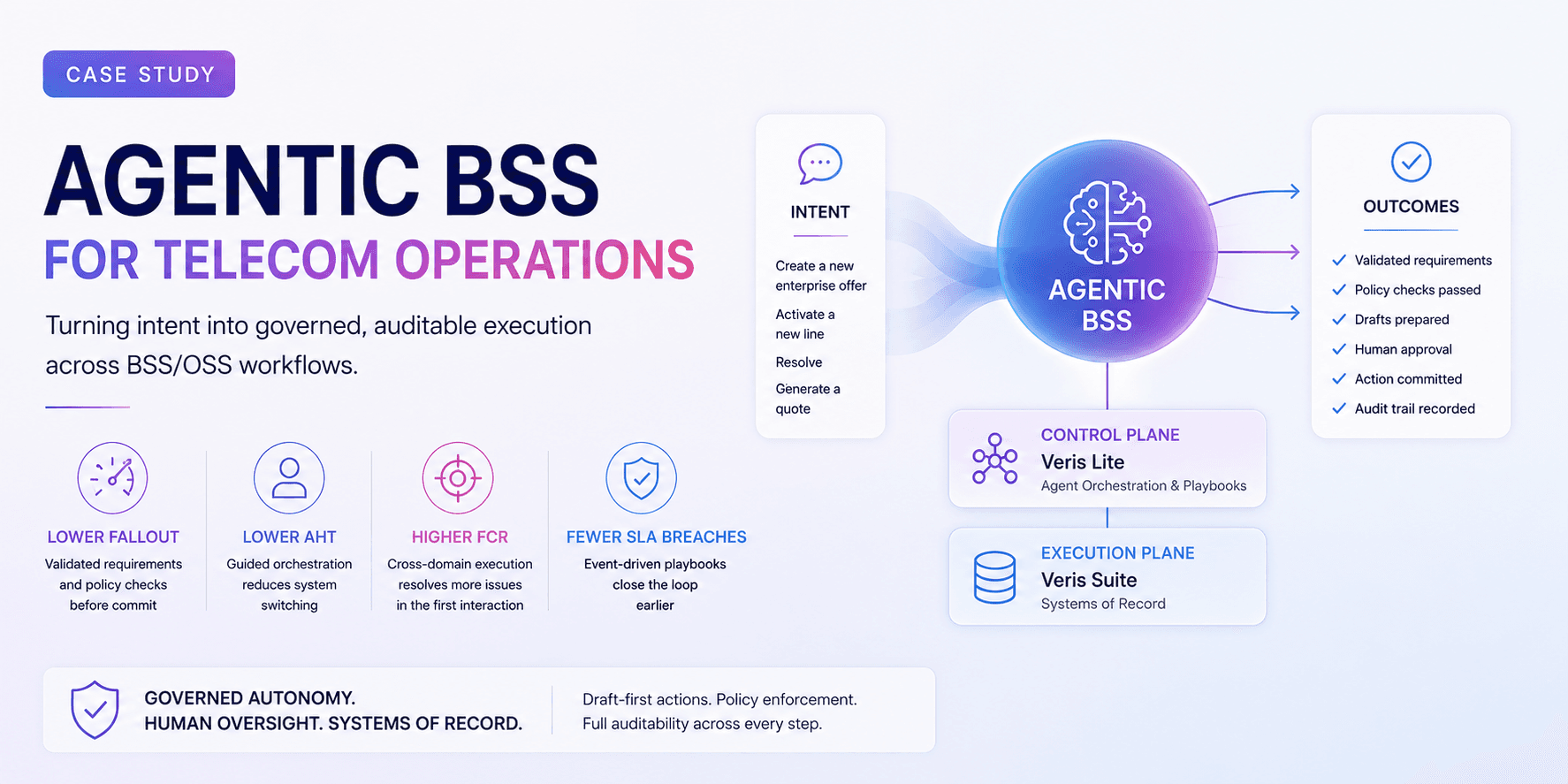
Agentic BSS is a governed execution layer. It turns customer and operational intent into auditable actions across BSS/OSS systems — without bypassing controls.
Cloudnet.ai’s Agentic BSS approach is designed to help operators reduce order fallout, lower handling time, improve first-contact resolution, and close operational loops earlier in high-volume telecom journeys.
What Is Agentic BSS?
Agentic BSS is an AI-native operating model and execution layer that transforms customer and operational intent into governed, auditable actions across telecom BSS and OSS platforms.
Unlike “assistant-only” approaches that focus on answering questions, summarizing records, or drafting text, Agentic BSS uses specialized AI agents to coordinate workflows such as product configuration, order fulfilment, billing operations, customer care, assurance, and SLA remediation through controlled APIs and event-driven triggers.
The key difference is execution.
Agentic BSS is not only about giving users advice. It is about helping users get work done across real operational systems — while keeping the BSS/OSS as the system of record.
This is not a replacement for core platforms. It is a change in how work is executed.
Agents are applied where telecom workflows are exception-heavy and cross-domain. They translate intent into structured requirements, orchestrate tool calls, handle validation and exceptions, and produce traceable outputs that can be reviewed, approved, and committed under well-defined business policies.
What Cloudnet.ai Means by “Agentic”
Cloudnet.ai’s direction is Agentic BSS: an approach to building AI-native enterprise systems that do not just assist work, but execute it.
Agentic BSS is an AI-native BSS model where autonomous agents understand intent, reason over business context, and execute business processes end-to-end — with governance and human oversight where required.
Here, intent means the outcome a user wants in plain language. For example:
“Create a new enterprise offer.”
“Activate a new line.”
“Resolve this order.”
“Generate a customer-ready quote.”
“Check why this order is stuck.”
“Prepare a compliant adjustment for this billing dispute.”
“Create a new IoT connectivity package for an enterprise customer.”
“Validate whether this product configuration will break downstream fulfilment.”
Instead of forcing teams to navigate systems step by step, agents translate intent into a structured action plan, call the right tools and APIs, track progress, and return a clear result a user can review — within defined business policies and boundaries.
In practice, this is the shift Cloudnet.ai is bringing to telecom operations: moving beyond AI add-ons toward governed execution across real BSS/OSS workflows.
The Operational Challenge: Telecom Workflows Are Too Fragmented
Telecom operators run some of the most complex operational environments in any industry.
A single customer request may require coordination across:
CRM
Product catalog
Pricing and offer management
Order management
Provisioning
Resource inventory
Billing and charging
Payments and credits
Trouble ticketing
Assurance
SLA management
Customer communications
Partner or enterprise portals
In many operators, these domains are technically integrated but operationally fragmented. Users still need to interpret customer intent manually, switch across multiple systems, check policies, validate product rules, collect missing information, and coordinate approvals.
This creates several persistent problems:
High order fallout
Long average handling time
Repeat contacts and escalations
Slow product and catalog change cycles
Manual billing investigation
Delayed assurance remediation
Weak operational traceability
Fear of automation due to unclear governance
Low trust in AI because outputs are not tied to controlled execution
Agentic BSS addresses this gap by creating a governed execution layer between human intent and BSS/OSS systems of record.
What Changes in Practice: Before / After Execution Examples
Agentic BSS only matters when it changes how work gets done in real operations. Below are concrete examples of what governed autonomy looks like in frontline and back-office telecom workflows.
1. Ordering and Fulfilment: Reducing Fallout
Before
A Customer Service Representative gathers requirements in free text, then jumps between CRM, catalog, order management, and provisioning systems.
The CSR may need to manually check customer eligibility, product compatibility, pricing rules, address or service availability, required fields, resource constraints, and fulfilment dependencies.
Missing fields or inconsistent product rules trigger downstream exceptions and rework. Orders get stuck. Customers call again. Operations teams investigate manually.
After
An agent turns the customer request into validated structured data.
The agent checks eligibility, product rules, required fields, service availability, and known fulfilment constraints. It drafts the required write-backs and routes only the approval moments to humans before committing changes through approved APIs.
The result is a cleaner order before it reaches fulfilment.
Operational impact
Lower order fallout
Fewer missing-field exceptions
Faster order-to-activation
Reduced rework
Better throughput for frontline teams
Higher revenue realization from successfully completed orders
2. Billing Inquiry and Dispute: Reducing Escalations
Before
A billing issue requires manual evidence gathering across usage records, policy rules, billing history, credits, adjustments, customer notes, and product configuration.
The CSR or back-office user must assemble context manually, interpret the issue, decide whether the customer is eligible for adjustment, and escalate when uncertain.
This often leads to long cycle times, inconsistent outcomes, and customer frustration.
After
An agent assembles the evidence, checks policy, identifies possible causes, proposes compliant resolution options, drafts adjustment actions, and submits them for approval.
Every step leaves a traceable audit record.
Operational impact
Faster billing resolution
Fewer escalations
More consistent policy application
Better customer experience
Lower handling cost
Stronger auditability for credits and adjustments
3. Assurance and SLA Remediation: Closing the Loop Earlier
Before
Alarm noise and cross-domain handoffs delay remediation. Network, service, and customer-impact data may sit in separate systems.
SLA risks are discovered late. Teams spend time correlating events, identifying affected customers, and deciding what actions to take.
After
Events trigger playbooks.
An agent runs checks, correlates service and customer context, recommends remediation, executes safe actions automatically where policy allows, and escalates only when risk thresholds or approval policies require it.
Operational impact
Earlier SLA risk detection
Faster remediation
Lower backlog
Fewer missed commitments
Better closed-loop operations
Clearer link between network events and customer/service impact
4. Product and Catalog Change: Reducing Fear of “Breaking Downstream”
Before
Product and catalog change requests move slowly because teams fear unintended impacts across ordering, provisioning, charging, billing, partner systems, and customer care.
Changes require manual review and cross-team coordination. Even small updates can take time because no one wants to break downstream workflows.
After
An agent converts intent into a structured change plan, checks product dependencies, validates downstream impacts, supports staged rollout, and produces a clear audit trail of what changed, why, and who approved.
Operational impact
Faster offer launch
Lower risk of downstream breakage
Better product governance
More transparent change management
Improved collaboration between product, IT, operations, and care teams
Why Now?
The business case is tightening as industry economics and complexity collide.
Operators face slow top-line growth alongside continual infrastructure investment. They must monetize 5G, IoT, enterprise services, private networks, and bundled digital offerings while reducing cost-to-serve.
At the same time, the architectural direction is becoming clearer. TM Forum’s Open Digital Architecture positions a blueprint to simplify, modernize, and automate operations as systems become more complex.
Agentic AI is also moving from concept to priority. Many telecom leaders are focused on scaling practical agentic use cases, especially in customer operations, service fulfilment, and back-office workflows. But the industry is also becoming more cautious about “agent washing” — superficial AI wrappers that look impressive in demos but fail in production because they lack controls, traceability, and integration with real systems.
The conclusion is simple: operators need AI that can execute real work across systems and prove it can be governed.
That is the role of Agentic BSS.
Cloudnet.ai’s Agentic BSS Stack
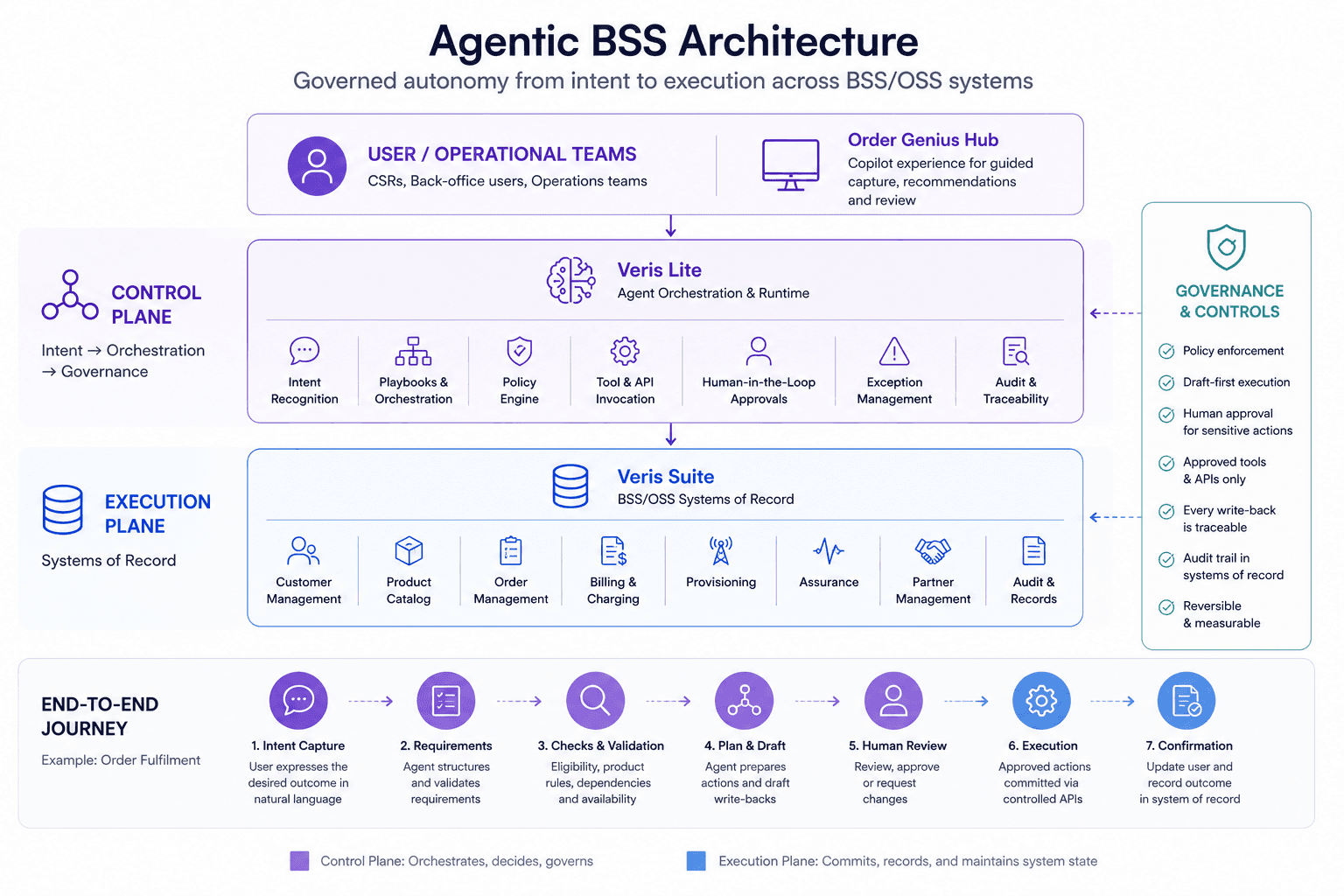
Cloudnet.ai’s Agentic BSS stack is designed around a control-plane / execution-plane separation.
This separation is important because telecom autonomy cannot be uncontrolled. Operators need agents that can reason, orchestrate, and act — but within clear policy boundaries, approved APIs, human gates, and auditable records.
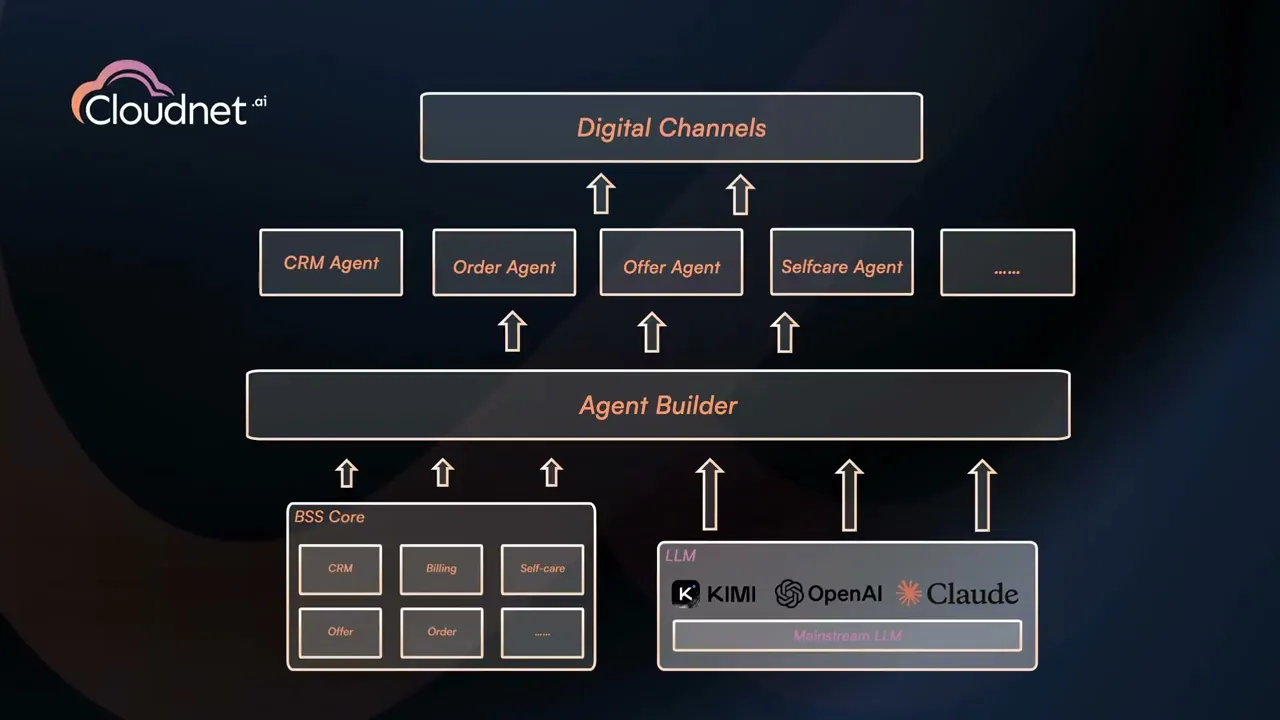
The Cloudnet.ai stack includes three main layers:
Veris Suite as the execution plane and system of record
Veris Lite as the control plane and agent orchestration layer
Order Genius Hub as the control surface and user experience layer
Veris Suite: Execution Plane / System of Record
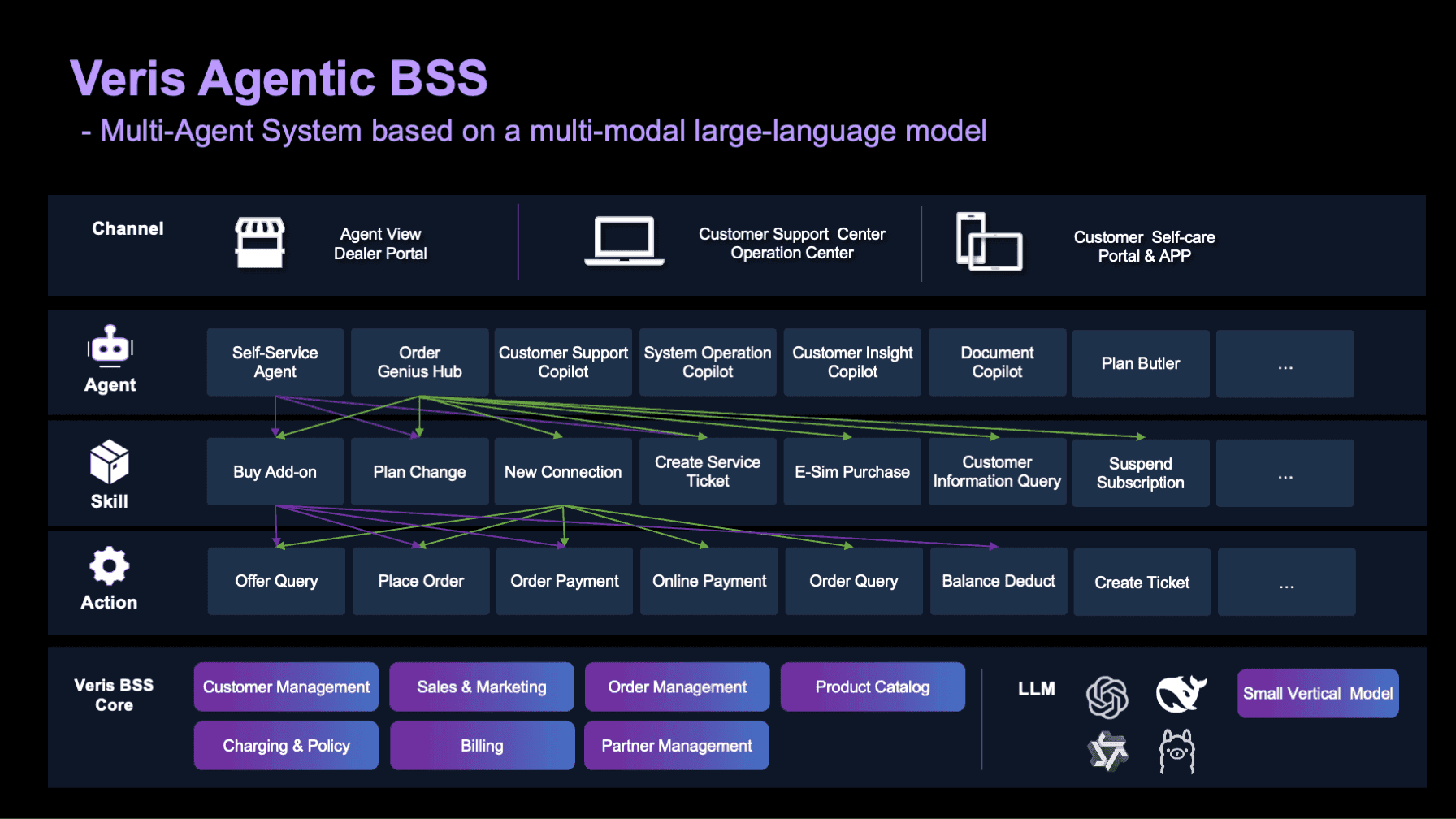
Veris Suite is the carrier-grade backbone for core BSS/OSS functions, including customer, product, order, billing, and assurance.
It remains authoritative for transactional integrity.
State changes, validations, approvals, and audit records live where they belong: inside the system of record.
This matters because Agentic BSS should not bypass the BSS. It should use the BSS properly.
In this model, Veris Suite provides the stable operational foundation for:
Customer management
Product catalog
Offer management
Order management
Billing and charging
Policy and rating
Partner management
Assurance
Audit records
Transaction history
Operational integrity
The execution plane is where committed business state lives.
Veris Lite: Control Plane / Agent Orchestration
Veris Lite is the agent runtime that turns intent into structured requirements, routes journeys through configurable playbooks, orchestrates tool calls, and manages exceptions.
It is where bounded autonomy is enforced.
Agents act through approved tools and events, not informal screen-scraping or opaque side channels.
Veris Lite provides the orchestration layer for:
Intent recognition
Requirement structuring
Journey routing
Playbook execution
API/tool invocation
Policy checks
Exception handling
Human-in-the-loop routing
Action tracking
Draft generation
Audit-friendly execution
This is the control plane: the layer where intent becomes governed workflow.
Order Genius Hub: Control Surface / User Experience
Order Genius Hub is the user-facing copilot experience for CSRs and operational teams.
It guides structured capture, reduces system switching, and presents recommendations and draft write-backs in a way that supports operational trust and fast review.
For frontline users, this means they no longer need to understand every downstream system in detail before progressing a customer request. The user can express the desired outcome, and the agentic layer helps convert that intent into structured, validated, executable steps.
Order Genius Hub supports:
Natural-language intent capture
Guided requirement collection
Recommendation review
Draft write-back review
Exception visibility
Human approval moments
Operational transparency
Faster user decision-making
This is the control surface: where humans interact with the governed execution layer.
Control Plane and Execution Plane
Control Plane: Intent → Orchestration → Governance
Order Genius Hub → Veris Lite → Agents + Playbooks + Policy Gates
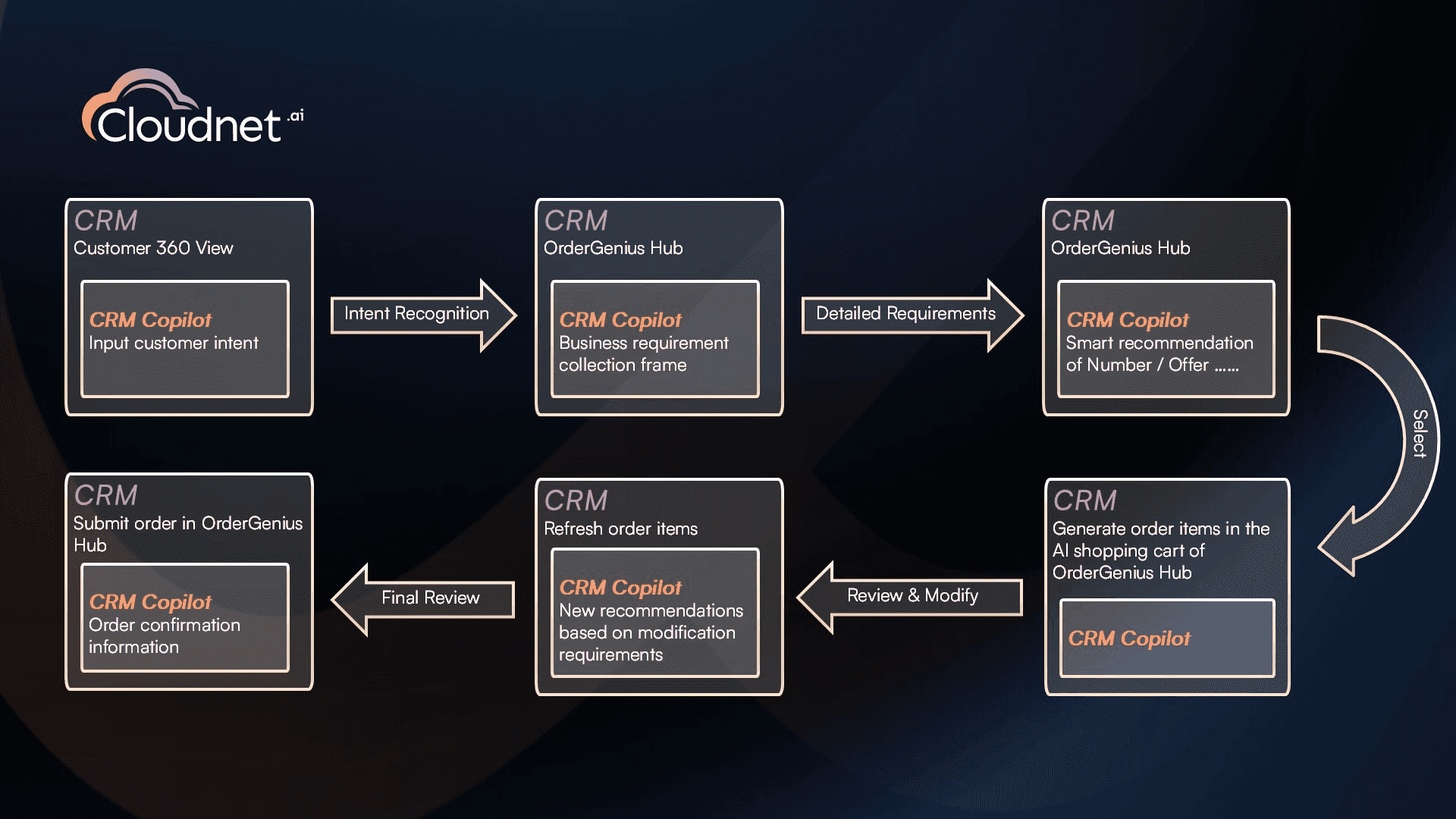
The control plane interprets intent, structures the request, selects the right journey, invokes approved tools, checks policy, and routes actions for review or approval.
It is designed for orchestration, not uncontrolled automation.
Execution Plane: Systems of Record
Veris Suite + Operator BSS/OSS → Order, Billing, Provisioning, Assurance
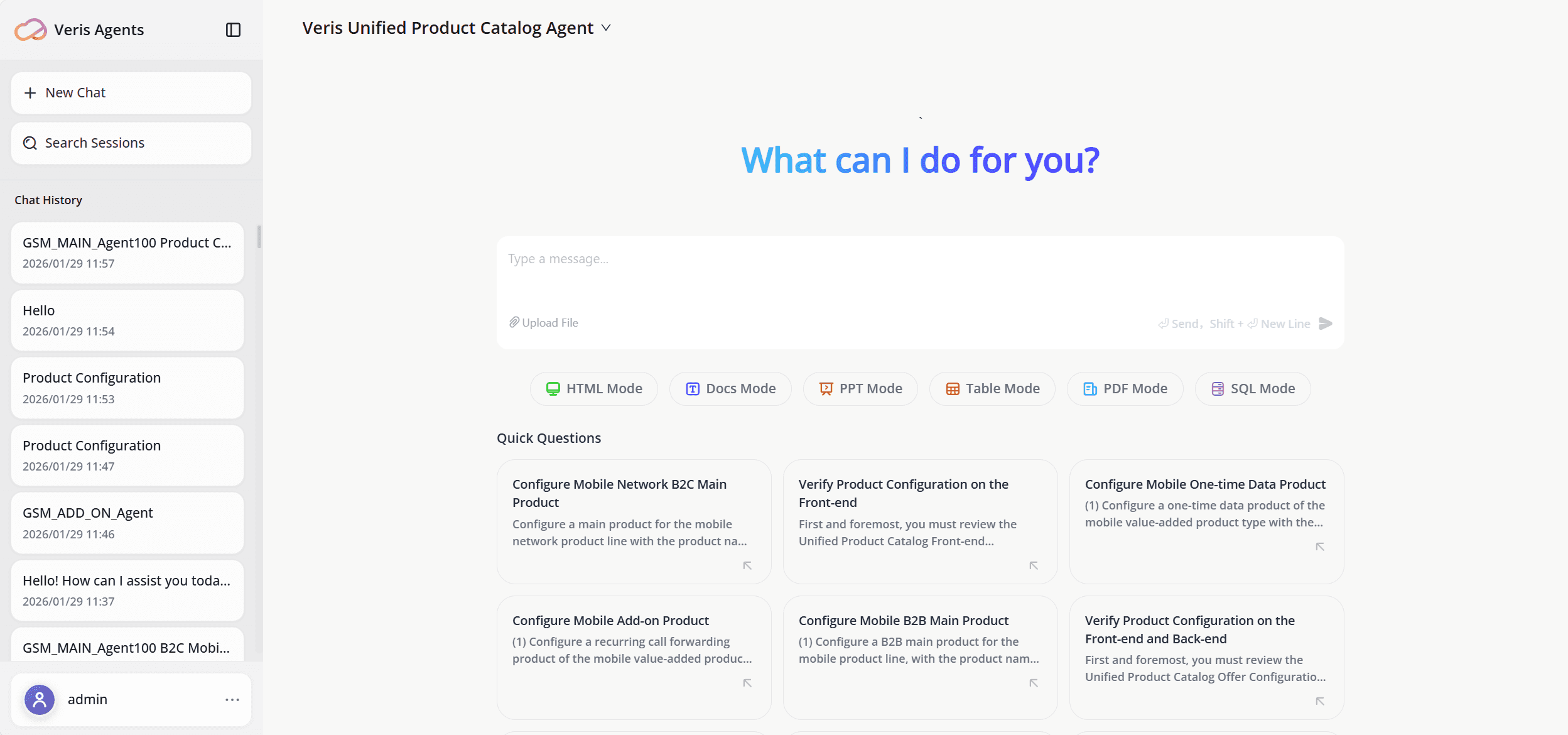
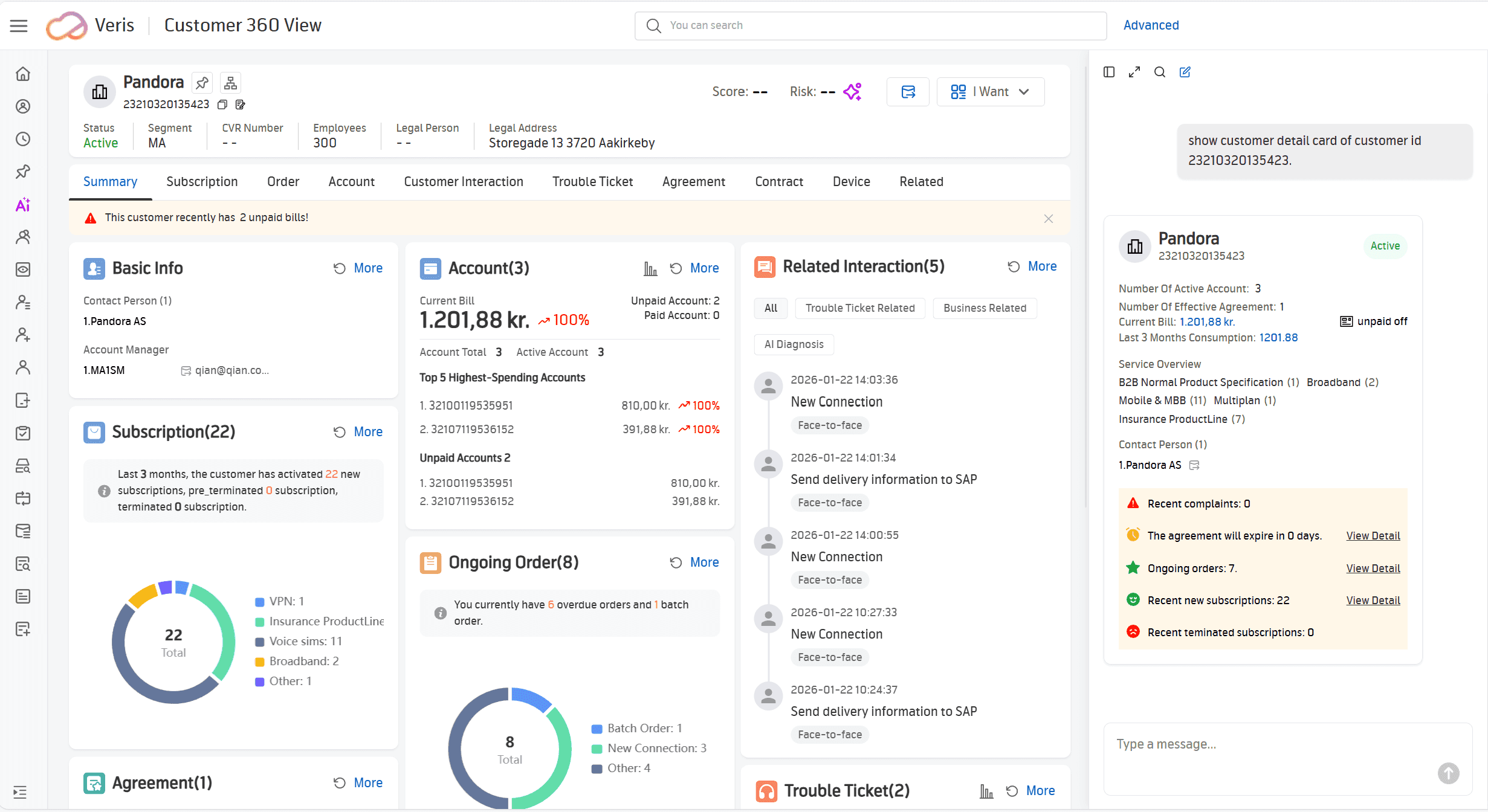
The execution plane remains authoritative. It holds transactional state, executes committed changes, records outcomes, and preserves auditability.
This separation allows autonomy to scale while governance remains explicit.
Agentic Product Configuration Demo
This demo shows how an AI agent can assist product and catalog teams by converting business intent into structured configuration steps, checking required fields, and preparing controlled actions for review before committing changes into the BSS.
OrderGenius Hub Workflow Demo
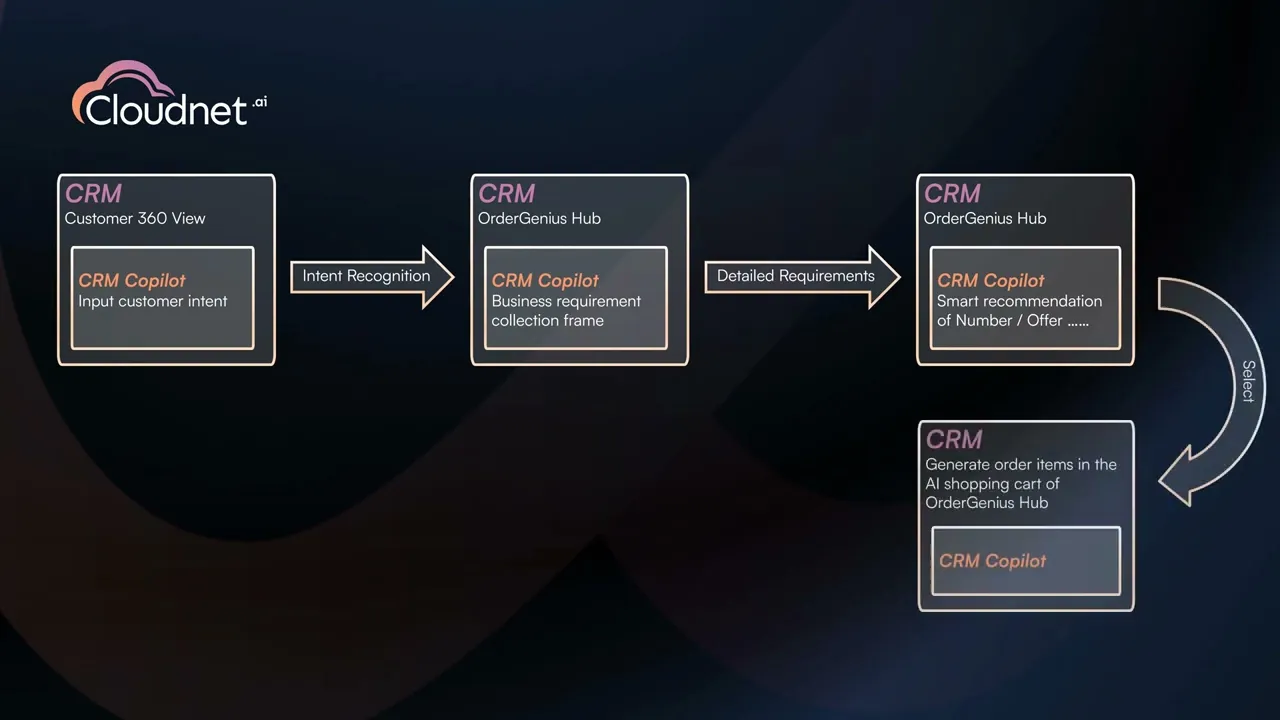
This demo illustrates how customer intent can be captured, structured, reviewed, and prepared for execution through governed BSS workflows, reducing system switching while keeping human approval and policy controls in place.
The Value Waterfall: From Mechanisms to Measurable Telco KPIs
Agentic BSS is only meaningful if it moves operator KPIs in production.
Cloudnet.ai’s approach targets improvements through specific, observable mechanisms.
1. Structured Capture → Lower Order Fallout
Turning free-form customer or operational intent into validated, complete data reduces exceptions and rework during fulfilment.
In many telecom environments, fallout starts early. The customer request is incomplete, the wrong product is selected, a mandatory attribute is missing, or an eligibility rule is overlooked.
Agentic BSS reduces this risk by structuring the request before it becomes an order.
The agent can validate required fields, check catalog rules, flag missing information, and prepare clean data for downstream systems.
This improves throughput and revenue realization.
2. Reduced System Switching → Lower AHT
Telecom users often move between CRM, catalog, order management, billing, trouble ticketing, and provisioning screens to complete a single customer journey.
This “swivel-chair” work increases average handling time and creates room for human error.
Guided orchestration decreases the need for manual system switching. The agentic layer can collect information, invoke checks, retrieve context, and present the next best action inside a guided workflow.
This reduces average handling time and frees frontline capacity.
3. Cross-Domain Execution → Higher FCR
Many customer issues cannot be resolved inside one domain.
A billing issue may require product context. An order issue may require provisioning status. A service complaint may require assurance data. A customer request may require catalog, policy, and account checks.
When agent workflows can invoke checks and actions across BSS/OSS domains in one governed journey, more issues can be completed within the first interaction.
This supports higher first-contact resolution and reduces repeat contacts and escalations.
4. Closed-Loop Remediation → Fewer SLA Breaches
Traditional assurance workflows often detect issues but do not close the loop quickly enough.
Events trigger alarms, alarms create tickets, tickets move between teams, and remediation is delayed.
Agentic BSS supports event-driven detection and playbook remediation. Agents can correlate events, check affected services, recommend actions, and execute safe steps automatically where policy allows.
This can resolve exceptions earlier, reduce backlog, and improve performance against time-bound commitments.
Governance You Can Audit
Telecom-grade autonomy must be transparent, reversible, and measurable.
Cloudnet.ai emphasizes draft-first execution:
Draft → Validate → Approve → Commit
This means agents can prepare actions, but sensitive changes are reviewed before they are committed.
Human-in-the-loop approvals remain in place for sensitive actions, high-risk changes, commercial adjustments, customer-impacting updates, and policy-defined exceptions.
The goal is not blind automation. The goal is governed autonomy.
Policy Enforcement and Human Gates
Agentic BSS must separate deterministic constraints from probabilistic reasoning.
A language model may help interpret intent, summarize context, and propose actions, but policy gates must determine what can actually be executed.
In practice, this means:
Agents execute only through approved tools, APIs, and recorded events.
Every material write-back is traceable.
The system records what changed, why it changed, and who approved it.
Operators can define which actions are automated and which must be reviewed.
Sensitive journeys can require human approval before commit.
High-risk actions can be blocked or escalated.
Audit trails are preserved inside systems of record.
This aligns with system-level AI governance best practices. Trust is built through accountability, transparency, safety, and operational controls — not by adding “AI” on top of brittle processes.
Why Governance Matters in Telecom
Telecom operations are not casual workflows.
A wrong action can affect billing, customer service, provisioning, SLA commitments, regulatory obligations, partner settlements, or network service availability.
That is why enterprise AI in telecom must be governed from the beginning.
Agentic BSS should answer practical operational questions:
What action did the agent recommend?
What data did it use?
Which tools did it call?
Which policy checks passed?
Which checks failed?
Was a human approval required?
Who approved the action?
What changed in the system of record?
Can the action be reviewed or reversed?
Is the outcome measurable?
Without these controls, agentic AI remains a demo. With these controls, it becomes an operating model.
Architecture Pattern: Governed Execution Across BSS/OSS
A production-grade Agentic BSS architecture should include:
User-facing control surface
Intent recognition layer
Agent orchestration runtime
Workflow/playbook engine
Policy and governance layer
Tool/API registry
Event-driven triggers
Human approval gates
Audit and traceability services
BSS/OSS integration layer
Systems of record
Monitoring and feedback loops
Cloudnet.ai’s approach maps directly into this pattern:
Order Genius Hub provides the user-facing control surface.
Veris Lite provides agent orchestration, playbooks, policy gates, and governed workflow execution.
Veris Suite provides the execution plane and system of record for BSS/OSS operations.
This is what allows the agentic layer to assist and execute without undermining operational control.
Example Workflow: Enterprise Offer Creation
A business user enters:
“Create a new enterprise offer for a logistics customer with 5G connectivity, IoT device support, and SLA-based support.”
The Agentic BSS workflow can:
Interpret the business intent.
Identify the relevant product family.
Check required product attributes.
Retrieve applicable pricing and policy rules.
Validate compatibility with existing catalog structure.
Draft the product configuration.
Check downstream order and billing impact.
Prepare a staged rollout plan.
Route the draft to a human reviewer.
Commit the approved configuration through Veris Suite.
Record the audit trail.
This is the difference between AI assistance and governed execution.
Example Workflow: Stuck Order Resolution
A CSR enters:
“Resolve this order. The customer has called twice and activation is still pending.”
The Agentic BSS workflow can:
Retrieve the order record.
Check missing attributes.
Review provisioning status.
Check product compatibility.
Review customer account status.
Identify the blocking step.
Recommend remediation.
Draft the required update or escalation.
Submit for approval if required.
Execute approved action through controlled APIs.
Update the customer-facing status.
This reduces manual investigation and helps close the loop faster.
Example Workflow: Billing Dispute
A CSR enters:
“The customer says this charge is incorrect. Please check and prepare a resolution.”
The Agentic BSS workflow can:
Retrieve billing history.
Check usage data.
Compare the charge against product and policy rules.
Review prior credits or adjustments.
Identify whether the charge is valid.
Recommend compliant resolution options.
Draft an adjustment if justified.
Route for approval based on value or policy.
Commit the approved change.
Record the audit trail.
The user remains in control, but the evidence gathering and policy checking are accelerated.
Business Impact
Agentic BSS can support improvements across multiple operational dimensions.
Customer Operations
Lower average handling time
Higher first-contact resolution
Reduced escalations
More consistent customer outcomes
Faster guided resolution for frontline teams
Order Management
Lower order fallout
Faster order-to-activation
Cleaner requirements capture
Reduced rework
Better downstream fulfilment quality
Product and Catalog Operations
Faster offer configuration
Reduced fear of downstream breakage
Better impact analysis
More structured change governance
Improved product lifecycle management
Billing Operations
Faster dispute handling
More consistent policy checks
Reduced manual evidence gathering
Better auditability for credits and adjustments
Assurance and SLA Operations
Earlier risk detection
Faster remediation
Reduced backlog
Better SLA performance
Stronger closed-loop operations
Why This Is Different from a Chatbot
A chatbot answers questions.
Agentic BSS executes governed workflows.
The difference is important.
A chatbot might tell a CSR what to do. An Agentic BSS workflow can structure the request, check policies, invoke approved tools, prepare write-backs, route approvals, and commit approved changes into systems of record.
A chatbot may summarize. Agentic BSS coordinates.
A chatbot may draft. Agentic BSS validates, orchestrates, and executes under governance.
A chatbot may sit beside operations. Agentic BSS becomes part of how operations are performed.
Summary
Cloudnet.ai’s Agentic BSS solution demonstrates how telecom operators can move from AI assistance to governed execution.
By separating the control plane from the execution plane, Cloudnet.ai enables AI agents to interpret intent, orchestrate workflows, invoke approved tools, manage exceptions, and support human review — while keeping Veris Suite and operator BSS/OSS systems as the authoritative systems of record.
The result is an AI-native operating model designed for real telecom work: product configuration, order fulfilment, billing operations, customer care, assurance, and SLA remediation.
Agentic BSS is not about replacing telecom platforms. It is about making telecom work executable, auditable, and scalable.
Conclusion
Telcos need AI that can do more than answer questions.
They need AI that can execute real work across systems, reduce operational friction, and prove that every action is governed.
Cloudnet.ai’s Agentic BSS approach provides a practical path forward: a governed execution layer that turns intent into structured, auditable action across BSS/OSS workflows.
With Veris Suite as the execution plane, Veris Lite as the agent orchestration layer, and Order Genius Hub as the user-facing control surface, Cloudnet.ai enables operators to move beyond AI add-ons toward AI-native telecom operations.
The future of BSS is not only cloud-native. It is agentic, governed, and execution-ready.