Case Study
Hong Kong International Airport: Cloud-Native BSS Modernization for 4G/5G Airport Services
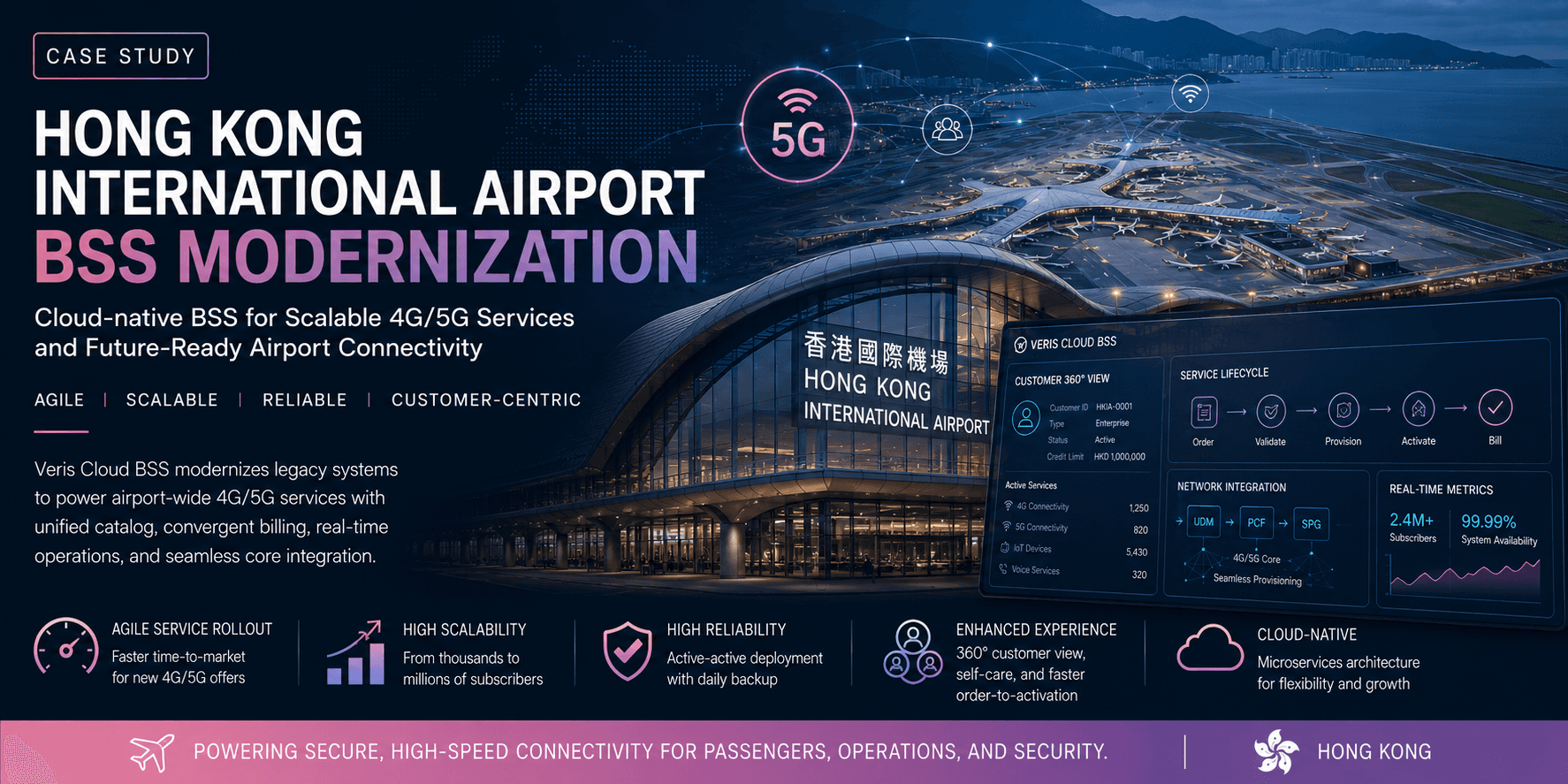
How Veris Cloud BSS Supported Scalable Service Rollout, Convergent Billing, and 4G/5G Core Integration for a Mission-Critical Airport Connectivity Environment
Airports are among the most demanding telecom environments in the world. They combine the traffic patterns of a dense public venue, the operational complexity of a logistics hub, the reliability expectations of critical infrastructure, and the security requirements of a highly regulated transport environment.
Hong Kong International Airport required a modernized BSS foundation to support airport-wide telecom services and future 4G/5G business models. The existing BSS environment was built on Oracle Forms, limiting scalability, flexibility, integration capability, and the speed at which new services could be introduced.
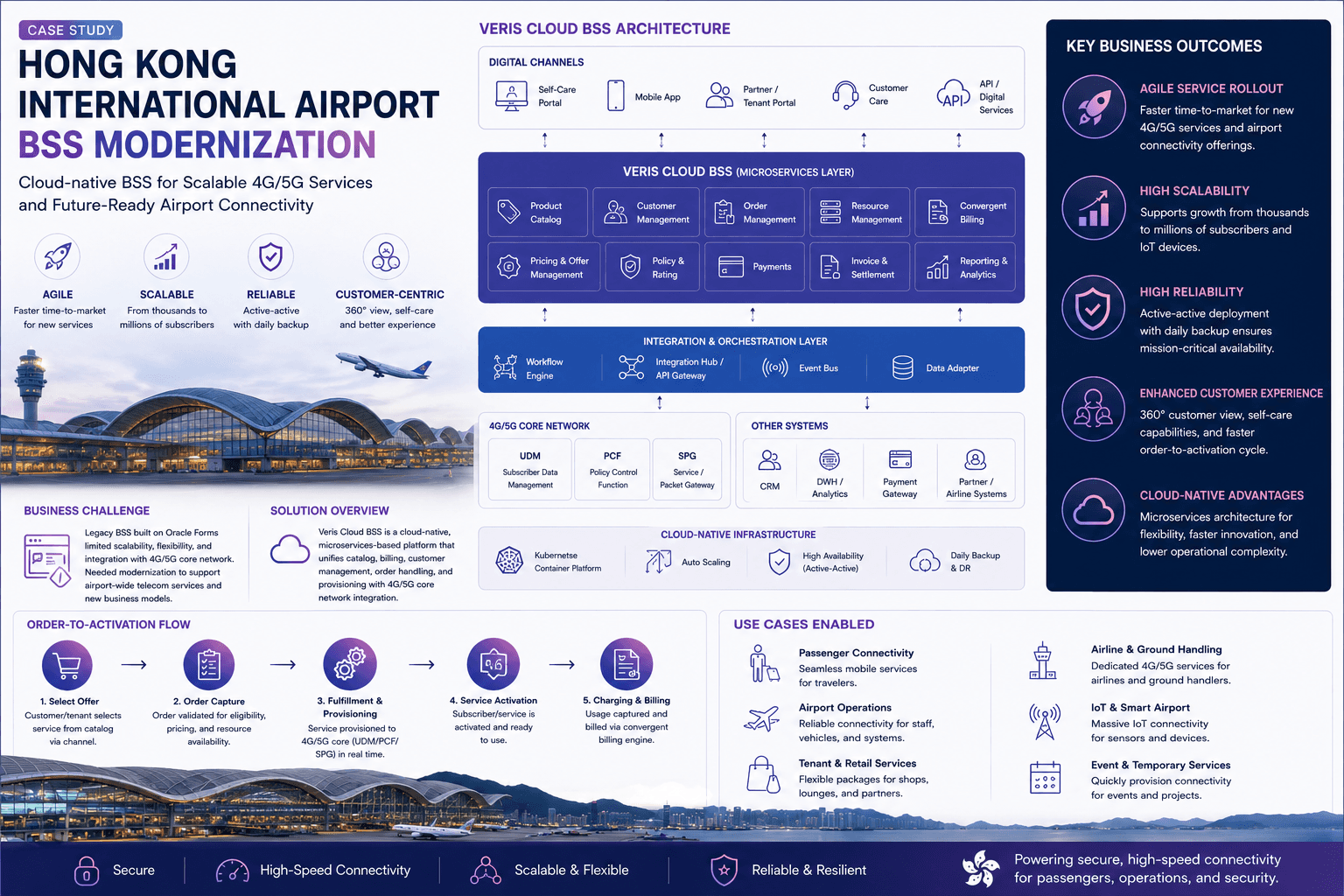
To support the airport’s evolving connectivity environment, Veris Cloud BSS was deployed as a microservices-based, cloud-native BSS platform. The solution provided a unified product catalog, convergent billing for 4G/5G services, real-time customer management, order handling, resource administration, and seamless provisioning integration with the airport’s 4G/5G core network functions, including UDM, PCF, and SPG.
The result was a modern BSS layer designed for faster service rollout, higher scalability, improved reliability, and a better customer experience across airport telecom services.
Customer Profile
Customer: Hong Kong International Airport
Industry: Aviation / airport infrastructure / telecom services
Location: Hong Kong
Environment: Airport-wide telecom services across passenger, operational, and security domains
Legacy challenge: Oracle Forms-based BSS limiting scalability and integration
Solution: Veris Cloud BSS
Architecture: Cloud-native, microservices-based BSS platform
Core integration: 4G/5G core network integration, including UDM, PCF, and SPG
Primary capabilities: Unified product catalog, convergent billing, customer management, order handling, resource administration, provisioning, active-active reliability, self-care, 360° customer view

Airport Connectivity Context
Airports are no longer simply transport facilities. They are digital operating environments.
A modern international airport depends on telecom services for passenger experience, airline operations, airport staff coordination, IoT systems, security services, retail environments, logistics operations, and critical infrastructure workflows.
Connectivity supports a wide range of airport functions, including:
Passenger mobile connectivity
Staff and operational communications
Airport tenant and retail services
Airline and ground-handling connectivity
IoT devices and sensors
Security systems and surveillance connectivity
Smart facility management
Baggage and logistics systems
Emergency response communications
Private or dedicated 4G/5G services
Self-service passenger workflows
Digital service portals and customer care
In this type of environment, telecom services must be scalable, reliable, and operationally flexible. The network layer alone is not enough. Airports also need a modern BSS layer that can define, sell, activate, bill, manage, and support services efficiently.
That is where Veris Cloud BSS becomes critical.

The Challenge: Legacy BSS Could Not Support the Next Phase of Airport Telecom Services
The airport’s existing BSS was built on Oracle Forms. While this type of legacy system may support stable operations for traditional service models, it becomes increasingly difficult to adapt when telecom services become more dynamic, integrated, and 5G-driven.
The legacy environment created several limitations.
Limited Scalability
Airport telecom services can grow from thousands of users, tenants, devices, and service accounts to much larger volumes as 4G/5G, IoT, private network services, and digital applications expand.
A legacy monolithic BSS architecture can make scaling difficult. Capacity expansion may require heavy infrastructure work, manual operations, or complex upgrades.
For an airport environment, scalability matters because demand is not static. Traffic can spike during peak travel periods, major events, holiday seasons, disruptions, airline schedule changes, or new service launches.
Limited Flexibility for New Business Models
Modern airport telecom services are no longer limited to basic connectivity. Airports may need to support:
Tenant connectivity packages
Airline service bundles
Operational SIM/device plans
IoT service subscriptions
Private network services
Temporary connectivity for events or construction projects
Retail and partner service models
SLA-based enterprise connectivity
Passenger-facing digital services
Bundled 4G/5G and value-added services
A legacy BSS can make these business models hard to configure and launch quickly. Each new offer may require custom development, manual catalog changes, billing adjustments, and operational workarounds.
Integration Constraints with 4G/5G Core Network
4G/5G services require close coordination between BSS, provisioning, subscriber data, policy control, charging, and core network systems.
The airport needed a BSS capable of integrating with 4G/5G core network components such as:
UDM for subscriber and identity-related data
PCF for policy control
SPG for service gateway / packet gateway-related service handling
Provisioning interfaces for subscriber, service, and resource activation
A legacy BSS built around older integration patterns can struggle to support real-time 4G/5G service activation and lifecycle management.
Slower Service Rollout
When product catalogs, order management, billing rules, and provisioning workflows are fragmented or hard-coded, launching new offers becomes slow.
For an airport telecom environment, slow rollout creates business risk. The airport may need to quickly activate new services for airlines, tenants, operational teams, VIP events, temporary sites, or emergency requirements.
The BSS layer must therefore support agile service creation and activation.
Limited Customer Experience
Modern telecom customers expect visibility, self-service, fast activation, accurate billing, and efficient support.
For airports, “customer” may mean passengers, airport tenants, airlines, operational departments, vendors, or internal service units. A fragmented BSS makes it difficult to provide a unified view of customer accounts, services, orders, usage, and billing.
The customer experience challenge is not only external. Internal airport teams also need faster, clearer, and more automated service management.
The Solution: Veris Cloud BSS
Veris Cloud BSS was deployed as a cloud-native, microservices-based BSS platform to modernize the airport’s telecom service management layer.
The solution introduced:
Unified product catalog
Convergent billing for 4G/5G services
Real-time customer management
Order handling
Resource administration
Seamless provisioning with 4G/5G core network
Integration with UDM, PCF, and SPG
360° customer view
Self-care capabilities
Active-active deployment with daily backup
Scalable architecture from thousands to millions of subscribers
The modernization shifted the airport away from a rigid legacy BSS toward a flexible platform capable of supporting current and future telecom services.
Solution Architecture
A modern airport BSS architecture must connect commercial service design with operational network execution.
Veris Cloud BSS provides this bridge through several core layers.
1. Unified Product Catalog
The product catalog defines the services that can be offered, sold, provisioned, and billed.
For an airport telecom environment, the catalog may support different service models:
Passenger connectivity services
Tenant connectivity packages
Airline service bundles
Operational SIM plans
IoT device connectivity
Temporary event connectivity
Private 4G/5G service packages
SLA-based enterprise services
Value-added services
A unified product catalog helps standardize offer creation and reduce dependency on custom development for every new service.
Instead of building each offer manually across disconnected systems, product managers can configure service attributes, pricing rules, eligibility, bundles, lifecycle rules, and provisioning requirements in a structured catalog environment.
2. Convergent Billing
Convergent billing is essential when different services, customer types, and charging models coexist.
An airport may need to support:
Recurring subscription fees
Usage-based charging
One-time activation fees
Device or SIM charges
Tenant service billing
Enterprise account billing
Temporary service charges
Bundled connectivity and value-added services
Prepaid or postpaid models
Internal cost allocation
Veris Cloud BSS supports convergent billing for 4G/5G services, enabling multiple service types and charging models to be managed through a common billing framework.
This reduces billing fragmentation and improves accuracy across complex airport telecom operations.
3. Real-Time Customer Management
Real-time customer management provides a consolidated view of customer accounts, services, orders, billing status, resources, and support history.
For airport telecom services, this 360° view is especially important because customers may include different groups with different operational needs:
Airlines
Airport tenants
Retailers
Service providers
Internal airport departments
Operational teams
Public or passenger-facing service users
IoT and device accounts
A 360° customer view enables faster service support, better issue resolution, and clearer operational visibility.
4. Order Handling and Order-to-Activation
Service activation speed depends heavily on order management.
Veris Cloud BSS supports order handling workflows that connect commercial order capture with downstream provisioning and resource assignment.
In practice, this means a service request can move from offer selection to order creation, validation, fulfillment, provisioning, activation, and billing with fewer manual steps.
For airport environments, this improves order-to-activation cycles for new services, upgrades, tenant requests, SIM/device provisioning, or temporary connectivity needs.
5. Resource Administration
Airport telecom services depend on accurate management of resources such as numbers, SIMs, devices, network identifiers, service profiles, IP resources, and connectivity assignments.
Resource administration helps ensure that services are mapped correctly to available technical resources.
This is particularly important when integrating with 4G/5G core systems, where subscriber profiles, policy rules, and service data must align with BSS records.
6. Provisioning and Core Network Integration
The solution provides seamless provisioning with the airport’s 4G/5G core network, including UDM, PCF, and SPG.
This integration allows BSS-defined services and customer profiles to be translated into network-level execution.
For example:
A new service is selected from the product catalog
The order is validated and created
Customer and resource information are updated
Provisioning workflows activate the service in the network
Subscriber or device profiles are passed to relevant core functions
Policy rules are applied through PCF integration
Subscriber data is aligned with UDM
Service routing or gateway behavior is coordinated with SPG
Billing records are aligned with the service lifecycle
This is the foundation for real-time 4G/5G service operations.
Technical Value of Cloud-Native Microservices BSS
The move from Oracle Forms-based legacy BSS to a cloud-native microservices platform creates several technical advantages.
Modular Scalability
Microservices allow individual BSS capabilities to scale more flexibly than monolithic systems. Functions such as catalog, billing, order management, customer management, and provisioning can evolve independently.
For airport telecom environments, this is valuable because different workloads scale differently. Billing, order handling, self-care, and provisioning may each experience different demand patterns.
Faster Change Cycles
Cloud-native BSS supports faster configuration, deployment, and upgrade cycles. This helps airports launch new offers and adapt service models without long development cycles.
Better Integration Readiness
Modern BSS must integrate with 4G/5G core, CRM, portals, charging systems, data platforms, monitoring tools, and operational systems.
A microservices-based architecture is better suited to API-driven integration than legacy form-based applications.
Higher Resilience
The deployed solution supports active-active deployment with daily backup. This improves reliability and reduces the operational risk of downtime.
For airport environments, system availability is critical. BSS downtime can affect service activation, customer support, billing, and operational workflows.
Future Readiness
A cloud-native BSS platform creates a foundation for AI-assisted operations, automation, analytics, and agentic workflows.
This is where Veris Cloud BSS can evolve toward Agentic BSS.
Results
The modernization delivered several major outcomes.
Agile Service Rollout
Veris Cloud BSS enabled faster time-to-market for new offers. With a unified catalog, configurable order handling, and integrated provisioning, the airport can introduce new service models more efficiently.
This is critical for airport telecom services, where business needs may change quickly due to new tenants, airline requirements, passenger services, operational projects, or temporary events.
High Scalability
The platform supports growth from thousands to millions of subscribers. This scalability is important not only for human users, but also for device and IoT growth.
As airport digital infrastructure expands, the number of connected endpoints can increase significantly.
Reliability
The active-active deployment with daily backup improves system availability and operational resilience.
For critical infrastructure environments, reliability is not optional. BSS availability affects the ability to manage services, activate orders, support customers, and maintain accurate billing.
Enhanced Customer Experience
The solution supports a 360° customer view, self-care options, and faster order-to-activation cycles.
For customers and internal teams, this means better transparency, faster service activation, and more efficient support.
Airport Use Cases Enabled
The BSS modernization supports multiple airport telecom use cases.
Airport Tenant Connectivity
Retailers, lounges, logistics providers, and service companies operating inside the airport may require connectivity services. Veris Cloud BSS can support tenant-specific offers, billing, account management, and service lifecycle management.
Airline and Ground-Handling Services
Airlines and ground handlers may require dedicated connectivity for operational workflows, mobile staff, baggage handling, aircraft turnaround, and field operations.
The BSS platform enables structured service packages and provisioning workflows for these enterprise-style customers.
Passenger-Facing Connectivity
Airports increasingly offer passenger-facing digital services. These may include Wi-Fi, mobile applications, premium connectivity, location-based services, or bundled passenger experiences.
BSS capabilities such as catalog, charging, customer management, and self-care support these service models.
IoT and Smart Airport Devices
Smart airports rely on sensors, cameras, asset trackers, kiosks, digital signage, and facility systems. These devices need connectivity, lifecycle management, provisioning, and sometimes usage-based billing or internal cost allocation.
Veris Cloud BSS provides a foundation for managing large numbers of connected devices and services.
Private 4G/5G Services
Airport environments may use private or dedicated 4G/5G services for operational teams, security, logistics, and critical communications.
The integration with UDM, PCF, and SPG supports 4G/5G service provisioning and policy control.
Temporary Event Connectivity
Airports host events, seasonal campaigns, construction projects, emergency drills, VIP movements, exhibitions, airline launches, and temporary operational scenarios.
These activities often require temporary connectivity packages that must be configured, activated, billed, and retired quickly.
A modern BSS platform allows the airport to package and launch temporary services more efficiently.
Event and High-Density Environment Relevance
Although this case is focused on airport telecom services, the architecture is highly relevant to other high-density and event-driven environments.
Airports, stadiums, exhibition centers, transport hubs, large campuses, and major events share several common challenges:
High user density
Multiple customer and tenant groups
Temporary and permanent service requirements
Need for secure connectivity
Complex billing and service models
Integration with private 4G/5G networks
Fast service activation
Need for self-care and customer visibility
Reliability requirements for operational services
In this sense, Veris Cloud BSS is not only an airport solution. It is a service management platform for complex telecom environments where network services must be packaged, monetized, provisioned, and managed across many user groups.
For large events, this same model can support temporary connectivity offers, vendor services, staff communications, private network slices, media operations, and event-specific billing.
For airports, the event-like complexity is continuous. Passenger peaks, operational disruptions, tenant activity, and security requirements make airports one of the most demanding environments for telecom service management.
Agentic BSS Direction: From Modern BSS to AI-Native Telecom Operations
Veris Cloud BSS provides the foundation for the next phase of telecom operations: Agentic BSS.
Traditional BSS systems manage products, customers, orders, billing, and provisioning. Agentic BSS extends this foundation by introducing AI agents that can understand business intent, assist users, execute workflows, and coordinate across BSS and network systems under controlled governance.
For an airport telecom environment, Agentic BSS can help transform BSS from a system of record into an intelligent operating layer.
What Agentic BSS Means
Agentic BSS is an AI-native operating model where specialized agents assist or execute telecom business workflows through controlled APIs, event triggers, and governed automation.
Instead of requiring users to manually navigate multiple systems, an agentic layer can help interpret natural-language requests, recommend next actions, prepare service configurations, initiate controlled workflows, and provide auditability.
This does not mean uncontrolled AI making decisions in critical infrastructure. It means AI agents operating within defined guardrails, approval flows, policy controls, and human-in-the-loop mechanisms.
Potential Airport Use Cases for Agentic BSS
For an airport telecom operator, Agentic BSS could support workflows such as:
“Create a temporary 5G service package for a three-day airline event.”
“Activate 50 operational SIMs for a new ground-handling partner.”
“Generate a tenant connectivity offer with usage-based billing.”
“Check why this service order is stuck before provisioning.”
“Compare current product catalog options for IoT camera connectivity.”
“Prepare a self-care onboarding package for a new airport retailer.”
“Summarize all active services for a specific airline tenant.”
“Identify orders delayed by missing resource assignments.”
“Recommend a policy profile for a high-priority operational service.”
“Generate a billing impact estimate for a new service bundle.”
These workflows combine catalog, customer, order, billing, resource, provisioning, and policy data. That is exactly where a modern BSS foundation is required.
Agentic BSS and 4G/5G Core Integration
Because Veris Cloud BSS integrates with 4G/5G core functions, an agentic layer can eventually help bridge commercial intent and network execution.
For example:
A business user describes the service requirement.
The agent identifies the correct product catalog template.
The agent checks customer eligibility and resource availability.
The agent prepares order details.
The agent recommends policy or service profiles.
The workflow is submitted for approval.
Once approved, the BSS provisions the service through core-network integrations.
The agent monitors status and reports completion or exceptions.
This turns a complex multi-system process into a guided, auditable workflow.
Governance and Human-in-the-Loop
For critical infrastructure such as airports, Agentic BSS must be governed carefully.
Key governance principles include:
Controlled API access
Role-based permissions
Approval workflows for high-impact actions
Audit trails
Explainable recommendations
Human-in-the-loop validation
Policy constraints
Integration with existing operational processes
Traceability from request to execution
This approach allows AI to improve productivity without compromising operational control.
Why Veris Cloud BSS Is the Foundation
Agentic BSS requires structured data, APIs, workflow logic, and clear service models. Legacy systems make this difficult because processes are fragmented, hard-coded, or dependent on manual operations.
Veris Cloud BSS creates the necessary foundation through:
Unified product catalog
Structured order handling
Customer and service data model
Billing and charging logic
Resource administration
Provisioning workflows
Integration with core network systems
Cloud-native architecture
API-oriented design
In other words, the modernization is not only about replacing Oracle Forms. It is about preparing airport telecom operations for AI-assisted, automated, and intent-driven service management.
Strategic Value
The Hong Kong International Airport case demonstrates the strategic role of BSS modernization in complex telecom environments.
Modern connectivity depends on more than radios, core networks, and transport. Operators also need a business and operations layer that can manage services end-to-end.
Veris Cloud BSS helps address this need by enabling:
Faster service creation
More scalable subscriber and device management
Integrated 4G/5G provisioning
Convergent billing
Improved customer experience
Greater operational reliability
Support for complex tenant and enterprise service models
A future path toward Agentic BSS
For airport environments, this creates a stronger foundation for secure, high-speed connectivity across passengers, operations, and security.
Cloudnet.ai Product Fit
Cloudnet.ai’s Veris Cloud BSS is designed for telecom operators, MVNO/MVNEs, enterprise network providers, and complex private network environments that need a modern, cloud-native BSS foundation.
Relevant capabilities include:
Product catalog management
Convergent billing
Customer management
Order management
Resource administration
Provisioning integration
4G/5G core integration
Self-care and customer experience tools
Active-active reliability model
Cloud-native microservices architecture
API-oriented integration
Foundation for Agentic BSS workflows
For Hong Kong International Airport, these capabilities were applied to support airport-wide telecom services and modernize the BSS layer for 4G/5G service growth.
Conclusion
Hong Kong International Airport required a BSS platform capable of supporting modern airport telecom services, 4G/5G core integration, scalable subscriber management, and faster service rollout.
By deploying Veris Cloud BSS, the airport moved from a legacy Oracle Forms-based environment to a cloud-native, microservices-based BSS platform with unified catalog, convergent billing, real-time customer management, order handling, resource administration, and integrated provisioning.
The modernization improved agility, scalability, reliability, and customer experience. It also created a foundation for the next phase of telecom operations: Agentic BSS, where AI agents can help business and operational teams configure, activate, monitor, and optimize services through governed, auditable workflows.
For airports and other complex service environments, BSS modernization is not only an IT upgrade. It is a strategic enabler for secure, high-speed connectivity, operational agility, and AI-native telecom service management.