Case Study
How CloudRAN.AI Private 5G Supported High-Density Event Connectivity for m3connect in Germany
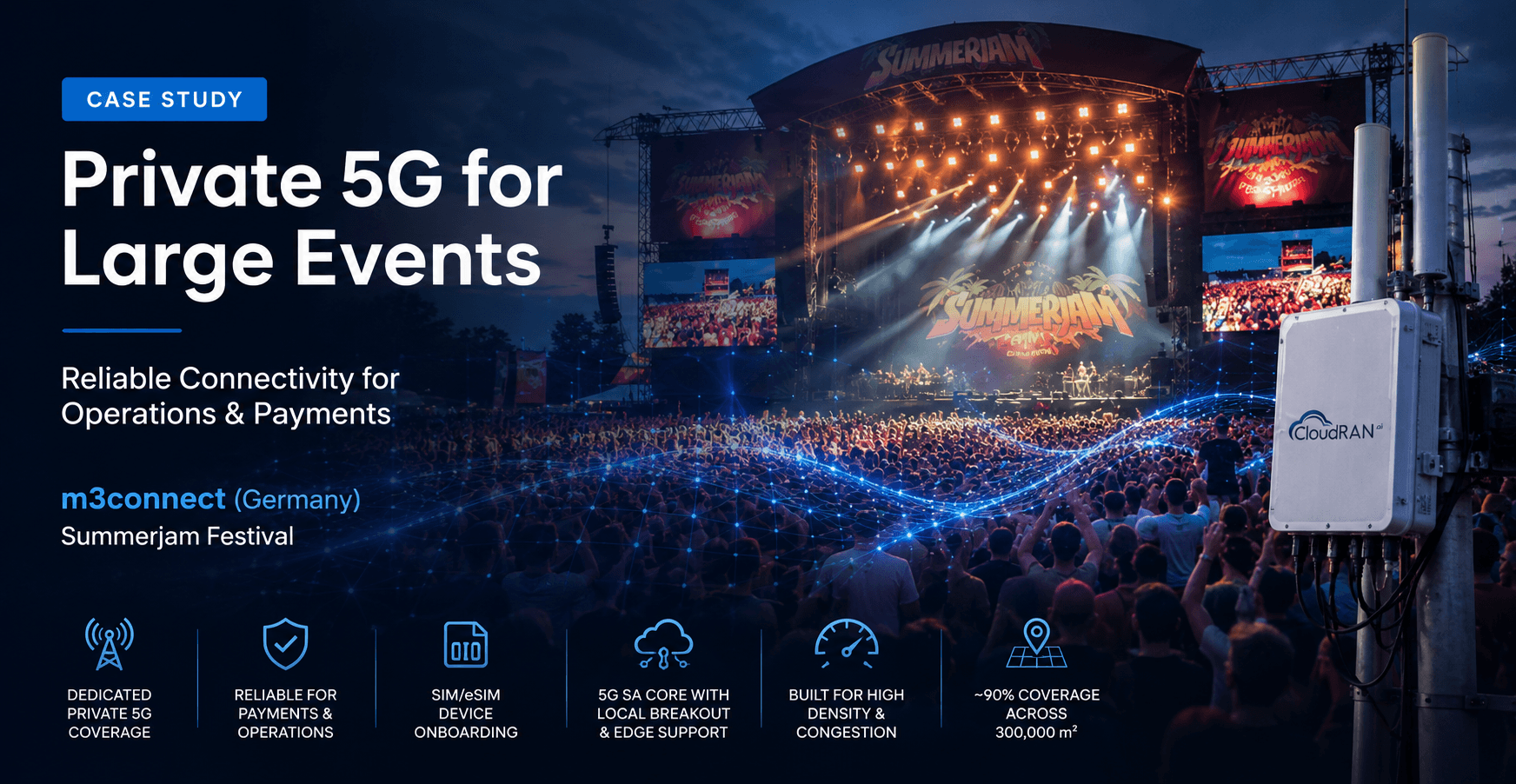
Private 5G for Large Events: Reliable Connectivity for Operations, Payments, and Venue Services
Large events are among the most demanding environments for wireless connectivity. Thousands of attendees, temporary infrastructure, mobile staff, payment terminals, access-control systems, vendors, and operational teams all converge in one location for a short period of time. Network usage rises sharply, radio conditions change throughout the day, and any connectivity failure can directly affect safety, operations, customer experience, and revenue.
At Germany’s “Summerjam Festival,” a major live music event, m3connect — a connectivity provider for large venues and events — required dependable on-site connectivity for operational workflows, especially mobile connectivity and payments, across a large temporary venue footprint.
The challenge was not simply to “provide internet.” The goal was to create a reliable, controlled, and rapidly deployable connectivity layer that could support event operations in an environment where public networks, Wi-Fi, and legacy mobile connectivity are often under pressure.
Our dedicated private 5G team, CloudRAN.AI, and our private 5G solution provided a dedicated wireless infrastructure approach for high-density event environments, combining private 5G RAN, radios, local 5G core capabilities, SIM/eSIM-based device onboarding, and controlled coverage planning to support operational traffic across the event site.
Customer Context: m3connect and Large-Venue Connectivity
m3connect is a Germany-based connectivity provider serving hotels, retail environments, enterprise locations, and large venues. In the event environment, the connectivity requirement is very different from a permanent enterprise campus.
Temporary event sites need networks that can be deployed quickly, operated reliably during peak usage, and removed or redeployed after the event. Unlike fixed enterprise networks, large events face a compressed timeline: the network must work correctly from the start, because there is little opportunity for lengthy tuning once gates open and crowds arrive.
For a live music festival or large public event, connectivity supports much more than attendee convenience. It is tied to practical operational workflows, including:
Payment terminals and point-of-sale systems
Staff communications and coordination
Access control and ticketing workflows
Vendor operations
Site management and event production workflows
Connectivity-dependent operational applications
Temporary back-office or logistics functions
In this context, “mostly works” is not good enough. A payment terminal that loses connectivity during peak time creates queues and lost revenue. A vendor with unstable connectivity cannot serve customers efficiently. A site operations team that cannot rely on the network loses visibility and control.
The Event Connectivity Problem
Large events create a uniquely difficult RF and networking environment.
First, user density is extremely high. Thousands of people gather in concentrated zones, often around stages, entrances, payment areas, food and beverage locations, and transport points. This creates sudden peaks in wireless demand and increases contention across available spectrum and network resources.
Second, public mobile networks are shared. Even when macro coverage exists, public networks are designed to serve broad geographic areas and many types of users. During major events, they may become congested as attendees upload videos, stream content, send messages, use maps, and access social platforms. This creates unpredictable performance for operational devices that need stable connectivity.
Third, Wi-Fi becomes difficult to manage at scale. Wi-Fi can be useful in many environments, but in outdoor or temporary high-density venues it may struggle with interference, unmanaged client behavior, spectrum contention, roaming instability, and inconsistent coverage. In event operations, this can affect point-of-sale devices, tablets, staff terminals, or mobile operational workflows.
Fourth, temporary sites demand fast setup and teardown. Traditional cabling and fixed infrastructure can be expensive, slow, and inflexible. For event operators and venue connectivity providers, the network must be operational quickly and should not require weeks of civil works or permanent installation.
The core challenge is therefore not just bandwidth. It is controlled, predictable, operational-grade wireless connectivity in a temporary, crowded, and dynamic environment.
Why Private 5G Fits the Large-Event Environment
Private 5G is well suited to event operations because it offers a dedicated, controlled mobile network layer that can be designed around operational priorities rather than best-effort public access.
Compared with public mobile networks, private 5G gives the event connectivity provider greater control over coverage, device access, traffic policies, and service continuity. Compared with Wi-Fi, private 5G offers SIM-based authentication, improved mobility, stronger coverage planning options, and better support for managed devices moving across a large footprint.
For large events, the most relevant advantages include:
Dedicated on-site wireless coverage
Controlled device access using SIM/eSIM profiles
Improved reliability for operational workflows
Support for mobility across venue areas
Local breakout and edge-ready architecture for responsive services
Reduced dependence on congested public networks
Faster deployment compared with fully wired temporary infrastructure
A reusable architecture for different venues and event formats
Private 5G does not replace every network technology on-site. Instead, it provides a dedicated operational connectivity layer for devices and workflows where reliability, mobility, and control matter most.
CloudRAN.AI Solution Approach
For the m3connect event scenario, CloudRAN.AI’s private 5G solution was positioned around a compact, event-ready architecture designed to deliver controlled on-site coverage and dependable connectivity for operational devices.
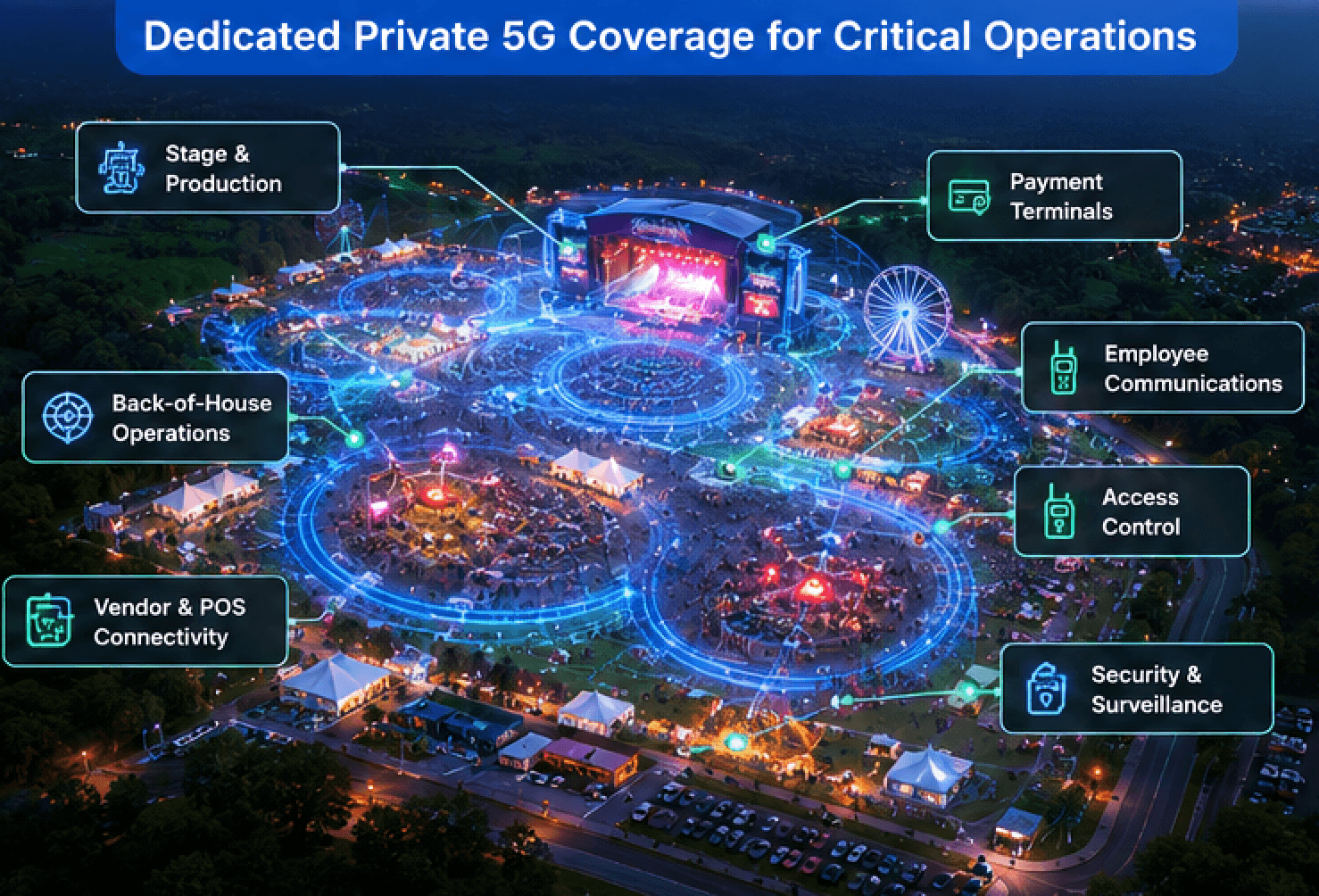
The solution approach included four core layers:
1. Private 5G RAN and Radio Coverage
CloudRAN.AI’s private 5G RAN and radio layer provided the wireless access foundation for controlled on-site coverage. In a large event environment, radio planning must account for venue layout, device locations, user-density zones, stage areas, access points, vendor zones, and operational movement patterns.
The objective is to ensure that operational devices remain connected across the areas where connectivity is required, especially for payments, access control, and staff workflows.
Unlike best-effort public coverage, the private 5G radio layer can be planned around the event operator’s specific coverage priorities.
2. Local 5G Standalone Core and Edge-Ready Breakout
A local 5G SA core can support controlled device registration, session management, and local traffic handling. For event operations, local breakout is important because it can reduce dependence on remote network paths and support more responsive connectivity for local services.
In practical terms, this architecture is designed to support operational applications that need predictable connectivity, including payment workflows, local systems, staff tools, and edge-connected services.
This is especially relevant where the network must continue supporting local operations even when external backhaul conditions are variable.
3. SIM/eSIM-Based Device Onboarding
For event operations, device control is critical. Private 5G enables SIM/eSIM-based provisioning, allowing the operator to manage which devices can access the network.
This is important for environments with many different device types, such as payment terminals, tablets, routers, CPEs, staff devices, and operational endpoints. Instead of relying on open or shared access, the private 5G network can authenticate approved devices and keep operational traffic within a controlled network environment.
SIM/eSIM provisioning also supports repeatable deployment models. Once device profiles and onboarding processes are defined, the same model can be reused across future event deployments.
4. Dedicated Spectrum and Controlled Performance
The solution was designed to support dedicated, controlled wireless performance across the event footprint. For large events, the ability to separate operational connectivity from attendee traffic is essential.
The goal is not to compete with every attendee’s smartphone usage. The goal is to ensure that critical operational workflows — especially payments and venue operations — are not dependent on congested public networks or unstable best-effort wireless environments.
Deployment Scenario
The event scenario involved one large event site with approximately 50 connected devices and a venue footprint of around 300,000 square meters.
The operational requirement focused on reliable connectivity across a broad temporary site, with particular attention to workflows that depend on stable network access during peak event activity.
Key deployment considerations included:
Coverage across a large outdoor event footprint
Support for temporary infrastructure
Fast setup and teardown
Reliable connectivity for operational devices
Support for payment and access-control-related workflows
Reduced reliance on congested public networks
Device onboarding and network access control
Reusability for future large-event deployments
The event environment also required a practical architecture that could be deployed without heavy permanent infrastructure. This is where the CloudRAN.AI “Private 5G in a Box” approach becomes relevant: packaging private 5G capabilities in a way that can be planned, deployed, and operated more easily for temporary or semi-temporary use cases.
Technical Architecture
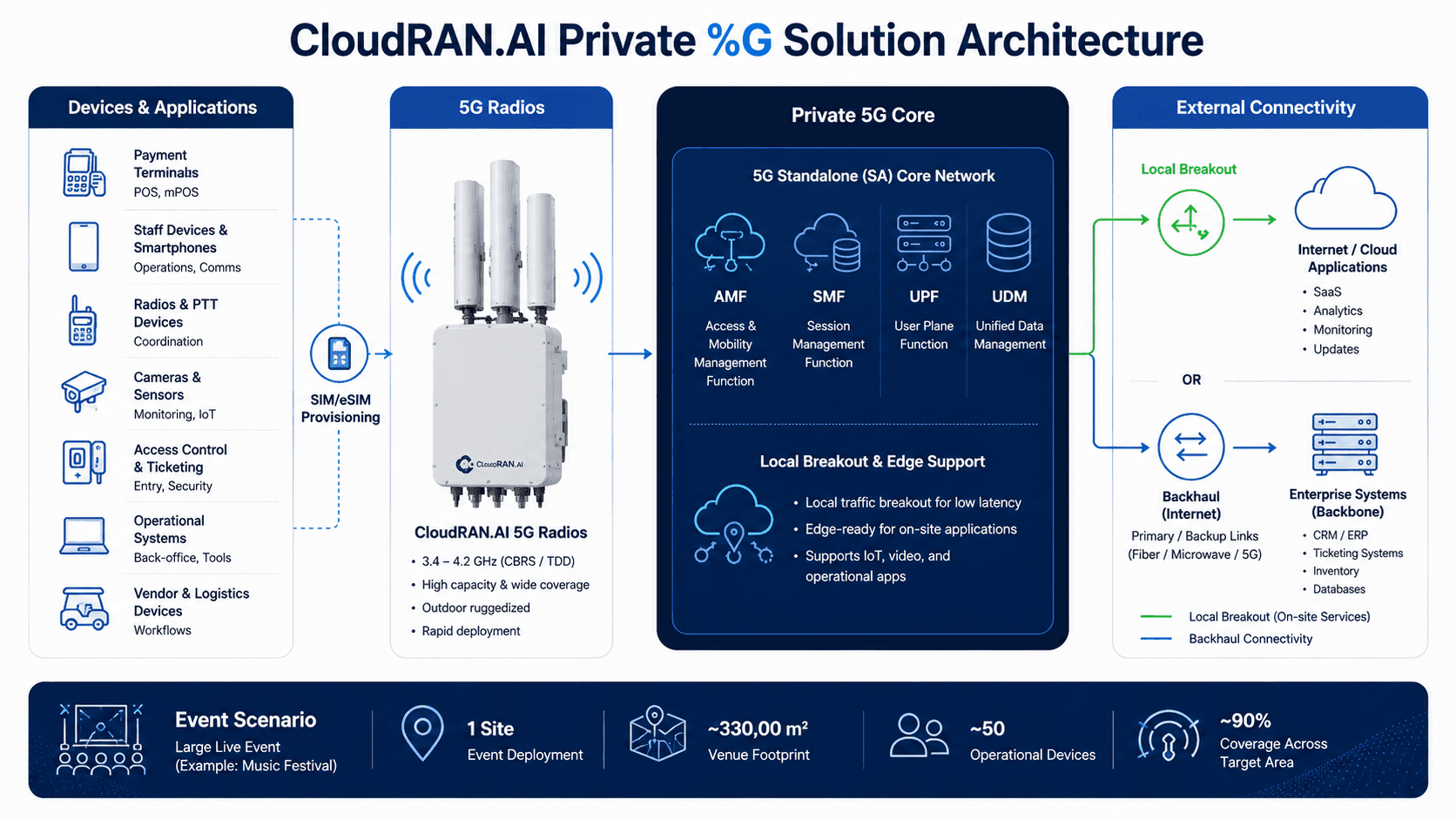
A typical CloudRAN.AI private 5G architecture for this type of scenario may include:
CloudRAN.AI private 5G RAN and radios
5G SA core with local user-plane capabilities
SIM/eSIM provisioning for authorized operational devices
CPEs or routers for local device aggregation where needed
Local breakout for responsive services
Backhaul connection to external networks or cloud applications
Operations and management tools for monitoring and configuration
Optional edge integration for local applications or AI-assisted workflows
For large events, the architecture is designed around practical deployment and operational continuity. The RAN provides dedicated wireless access. The 5G core manages sessions and authentication. SIM/eSIM provisioning ensures that only approved devices connect. Local breakout supports responsive service access. CPEs or routers can connect downstream local devices where direct 5G modules are not used.
This architecture gives the event connectivity provider more control over the network than a pure Wi-Fi or public-network-based setup.
Why This Matters for Event Payments
Payments are one of the most sensitive connectivity-dependent workflows at large events.
When payment terminals fail, the impact is immediate: queues grow, vendors lose sales, customers become frustrated, and the event operator may face operational complaints. Cashless or mobile-first event environments make this even more important.
A private 5G layer can help support payment connectivity by giving payment devices access to a dedicated operational network rather than relying entirely on congested public mobile networks or shared Wi-Fi. For temporary venues, this can be especially valuable because payment areas are often distributed across food, beverage, merchandise, entry, and VIP zones.
The private 5G approach supports a more controlled connectivity model for these devices, helping reduce the risk of workflow failure during peak demand periods.
Why This Matters for Operations
Beyond payments, large events rely on connectivity for staff coordination, logistics, access control, and vendor operations.
Operational teams need connectivity that works across the site, not just in fixed indoor areas. Staff may move between entrances, stages, service areas, command posts, and vendor zones. Devices may need to roam across a wide outdoor footprint. Temporary structures can also change radio conditions as the event site is built and adjusted.
Private 5G is well suited to this type of mobile operational environment because it supports wide-area mobility, managed access, and more predictable coverage planning than unmanaged best-effort wireless connectivity.
For event operators, this can translate into more reliable workflows and fewer connectivity-related disruptions.
Results
The deployment supported a large event-site environment with approximately:
1 event site
50 connected devices
Around 300,000 square meters of venue footprint
Approximately 90% coverage achieved across the target area
The solution helped improve coverage and operational productivity for the event environment and enabled connectivity-dependent workflows that are difficult to support reliably under high congestion.
In practical terms, the private 5G approach provided a dedicated operational network layer for scenarios where Wi-Fi, public 5G, or legacy LTE may struggle under density, mobility, and temporary deployment constraints.
Strategic Value for Venue and Event Connectivity Providers
For connectivity providers such as m3connect, the value of private 5G extends beyond a single event.
A successful deployment model can become reusable across multiple high-density venues and temporary event scenarios. Once the architecture, device onboarding process, coverage planning method, and operational workflow are defined, the provider can replicate the model across music festivals, sports events, exhibitions, large outdoor venues, temporary campuses, and other high-density environments.
This creates a repeatable service model:
Assess the event footprint and critical workflows
Plan private 5G coverage around operational zones
Provision approved devices using SIM/eSIM
Deploy private 5G RAN, core, radios, and CPEs
Connect payment, access-control, vendor, or staff devices
Monitor performance during the event
Reuse the deployment model for future venues
For event connectivity providers, this can turn private 5G from a one-off technical project into a repeatable operational service.
From Temporary Deployment to Repeatable Event Connectivity
The m3connect scenario demonstrates why private 5G is increasingly relevant for large events and temporary venues.
The problem is not only that crowds consume bandwidth. The deeper issue is that event operations require a dependable connectivity layer at the same time the public wireless environment becomes most congested.
Private 5G gives event operators and connectivity providers a way to separate critical operational workflows from uncontrolled public network conditions. It also provides a framework for secure device access, managed coverage, and repeatable deployment.
For large events, this means better support for operational continuity, payment reliability, and venue productivity.
CloudRAN.AI Private 5G for High-Density Venues
CloudRAN.AI’s private 5G portfolio is designed to make private mobile networks easier to deploy across enterprise, industrial, and temporary environments.
For large events, CloudRAN.AI supports deployment models that combine:
Private 5G RAN
Compact radio solutions
5G SA core
SIM/eSIM-based onboarding
Local breakout and edge-ready architecture
CPE and router integration
Operations and management capabilities
Partner-ready deployment workflows
This makes the solution relevant not only for events, but also for stadiums, campuses, industrial sites, ports, logistics hubs, offshore sites, and mission-critical operational environments.
The key principle is the same: when connectivity becomes operationally critical, enterprises need a network they can control.
Conclusion
The m3connect large-event deployment shows how private 5G can help solve one of the most persistent problems in event connectivity: delivering reliable operational coverage in a temporary, high-density, and congestion-prone environment.
By using a dedicated private 5G architecture, event connectivity providers can support payments, operations, access control, and mobile workflows without depending entirely on public networks or best-effort Wi-Fi.
For large events, this is not just a connectivity upgrade. It is an operational resilience layer.
CloudRAN.AI Private 5G helps event connectivity providers bring controlled, deployable, and repeatable wireless infrastructure to environments where reliability matters most.