Case Study
TV Broadcasting with Private 5G FWA in Japan: Low-Latency, High-Throughput Wireless Delivery for Rural CATV Service
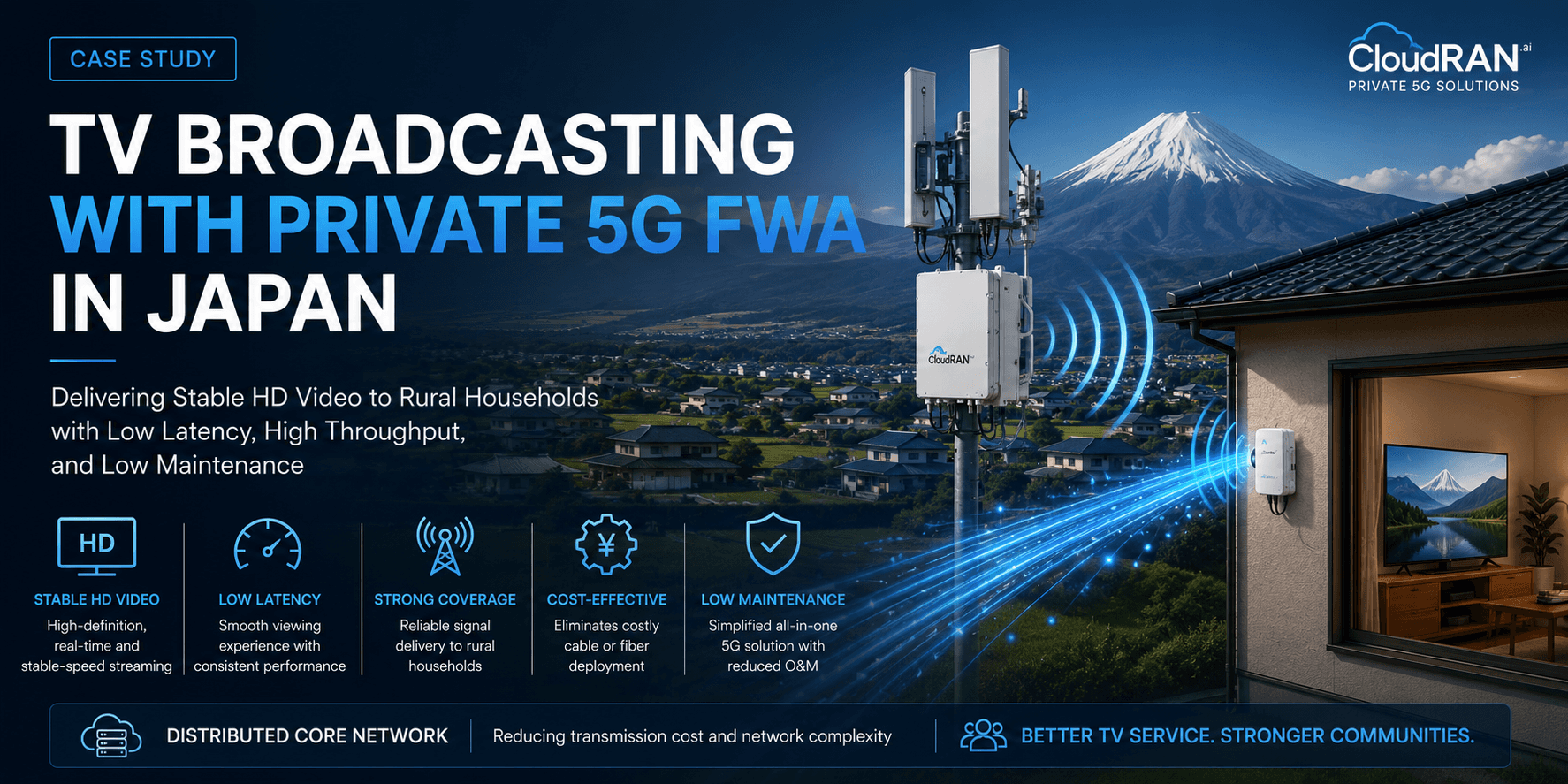
How CloudRAN.AI Private 5G Enabled a Japanese CATV Operator to Deliver Stable HD Video Services Without Costly Last-Mile Cabling
Cable television operators are under increasing pressure to modernize video delivery infrastructure while controlling network deployment cost, maintenance complexity, and last-mile service expansion challenges. In dense urban areas, fiber and cable infrastructure can often be justified by subscriber density. In rural and semi-rural areas, however, the economics are very different. Homes may be distributed across wide geographic areas, cable routes can be expensive to extend, and legacy wireless systems may struggle to keep pace with growing expectations for high-definition video, stable throughput, and low-latency service delivery.
In Japan, a CATV operator required a more efficient way to transmit TV content to households in rural areas. The operator had previously relied on traditional 4G-based systems, but growing capacity requirements and increasing system complexity made the existing approach more expensive to maintain and less suitable for future service expansion.
CloudRAN.AI provided a private 5G Fixed Wireless Access solution designed to support high-definition, real-time, and stable-speed video streaming without requiring extensive physical wiring or building modification. By using private 5G as a wireless last-mile access layer, the operator could reduce deployment complexity while maintaining consistent performance for TV service delivery.
The result was a more scalable, lower-maintenance architecture for rural CATV distribution — using private wireless connectivity to deliver video services where fiber or cable rollout would be slow, costly, or operationally inefficient.
Customer Profile
Industry: Cable television / broadband access
Customer type: CATV operator
Location: Japan
Deployment scenario: Rural and semi-rural household video distribution
Technology model: Private 5G Fixed Wireless Access
Primary use case: HD video delivery to households
Key requirements: Low latency, high throughput, stable coverage, low maintenance, reduced transmission cost, simplified distributed core architecture
The customer operates in a market where service reliability is critical. TV services are highly sensitive to user experience. Viewers expect stable video quality, predictable service continuity, and minimal interruption. Unlike general internet browsing, video delivery exposes network instability very quickly: buffering, pixelation, latency, inconsistent throughput, or link drops are immediately visible to the end user.
For CATV operators, this makes network architecture a business-critical decision. The access network must be cost-effective, but it must also be stable enough to support household video services at scale.
Industry Context: The Last-Mile Challenge for CATV Operators
Traditional CATV operators have historically relied on coaxial cable, hybrid fiber-coax networks, fiber-to-the-home, microwave links, or mobile network-based wireless access depending on local geography and infrastructure conditions.
In rural areas, last-mile network economics are challenging. Extending cable or fiber to each household can require high civil-work cost, long deployment timelines, rights-of-way coordination, physical installation, and ongoing maintenance. Where homes are distributed across wide areas, the cost per household can become difficult to justify.
Wireless access can reduce deployment friction, but not every wireless technology is suitable for stable video service delivery. A CATV operator must consider:
Consistent throughput for HD video
Low latency and low jitter
Coverage into or near the household
Service stability across weather and environmental conditions
Low maintenance requirements
Operational simplicity for distributed sites
Cost efficiency compared with fiber or cable expansion
Ability to scale across additional households or communities
Legacy 4G systems may provide coverage, but they can become increasingly complex and expensive to maintain as video quality expectations rise and network capacity demand grows. Public mobile networks may not provide the operational control required for a CATV service provider. Traditional cabling can provide strong performance but may be financially inefficient in sparsely populated areas.
This creates a strong fit for private 5G FWA.
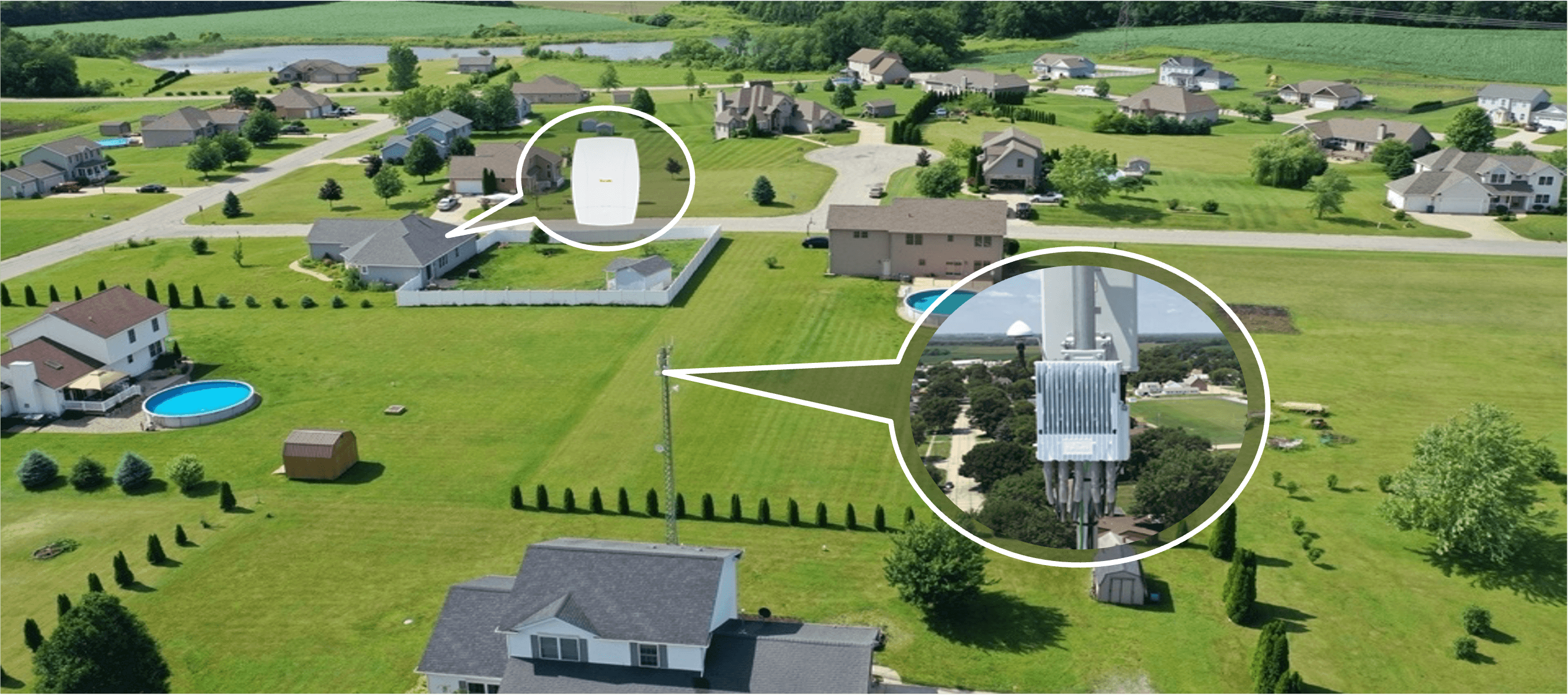
Why Private 5G FWA Fits Rural TV Broadcasting
Private 5G Fixed Wireless Access allows operators to create a dedicated wireless access layer for service delivery. Instead of extending cable or fiber to every household, the operator can deploy private 5G radio infrastructure and customer-side receiving equipment to deliver video and connectivity services wirelessly.
For rural CATV, the value is practical:
Fewer physical cable routes
Reduced building modification
Faster household service enablement
Lower site footprint compared with older systems
Lower maintenance complexity
Stable wireless delivery for HD video
Distributed architecture that reduces backhaul and central-core bottlenecks
Better alignment with low-density rural economics
Private 5G FWA is not simply a substitute for consumer broadband. In this scenario, it functions as a controlled access network for video service delivery. The operator can design the network around specific service requirements rather than relying on best-effort public connectivity.
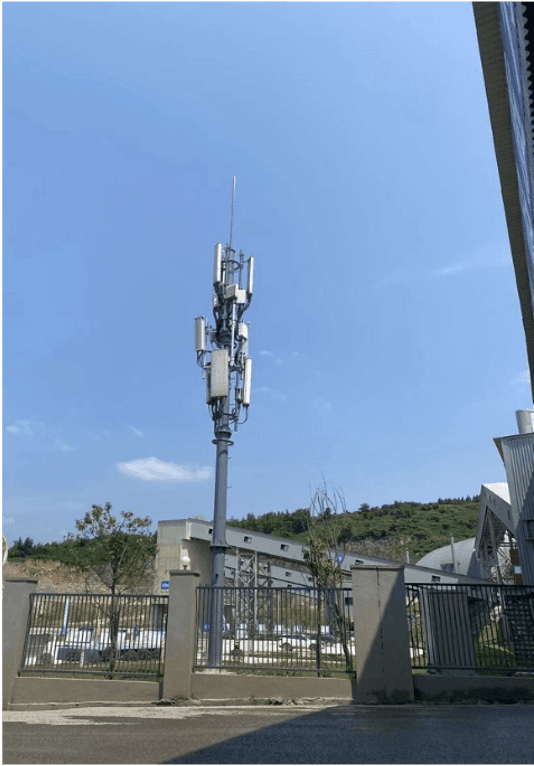
Service Requirements
The CATV operator required a wireless delivery model that could support TV broadcasting and video service requirements in rural Japan.
Low Latency and Consistent High Throughput
Video service delivery requires stable throughput. For HD video, the issue is not only peak bandwidth; it is consistency. A network that occasionally reaches high speed but frequently drops or fluctuates can create visible service quality problems.
The private 5G FWA network needed to provide predictable wireless capacity for household video streams, supporting real-time and high-definition content delivery.
Latency also matters because video distribution systems, content control systems, interactive services, and network management workflows may depend on responsive connectivity. Low latency and low jitter help maintain service quality and reduce user-visible disruptions.
Low Maintenance Cost
The operator needed to reduce the cost and complexity of maintaining the whole system. Legacy distributed 4G systems can require more complex maintenance, especially when multiple sites, core-network dependencies, and hardware components must be managed across rural areas.
CloudRAN.AI’s private 5G architecture was designed to simplify the deployment model by reducing unnecessary infrastructure complexity and supporting a more compact, distributed network architecture.
Strong Coverage into the Household
A rural CATV FWA system must provide good coverage performance toward customer premises. The network must support signal delivery across residential areas and into household receiving points, reducing the need for extensive physical wiring.
This is especially relevant in rural villages, detached homes, and semi-rural residential clusters where cable extension would be costly.
Distributed Core Network Architecture
A distributed core network approach can reduce transmission cost and complexity by moving key network capabilities closer to the service area. Instead of depending entirely on a distant centralized core and long transport paths, the operator can use a more localized architecture to support video distribution and household connectivity.
For TV service delivery, this can improve network responsiveness, reduce bottleneck risk, and simplify rural deployment models.
CloudRAN.AI Private 5G Solution
CloudRAN.AI’s private 5G FWA solution provided the CATV operator with a dedicated wireless access layer for household video delivery.
The solution enabled high-definition, real-time, and stable-speed video streaming for households in rural areas, while reducing the need to lay cable or fiber to each home.
The architecture was built around four main objectives:
Deliver stable HD video over private wireless connectivity
Reduce deployment cost compared with physical last-mile cabling
Lower maintenance complexity through a compact distributed architecture
Create a scalable rural access model for CATV service expansion
Solution Architecture
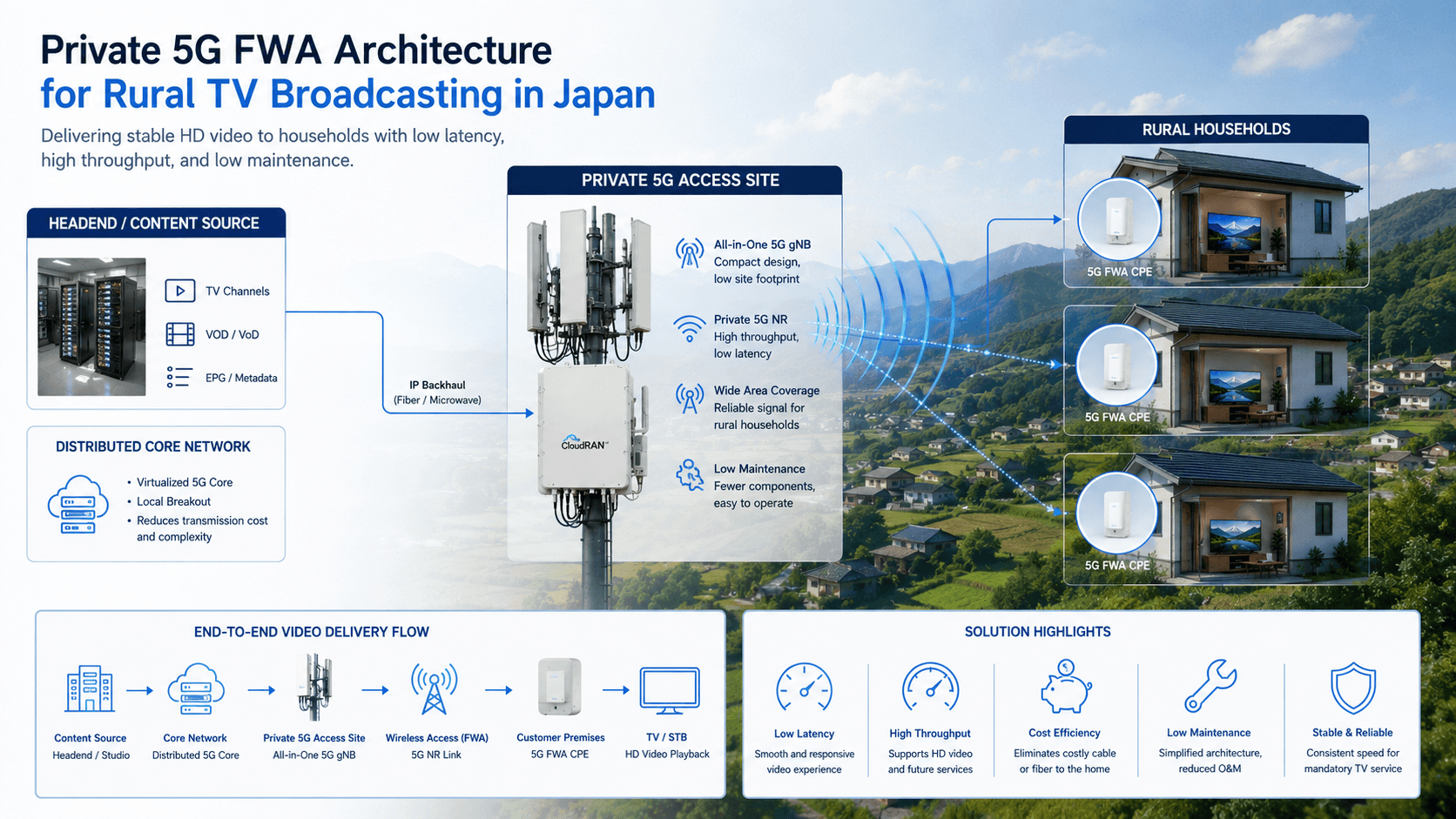
A CloudRAN.AI private 5G FWA architecture for rural CATV broadcasting typically includes:
Private 5G radio units / all-in-one gNBs
5G SA or distributed private core capabilities
Customer-premises receiving equipment or 5G CPEs
Local breakout or distributed service routing
Backhaul connectivity to CATV headend, video distribution system, or operator network
Centralized management and monitoring
Service delivery path toward household video equipment or local customer network
The architecture is designed to deliver video service from the operator network through a private 5G wireless access layer to the household.
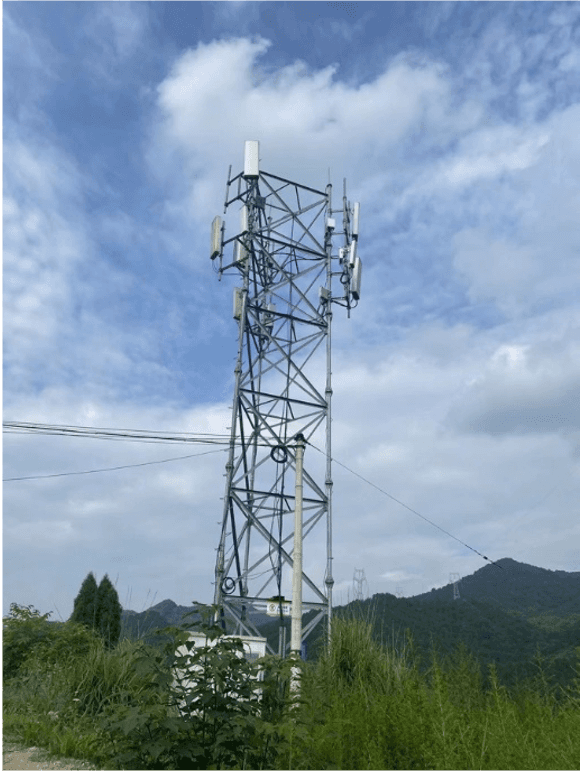
1. Private 5G Radio Access
The private 5G radio layer provides wireless coverage from the operator site or local access point toward target households. For rural areas, radio planning must consider terrain, building distribution, tower placement, line-of-sight or near-line-of-sight conditions, vegetation, and household density.
Compared with extending physical cable, radio access provides a faster and more flexible way to reach distributed homes.
2. All-in-One 5G gNB
CloudRAN.AI’s all-in-one 5G gNB model helps reduce site footprint and simplify deployment. A compact base station architecture is especially valuable for rural operators because sites may have limited space, limited power options, and constrained maintenance access.
By reducing the number of required hardware components, the operator can simplify site deployment and ongoing maintenance.
3. Distributed / Virtualized Core
The solution uses a distributed core network approach to reduce the cost and complexity of centralized transmission. Moving network functions closer to the access site can reduce long-path dependencies and improve the efficiency of service delivery.
For CATV video services, this helps avoid unnecessary bottlenecks and supports a more resilient rural service model.
4. Private 5G FWA Customer Access
At the household side, 5G FWA can connect customer premises without the need for new physical cable installation. Depending on the deployment model, a CPE can receive the 5G signal and connect to in-home networking or video delivery equipment.
This enables service expansion without modifying each building extensively or running dedicated physical cable to every home.
5. Centralized Operations and Monitoring
For a CATV operator, network visibility is important. The operator must be able to monitor sites, devices, coverage, traffic, and service quality across distributed areas.
CloudRAN.AI’s private 5G solution supports centralized operations and management, allowing the operator to maintain the network more efficiently than complex legacy deployments.
Why Distributed Core Matters for CATV FWA
In traditional centralized mobile architectures, traffic may need to travel through multiple network layers before reaching the service platform. For video delivery, this can increase complexity and cost, especially if rural access sites are far from centralized network infrastructure.
A distributed core architecture can place key network functions closer to the edge of the service area. This supports:
Lower latency
Reduced transmission cost
Simplified rural architecture
Better local service continuity
More efficient routing for video traffic
Reduced dependence on expensive central infrastructure
For rural CATV operators, this is important because every additional transport layer adds cost and operational burden. A distributed model helps the operator align network architecture with rural service economics.
Why Private 5G Improves Household Video Delivery
Video delivery is sensitive to throughput variation. Even when average bandwidth appears sufficient, inconsistent wireless performance can degrade user experience.
Private 5G improves the service model by providing a dedicated and controlled access network. The operator can plan coverage, manage devices, monitor performance, and optimize the network around video service requirements.
Key advantages include:
More predictable wireless capacity than best-effort public access
Better control over network resources
Dedicated coverage planning for target households
Lower operational complexity than extensive cabling
Ability to scale service area gradually
Support for HD and real-time video delivery
Reduced maintenance compared with older multi-component systems
For CATV operators, the benefit is not just speed. It is controllable service quality.
Performance and Operational Benefits
The deployment focused on three major outcomes: low latency, high throughput, and low maintenance.
Low Latency
Private 5G supports a more responsive service architecture, particularly when combined with local or distributed core capabilities. This is useful for real-time video delivery, service control, monitoring, and interactive service features.
High Throughput
HD video requires stable throughput across the access link. Private 5G FWA provides a stronger wireless access platform than legacy systems when designed around service-specific coverage and capacity requirements.
Low Maintenance
CloudRAN.AI’s all-in-one 5G gNB and virtualized/distributed core approach reduce hardware footprint and simplify operations. Fewer physical components and less dependence on extensive cable deployment can reduce site maintenance effort.
Cost Efficiency
The solution reduces the need to lay physical cable or fiber to every household. For rural areas, this can significantly reduce deployment time, civil-work cost, and installation complexity.
Stability
Consistent speed is mandatory for TV service. CloudRAN.AI private 5G provides a stable wireless delivery model that supports the quality expectations of household video services.
Comparison with Legacy 4G-Based Delivery
The operator previously relied on traditional 4G infrastructure. Over time, this model became less attractive because of growing capacity demand and the increasing complexity of maintaining 4G systems.
Private 5G FWA offers several improvements over legacy 4G delivery models:
Requirement | Legacy 4G-Based Model | CloudRAN.AI Private 5G FWA |
|---|---|---|
Video service quality | Increasing pressure from HD video demand | Designed for stable HD video delivery |
Network control | More limited service-specific control | Dedicated private network control |
Maintenance | Higher complexity across legacy systems | Lower-maintenance compact architecture |
Core network model | More centralized / complex | Distributed core option for lower cost and complexity |
Household connection | Wireless but capacity-constrained over time | Private 5G FWA with stronger performance foundation |
Rural expansion | Cost and complexity increase with service area | More scalable wireless last-mile model |
This shift is important because CATV operators need access networks that can evolve with video quality expectations and rural service expansion requirements.
Reducing the Need for Physical Wiring
One of the most important advantages of private 5G FWA is the reduction of physical installation work.
For rural households, laying cable or fiber can involve:
Route surveys
Civil works
Pole or duct access
Building entry work
Customer installation scheduling
Maintenance of physical cable routes
Repair after weather or environmental damage
A private 5G FWA model reduces this burden by delivering service wirelessly from the operator’s private 5G access point to the customer premises.
This is especially valuable in rural Japan, where terrain, household spacing, and infrastructure cost can make wired rollout inefficient.
Rural Connectivity and Service Equity
Although this case focuses on CATV broadcasting, the broader relevance is rural digital infrastructure.
Rural communities often face a gap between service expectations and network economics. Consumers expect high-quality video and connectivity, but operators must manage lower population density and higher per-household deployment cost.
Private 5G FWA can help close this gap by giving operators a more flexible last-mile option. Instead of choosing between expensive physical cabling and lower-performance legacy wireless, operators can deploy a dedicated private 5G access network optimized for the target service area.
For CATV operators, this can create a path to maintain and expand service quality in rural markets without unsustainable infrastructure cost.
Event and Large-Site Relevance
Although this deployment focuses on rural TV broadcasting, the architecture has strong relevance for large events and temporary venues.
Large events, festivals, sports venues, and temporary broadcast environments often face similar requirements:
High-throughput video transmission
Stable wireless performance
Low-latency service delivery
Rapid deployment without extensive cabling
Reduced dependence on public networks
Distributed edge or local breakout
Low site footprint
Easy teardown or redeployment
In a CATV rural deployment, the private 5G FWA network delivers HD video to households. In an event environment, a similar architecture can support live video backhaul, temporary broadcast feeds, production connectivity, operational networks, or vendor services.
The underlying principle is the same: when physical cabling is expensive, slow, or impractical, private 5G can provide a controlled wireless transport layer for video and operational services.
This connects directly with CloudRAN.AI’s broader private 5G event and broadcasting capabilities, where rapid deployment, high uplink/downlink capacity, and local service control are critical.
CloudRAN.AI Product Fit
CloudRAN.AI’s private 5G portfolio is designed for enterprise, industrial, and operator-led private network deployments.
For this CATV FWA use case, relevant capabilities include:
Private 5G radio access
All-in-one 5G gNB for reduced footprint
5G SA core / distributed core architecture
Fixed Wireless Access support
Local breakout and edge-ready design
CPE-based household connectivity
Centralized network management
Lower-maintenance deployment model
Scalable coverage for rural and semi-rural areas
Support for high-throughput, low-latency video delivery
The solution supports a practical deployment model for operators that need to modernize service delivery without overbuilding physical infrastructure.
From CATV Modernization to Private Wireless Service Expansion
The Japanese CATV deployment shows how private 5G can support a new operating model for regional operators.
At the first level, private 5G FWA improves household service delivery by reducing dependence on physical cabling.
At the second level, it lowers network complexity through a compact and distributed architecture.
At the third level, it creates a scalable access model for rural expansion.
At the fourth level, it positions the operator to support future services beyond traditional TV, including broadband access, local content delivery, remote monitoring, community connectivity, or event-based temporary video transport.
This makes private 5G FWA more than a replacement for legacy 4G. It becomes a flexible service platform.
Conclusion
The Japanese CATV operator deployment demonstrates how CloudRAN.AI Private 5G FWA can help modernize rural TV service delivery.
By using private 5G as a wireless last-mile access layer, the operator can deliver stable HD video services while reducing the time, cost, and complexity associated with laying cable or fiber to households.
The solution provides low latency, high throughput, strong coverage performance, reduced maintenance cost, and a distributed architecture designed to lower transmission complexity.
For CATV operators, private 5G FWA offers a practical path toward rural service modernization — combining the reliability required for TV broadcasting with the flexibility of wireless deployment.
CloudRAN.AI Private 5G helps operators deliver high-quality video and connectivity services in environments where traditional last-mile infrastructure is too slow, too costly, or too complex to scale.