Case Study
Smart Mining with Private 5G: Remote-Controlled Truck Operations, Multi-Camera Monitoring, and AI-Ready Connectivity in Ordos
How CloudRAN.AI Private 5G Helped an Open-Pit Coal Mine Enable Low-Latency Remote Operations, Multi-Camera Monitoring, and Safer Autonomous Workflows
Open-pit mining is one of the most challenging environments for industrial wireless networks. The terrain changes continuously. Vehicles move across wide and irregular areas. Heavy machinery creates vibration, dust, obstruction, and safety risk. Operational teams require continuous visibility from multiple camera feeds, reliable uplink capacity, and extremely low latency for remote-control workflows.
In Ordos, China, a large open-pit coal mining operation required a private wireless network capable of supporting remote truck operations, driver fatigue monitoring, multi-angle video transmission, and rapid on-site deployment across a dynamic mining environment.
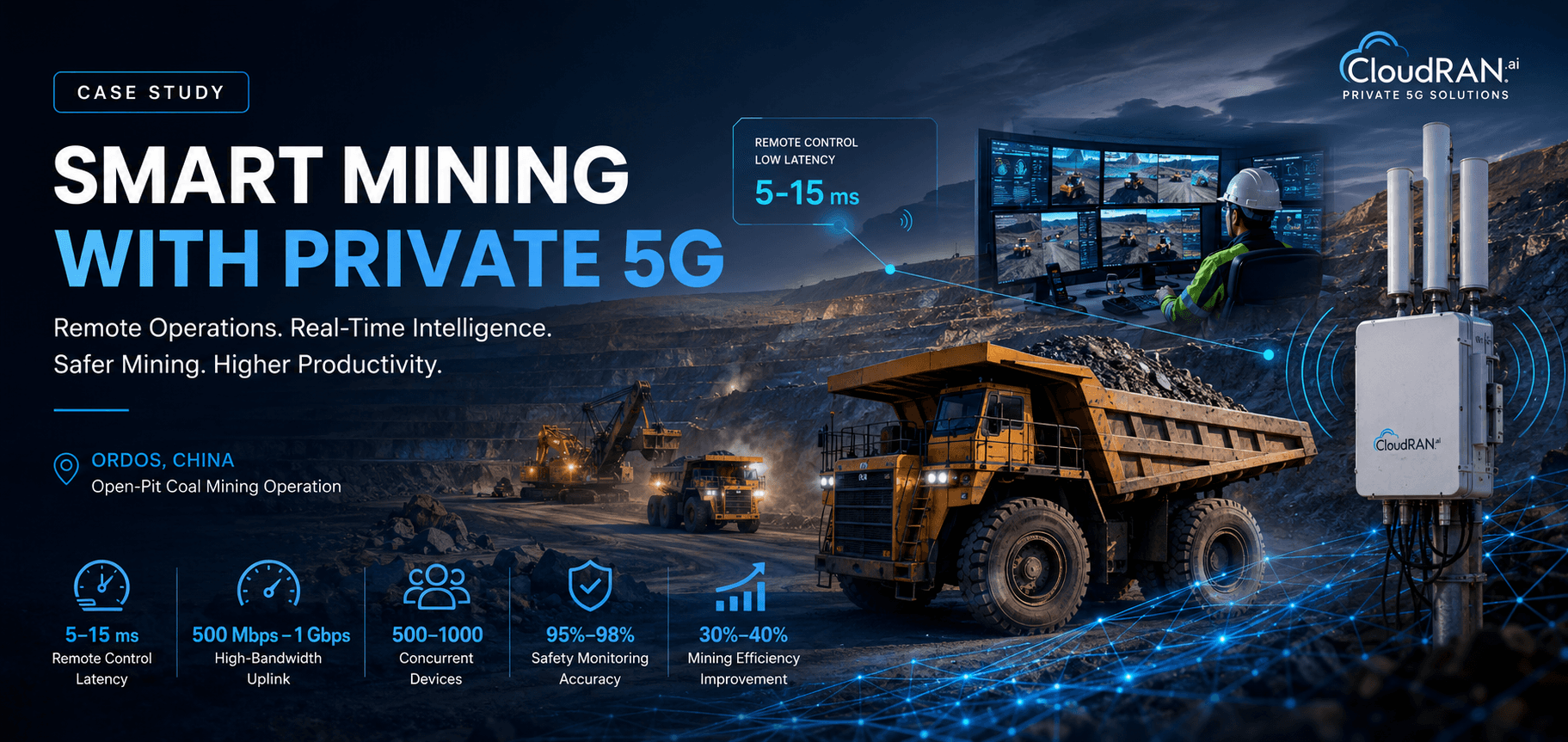
CloudRAN.AI deployed a private 5G network to support the mine’s transition toward a more data-driven, remotely operable, and safety-focused smart mining model. The solution enabled remote operation of mining trucks, high-bandwidth video monitoring, and enhanced operational analytics through a dedicated private 5G connectivity layer.
The deployment demonstrated how private 5G can support industrial automation in environments where conventional wireless technologies struggle to provide consistent latency, uplink capacity, mobility, and coverage flexibility.
Customer Profile
Industry: Open-pit coal mining
Location: Ordos, China
Site type: Large open-pit mining operation
Mining area: Approximately 6.25 km²
Production scale: Expanded from around 1.2 million tons to 2.4 million tons per year
Core use cases: Remote truck control, multi-camera monitoring, fatigue detection, mobile equipment connectivity, smart mining operations
The Ordos mining site represents a typical large-scale open-pit mining environment: broad physical coverage, constantly changing terrain, heavy vehicle movement, high safety requirements, and an increasing need for real-time operational visibility.
As mining operations scale, connectivity becomes more than a support function. It becomes a core operational infrastructure layer. Without reliable wireless connectivity, remote driving, real-time safety monitoring, intelligent dispatch, and high-bandwidth video analytics cannot operate effectively.
Mining Connectivity Challenge
Smart mining requires the network to follow the operation, not the other way around.
In open-pit mining, the working area changes as excavation progresses. Haul roads shift. Loading and unloading zones move. Terrain elevation changes. Network coverage that worked in one phase of the site may become insufficient as the mine expands or equipment moves to a new area.
Traditional industrial wireless approaches face several limitations in this environment.
Wi-Fi can be difficult to scale across large outdoor mining areas. It often requires dense access point placement, suffers from interference and roaming issues, and is not designed for predictable mobility across large industrial footprints.
Public mobile networks may provide macro coverage, but they are not optimized for the mine’s specific operational workflows. They also do not provide the same level of control over device access, traffic priority, local breakout, or deterministic performance for mission-critical mining operations.
Wired infrastructure is valuable for fixed assets, but it cannot efficiently support mobile trucks, reconfigurable operating zones, and rapidly changing open-pit terrain.
The Ordos mine required a dedicated private network that could support:
Remote truck and equipment control
Driver fatigue detection using multi-angle cameras
High-bandwidth uplink for real-time video
Low-latency control-plane and user-plane responsiveness
Flexible, reconfigurable coverage across shifting terrain
Mobility across multiple base station coverage areas
Rapid deployment without heavy site infrastructure
Simplified network operations for industrial teams
The goal was not only to improve wireless coverage. The goal was to make remote and intelligent mining operations technically feasible at production scale.
Service Requirements
The mining site required a private wireless architecture designed around operational reliability, mobility, and uplink-heavy industrial data.
Key service requirements included:
Remote Truck and Equipment Control
Remote truck operation depends on low and stable latency. Human operators must be able to control vehicles from a remote command environment while receiving near-real-time visual feedback from cameras mounted on the vehicle.
For this use case, jitter is as important as average latency. Even if the average network delay is acceptable, sudden latency spikes or packet loss can degrade operator confidence and create safety risk.
The network therefore needed to support low-latency, stable uplink and downlink communication between remote-control systems, vehicle-mounted equipment, and operational command points.
Multi-Camera Video Transmission
Remote driving and fatigue detection require multiple video streams from different viewing angles. These may include forward-facing cameras, side cameras, cabin cameras, blind-spot cameras, rear cameras, or equipment-status feeds.
This creates a demanding uplink requirement. Unlike consumer mobile broadband, where downlink traffic is often dominant, smart mining applications are heavily uplink-driven. Vehicle-mounted cameras and sensors continuously send data back to control rooms, edge systems, or analytics platforms.
The network needed enough uplink capacity to support real-time multi-camera visibility without degrading remote-control performance.
Safety and Fatigue Monitoring
Mining operations require continuous safety monitoring for drivers, remote operators, vehicles, and surrounding work zones.
Fatigue detection and safety analytics depend on reliable data capture from camera systems and monitoring devices. If video is delayed, unstable, or unavailable, safety monitoring accuracy and responsiveness are affected.
The deployment therefore needed connectivity that could support high-accuracy monitoring workflows and enable safer operations across the mining site.
Flexible, Reconfigurable Coverage
Open-pit mines are not static facilities. Network coverage must adapt to changing topography, vehicle routes, excavation zones, and temporary work areas.
The mine required a coverage model that could be deployed quickly and adjusted as operations evolved, without requiring complex redesign or heavy fixed infrastructure at every stage.
Rapid On-Site Deployment
Mining operations cannot afford long network deployment cycles. Any connectivity solution must be practical for industrial teams to deploy, operate, and adjust in the field.
CloudRAN.AI’s compact private 5G architecture was used to support faster on-site deployment, simplified infrastructure, and easier operational rollout.
CloudRAN.AI Private 5G Solution
CloudRAN.AI deployed a private 5G network to provide dedicated industrial connectivity for the Ordos open-pit mine.
The solution combined private 5G radio access, vehicle-mounted connectivity, local networking capabilities, and operational support for low-latency, high-bandwidth mining applications.
The architecture was designed around three practical principles:
Low-latency connectivity for remote operations
High-capacity uplink for video and monitoring
Flexible coverage for dynamic mining terrain
Solution Architecture
The CloudRAN.AI private 5G solution supported the mine through a dedicated network architecture consisting of:
Compact all-in-one private 5G base station design
Private 5G radio coverage for mining zones
Vehicle-mounted CPEs for mining trucks and mobile equipment
Support for multi-camera video input from vehicles
Local breakout and edge-ready connectivity for responsive services
Mobility support across multiple base station coverage areas
Centralized network management and operational monitoring
Simplified deployment using single-cable power and backhaul where applicable
The private 5G network created a controlled wireless layer for mining operations. Instead of relying on public network behavior or best-effort Wi-Fi access, mining devices could connect through a dedicated industrial network planned around site requirements.
Radio Layer
The radio layer provided private 5G coverage across the mining site, supporting connectivity for mobile trucks, operational equipment, cameras, sensors, and monitoring systems.
For open-pit mining, radio planning must account for site geometry, elevation changes, haul roads, pit walls, and moving equipment. Coverage cannot be treated as a flat indoor deployment. It must be aligned with production zones and operational movement patterns.
CloudRAN.AI’s private 5G radio layer supported the creation of wide-area industrial coverage while reducing the need for dense and fragile access point infrastructure.
Vehicle-Mounted Connectivity
Mining trucks and mobile equipment were connected using vehicle-mounted CPEs. These CPEs served as connectivity gateways between on-board systems and the private 5G network.
This enabled the vehicle to support multiple connected systems, including:
Remote-control interfaces
Multi-angle cameras
Safety monitoring devices
Driver or cabin monitoring
Equipment telemetry
Operational data transmission
The vehicle-mounted CPE model is especially important because many industrial systems are not natively 5G-enabled. The CPE provides a practical bridge between existing vehicle-side devices and the private 5G network.
Core Network and Local Breakout
For remote operations, network responsiveness matters. A private 5G architecture with local breakout can keep critical operational traffic close to the site rather than routing every session through distant cloud infrastructure.
This is important for latency-sensitive applications such as remote control, video feedback, and local operational systems.
The private 5G core provides device authentication, mobility/session management, and traffic control, while local breakout supports edge-ready workflows for mining applications that benefit from low-latency local processing.
Management and Operations
Industrial private 5G deployments must be manageable by operational teams. Network visibility, configuration, lifecycle management, and troubleshooting are essential for production environments.
CloudRAN.AI’s private 5G solution supports operational management across deployment, monitoring, configuration, and network lifecycle activities, helping industrial teams operate the network as part of the mining site’s production infrastructure.
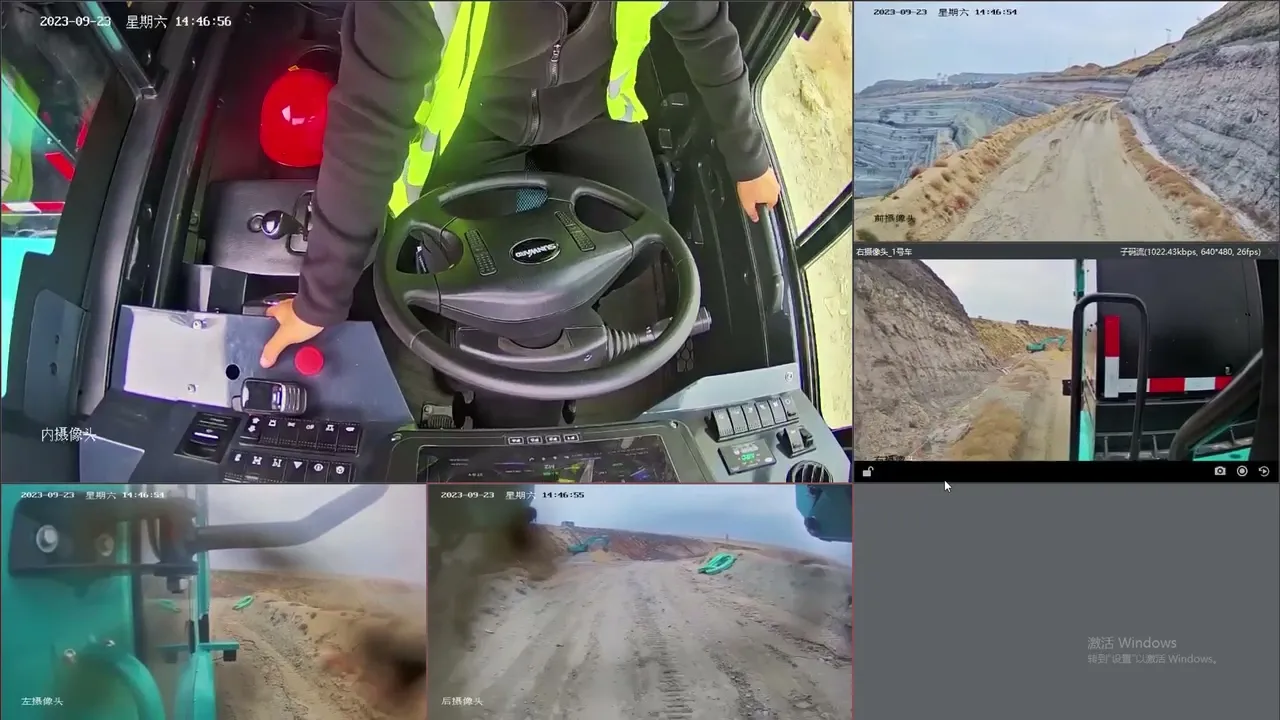
Remote-Controlled Mining Truck POV — Ordos Open-Pit Mine
This video shows the point of view from a mining truck operating in the Ordos open-pit mine. The vehicle is not being manually driven from the cab; it is operated remotely, with private 5G supporting the low-latency connectivity and video feedback required for remote mining operations.
Performance Impact
The deployment showed significant improvements across latency, bandwidth, device scalability, safety monitoring, and mining efficiency.
Indicator | Before Private 5G | After Private 5G | Improvement |
|---|---|---|---|
Remote control latency | 50–100 ms | 5–15 ms | Reduced by 70%–95% |
Bandwidth | 10–50 Mbps | 500 Mbps–1 Gbps | Increased by around 1000%–10000% |
Concurrent devices | 50–100 | 500–1000 | Improved by around 1000% |
Safety monitoring accuracy | 70%–80% | 95%–98% | Enhanced to near-production-grade accuracy |
Mining efficiency | N/A | Productivity increased by 30%–40% | 30%–40% improvement |
These improvements are especially important because mining automation depends on multiple network characteristics improving together. High bandwidth alone is not enough. Low latency alone is not enough. Smart mining requires a combination of stable latency, strong uplink capacity, broad device connectivity, and reliable coverage across the work site.
Why Latency Matters in Remote-Controlled Mining
Remote control is one of the most demanding applications in industrial private 5G.
When a mining truck is controlled remotely, the operator depends on video feedback, control signals, and vehicle telemetry. Delays in the network can affect how quickly the operator sees the environment and how quickly the vehicle responds to control input.
In a controlled industrial setting, a reduction from 50–100 ms to 5–15 ms is operationally meaningful. It can improve responsiveness, reduce control uncertainty, and make remote operation more practical for production environments.
The benefit is not only faster command transmission. It is greater operator confidence and better alignment between the remote-control interface and the physical vehicle.
For mining environments, this can support safer operations in high-risk zones, reduce the need for personnel exposure near active mining areas, and create a foundation for more automated equipment workflows.
Why Uplink Capacity Matters in Smart Mining
Many enterprise networks are designed around downlink-heavy usage. Smart mining is different.
Mining automation creates large uplink demand because the site continuously sends video, sensor data, equipment telemetry, and safety monitoring data back to command systems.
Vehicle-mounted multi-camera systems are particularly uplink-intensive. Remote operation may require multiple simultaneous camera angles to provide adequate situational awareness. Fatigue detection and safety analytics may require continuous video streams from cabin-facing and external cameras.
The increase from tens of Mbps to hundreds of Mbps or gigabit-class bandwidth gives the mining site more room to support:
Multi-camera remote driving views
Fatigue detection video
Safety monitoring
Equipment telemetry
Operational dashboards
Future AI-assisted analytics
Additional connected devices
For open-pit mines, this uplink capacity is a key enabler of production-grade smart mining.
AI + 5G Reality: Adapting to Dynamic Mining Terrain
The Ordos mining site illustrates a central challenge in smart mining: the environment does not stay still.
As terrain changes, coverage planning must adapt. Excavation zones move, truck routes shift, and the physical geometry of the mine changes over time.
CloudRAN.AI’s AI-assisted planning approach, represented by Megrez, is designed to support faster network planning and adaptation in environments where traditional manual planning can be slow or difficult to update.
For mining, AI-assisted planning can help teams evaluate coverage needs, site constraints, deployment options, and equipment placement more efficiently. In a changing open-pit environment, this supports a more repeatable and responsive deployment model.
The value is not that AI replaces engineering expertise. The value is that AI can help accelerate planning workflows, reduce repetitive work, and support better consistency across deployments.
For a mine such as Ordos, this means private 5G can become a more adaptable operational layer rather than a one-time static network design.
Solution Advantages
Quick Deployment
The CloudRAN.AI private 5G solution uses a compact architecture designed to reduce deployment complexity.
Key deployment advantages include:
Compact all-in-one base station design
Single-cable power and backhaul where applicable
Plug-and-play installation model
Reduced dependence on complex site infrastructure
Faster rollout for industrial environments
In mining, faster deployment matters because production sites cannot easily pause operations for long network installation cycles.
High Scalability
The solution supports growth from initial connected equipment to larger smart mining deployments.
Scalability advantages include:
Vehicle-mounted CPE support for multi-camera inputs
Mobility across multiple base stations
Seamless coverage across shifting terrain
Support for hundreds of connected devices
Expandability for additional sensors, cameras, and operational endpoints
This makes the architecture suitable not only for one remote-controlled truck workflow, but also for broader mining-site digitization.
Cost Savings and Infrastructure Simplification
Private 5G can reduce infrastructure complexity by covering larger outdoor areas with fewer radio sites compared with dense Wi-Fi deployments.
The CloudRAN.AI Network-in-Radio approach supports simplified infrastructure by integrating key network capabilities into a compact deployment model. For industrial environments, this can reduce engineering complexity, shorten deployment time, and lower the operational burden of maintaining multiple disconnected network systems.
Safety Improvement
By enabling remote operation and enhanced monitoring, private 5G can help reduce personnel exposure to hazardous mining zones.
Workers can operate or supervise equipment from safer locations, while cameras and sensors provide continuous visibility into vehicle status, operator condition, and site conditions.
The improvement in safety monitoring accuracy from 70%–80% to 95%–98% indicates that higher-quality connectivity can materially improve the performance of monitoring systems.
Productivity Improvement
The deployment supported a reported 30%–40% improvement in mining productivity.
This improvement can be understood through several mechanisms:
Reduced downtime from connectivity instability
Faster and more reliable remote-control workflows
Improved visibility for equipment operation
Better safety monitoring and fewer manual interventions
More connected devices supporting site coordination
Stronger foundation for automation and analytics
In smart mining, productivity improvement is not driven by a single application. It comes from the combined effect of connectivity, visibility, automation, and safer operations.
Industry Relevance: Why Private 5G Is Becoming Critical for Mining
Mining is one of the clearest industrial use cases for private 5G.
The industry is under pressure to improve productivity, reduce safety incidents, address labor shortages, and digitize operations across remote or harsh environments. Many mining sites are also trying to move from manually operated equipment toward remote-controlled, semi-autonomous, or fully autonomous workflows.
These applications require a wireless network with characteristics that Wi-Fi and public mobile networks may not consistently provide:
Wide-area outdoor coverage
Mobility support for heavy vehicles
Low latency for control
High uplink capacity for video
SIM-based secure access
Local traffic handling
Industrial reliability
Support for edge computing and AI analytics
Centralized management and lifecycle control
Private 5G is not simply a faster network. In mining, it becomes the communications foundation for a new operating model.
It allows mines to connect vehicles, machines, workers, sensors, cameras, and control systems through a dedicated network that is designed for the production environment.
From Remote Control to Data-Driven Mining
The Ordos deployment shows how private 5G can support the transition from connected mining to intelligent mining.
At the first level, private 5G improves connectivity. It gives mobile equipment, cameras, and operational systems access to a dedicated high-performance network.
At the second level, it enables remote operations. Trucks and equipment can be controlled or supervised from safer locations, supported by low-latency video and control communication.
At the third level, it supports operational intelligence. As more devices connect, the mine can collect more real-time data from vehicles, cameras, and field systems.
At the fourth level, it creates the foundation for AI-assisted operations. Safety monitoring, fatigue detection, production analytics, dispatch optimization, and predictive maintenance all depend on reliable data flows from the field.
CloudRAN.AI private 5G provides the connectivity layer that makes this progression possible.
Event and Large-Site Relevance
Although this deployment is in mining, the technical challenges are closely related to other large-site and event environments.
Both open-pit mines and large events require reliable connectivity across temporary or changing physical environments. Both involve mobile users or assets. Both create uplink-heavy workflows. Both require rapid deployment and flexible coverage. Both may operate in areas where public networks are congested, unavailable, or insufficient for operational workflows.
The same private 5G principles that support remote mining operations can also support:
Large events and festivals
Stadium operations
Temporary industrial sites
Emergency response zones
Ports and logistics yards
Construction sites
Offshore operations
Utility field operations
In each case, the value comes from creating a dedicated, controlled network for critical operations rather than relying on best-effort connectivity.
For mining, the critical workflow is remote equipment operation and safety monitoring. For events, it may be payments, access control, staff communications, and production systems. For ports, it may be automated vehicles and crane operations. The connectivity architecture is adaptable across these environments because the underlying requirement is similar: reliable private wireless coverage for operationally critical workflows.
CloudRAN.AI Product Fit
CloudRAN.AI’s private 5G product portfolio is designed to make enterprise and industrial private networks easier to deploy, manage, and scale.
For mining and other industrial environments, the relevant capabilities include:
Private 5G radio access
Compact all-in-one base station design
5G SA core support
Network-in-Radio architecture
Local breakout and edge-ready connectivity
Vehicle-mounted CPE integration
SIM/eSIM-based device onboarding
Centralized network management
AI-assisted planning and deployment workflows
Support for low-latency and high-uplink industrial applications
The Ordos deployment aligns closely with CloudRAN.AI’s broader strategy: making private 5G faster to plan, easier to deploy, and more practical for production environments.
Conclusion
The Ordos open-pit mining deployment demonstrates how private 5G can transform industrial operations when connectivity becomes mission-critical.
By deploying a dedicated private 5G network, the mine was able to support remote-controlled truck operations, multi-camera video monitoring, improved safety analytics, broader device connectivity, and higher operational productivity.
The results show the value of combining low latency, high bandwidth, mobility, and flexible coverage in one industrial wireless architecture.
For mining operators, private 5G is not only a connectivity upgrade. It is a foundation for safer, more productive, and more automated operations.
CloudRAN.AI Private 5G helps industrial sites move from manual, connectivity-constrained workflows toward data-driven, remotely operable, and AI-ready smart operations.