Case Study
Local 5G for Smart Manufacturing in Japan: Reliable Wireless Coverage for Factory Automation, Quality Control, and Remote Equipment Monitoring
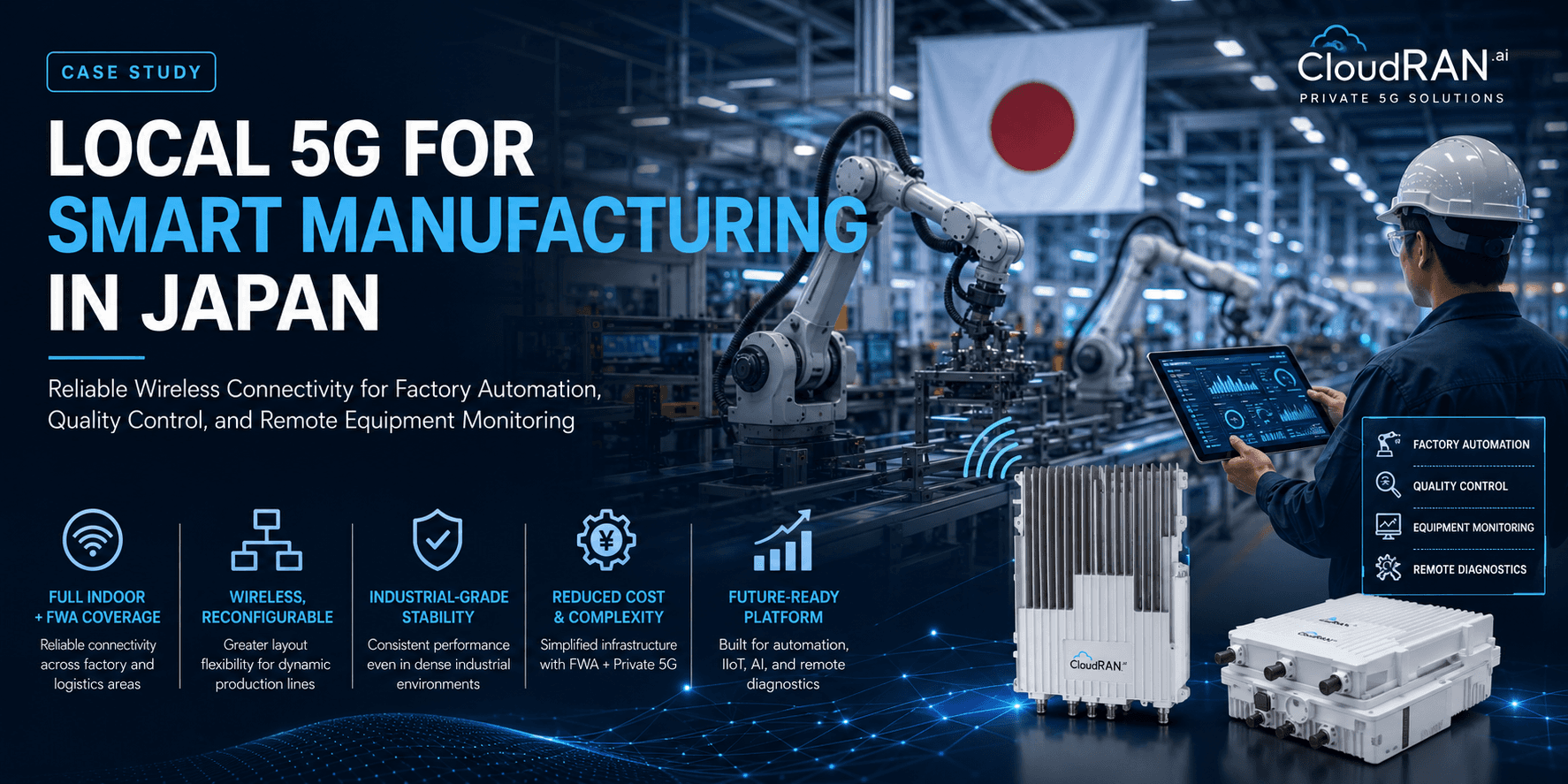
How CloudRAN.AI Private 5G Enabled Industrial-Grade Wireless Connectivity for a Major Japanese Manufacturer of Industrial Wiring Systems
Manufacturing environments are becoming increasingly software-defined, sensor-rich, and automation-driven. Production lines, robotic work cells, inspection systems, warehouse flows, logistics zones, and remote monitoring applications all depend on reliable connectivity. Yet many factories still rely on a mix of legacy wired connections, fragmented Wi-Fi, and isolated industrial networks that were not designed for flexible, data-driven operations.
For a major Japanese manufacturer of industrial wiring systems, the challenge was clear: the factory needed reliable wireless coverage across production and logistics areas while reducing dependence on fixed cabling and unstable indoor wireless connectivity. The customer required a network architecture that could support smart manufacturing use cases, including connected production equipment, remote equipment monitoring, industrial sensors, quality-control workflows, and reconfigurable factory layouts.
CloudRAN.AI deployed a Private 5G network to provide industrial-grade wireless connectivity across the customer’s manufacturing environment, combining Fixed Wireless Access with indoor private wireless coverage. The solution helped the customer move from limited and inflexible connectivity toward a more scalable, resilient, and future-ready smart factory network.
Customer Profile
Industry: Industrial manufacturing
Customer type: Major Japanese manufacturer of industrial wiring systems
Location: Japan
Site environment: Factory production and logistics areas
Primary network model: CloudRAN.AI Private 5G / Local 5G
Core use cases: Factory automation, Fixed Wireless Access, indoor coverage, quality control, equipment monitoring, connected sensors, remote diagnostics
The customer operates in a manufacturing segment where production reliability, process continuity, and quality assurance are critical. Industrial wiring systems are used across automotive, equipment, industrial automation, electronics, and infrastructure-related sectors, which means manufacturing operations must maintain high levels of repeatability, traceability, and production discipline.
As production environments become more automated and more data-driven, the factory network becomes part of the production system itself. Connectivity is no longer only an IT utility. It becomes a foundation for manufacturing execution, production visibility, equipment monitoring, quality control, and operational flexibility.
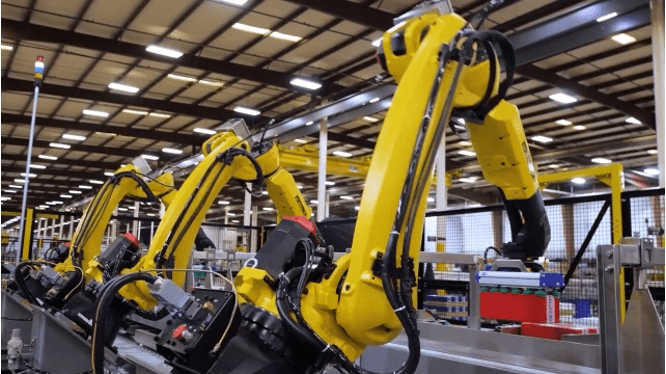
Manufacturing Connectivity Challenge
Smart manufacturing requires connectivity that is stable, secure, flexible, and able to support both fixed and mobile industrial systems.
In a traditional factory environment, many production assets are connected through fixed Ethernet or legacy industrial cabling. This approach is reliable for static equipment, but it creates limitations when production lines need to be reconfigured, new equipment must be added, or temporary production zones are created.
Wi-Fi can support some applications, but in dense industrial environments it may be affected by interference, metal structures, moving equipment, coverage shadows, roaming instability, and unmanaged device behavior. Factories also contain many sources of RF complexity: machinery, racks, walls, safety barriers, conveyors, robotic arms, metal surfaces, electrical systems, and moving operators.
For the Japanese manufacturer, the existing connectivity model created several challenges:
Indoor wireless coverage was limited in some factory areas
Wired connections reduced layout flexibility
Reliability could become unstable in dense or obstructed areas
Cabling increased deployment and maintenance cost
Adding new equipment or sensors required additional physical work
Production and logistics areas needed more consistent connectivity
Automation and remote monitoring required a stronger wireless foundation
The customer needed a network that could support industrial operations without forcing every new device, sensor, or workstation to depend on additional cabling.
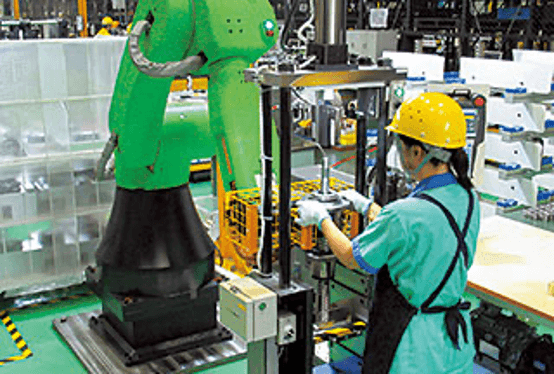
Why Local 5G Matters in Japan
Japan has been one of the most active markets for Local 5G adoption in industrial and enterprise environments. Local 5G allows enterprises, municipalities, and industrial organizations to deploy dedicated private 5G networks for specific locations such as factories, campuses, logistics hubs, ports, venues, and infrastructure sites.
For Japanese manufacturing, Local 5G is especially relevant because factories are under pressure to improve productivity, address labor shortages, increase automation, and support more flexible production models. Many manufacturers are moving toward smart factory architectures that combine industrial IoT, robotics, remote maintenance, machine vision, and data-driven quality management.
These applications require more than basic wireless coverage. They require predictable connectivity, secure device access, and the ability to support both high-bandwidth and low-latency industrial workflows.
CloudRAN.AI Private 5G fits this environment by providing a dedicated wireless layer designed for enterprise-controlled operations, rather than relying entirely on public networks or best-effort Wi-Fi.
Service Requirements
The customer’s manufacturing environment required a private wireless network that could support day-to-day production needs while also enabling future smart factory applications.
Consistent Indoor Wireless Coverage
The factory required reliable wireless connectivity across production and logistics areas. In manufacturing, coverage gaps can directly affect operational workflows. A device that loses connectivity may interrupt data collection, delay quality inspection, disrupt equipment monitoring, or create blind spots in production visibility.
The goal was to provide industrial-grade coverage across the factory floor, including areas where legacy Wi-Fi or wired-only infrastructure was insufficient.
Fixed Wireless Access to Replace or Reduce Legacy Cabling
The customer needed a more flexible way to connect industrial equipment, workstations, sensors, and operational systems without extending physical cabling to every location.
Fixed Wireless Access allows private 5G to act as a wireless alternative to fixed connections in selected areas. Instead of relying only on wired drops, the factory can use 5G-connected endpoints, routers, or CPEs to extend connectivity to production and logistics zones.
This is especially useful in factories where equipment layout changes, temporary production cells are created, or cabling is expensive and disruptive.
Support for Automated Production Equipment and Sensors
Smart manufacturing depends on connected production systems. These may include robotic equipment, machine controllers, inspection stations, environmental sensors, barcode systems, logistics devices, mobile terminals, and industrial monitoring platforms.
The private 5G network needed to support a growing number of connected devices while maintaining reliability and coverage consistency.
Remote Equipment Monitoring and Diagnostics
Remote monitoring allows operations teams to track equipment status, production performance, faults, alarms, and maintenance indicators without requiring constant manual inspection.
For a factory producing industrial wiring systems, remote monitoring can support better visibility into production lines, test stations, machine utilization, and quality-control points.
Private 5G provides a dedicated network layer for these monitoring workflows, helping ensure that critical data flows reliably from production equipment to operational systems.
Data-Driven Quality Control
Quality control in industrial wiring manufacturing depends on precise process control, inspection, traceability, and defect prevention. As factories adopt more machine vision, automated inspection, and real-time data collection, network reliability becomes more important.
A private 5G network can support quality-control workflows by connecting inspection systems, sensors, production terminals, and data platforms through a controlled and secure wireless architecture.
CloudRAN.AI Private 5G Solution
CloudRAN.AI deployed a Private 5G network to support the customer’s smart manufacturing requirements across production and logistics areas.
The solution combined Fixed Wireless Access with indoor private wireless coverage, allowing the factory to extend reliable connectivity without relying only on legacy cabling or unstable Wi-Fi.
The deployment was designed around four key objectives:
Improve wireless coverage across factory areas
Increase layout flexibility by reducing dependence on fixed cabling
Provide industrial-grade stability for production workflows
Create a future-ready platform for automation, IoT, and remote diagnostics
Solution Architecture
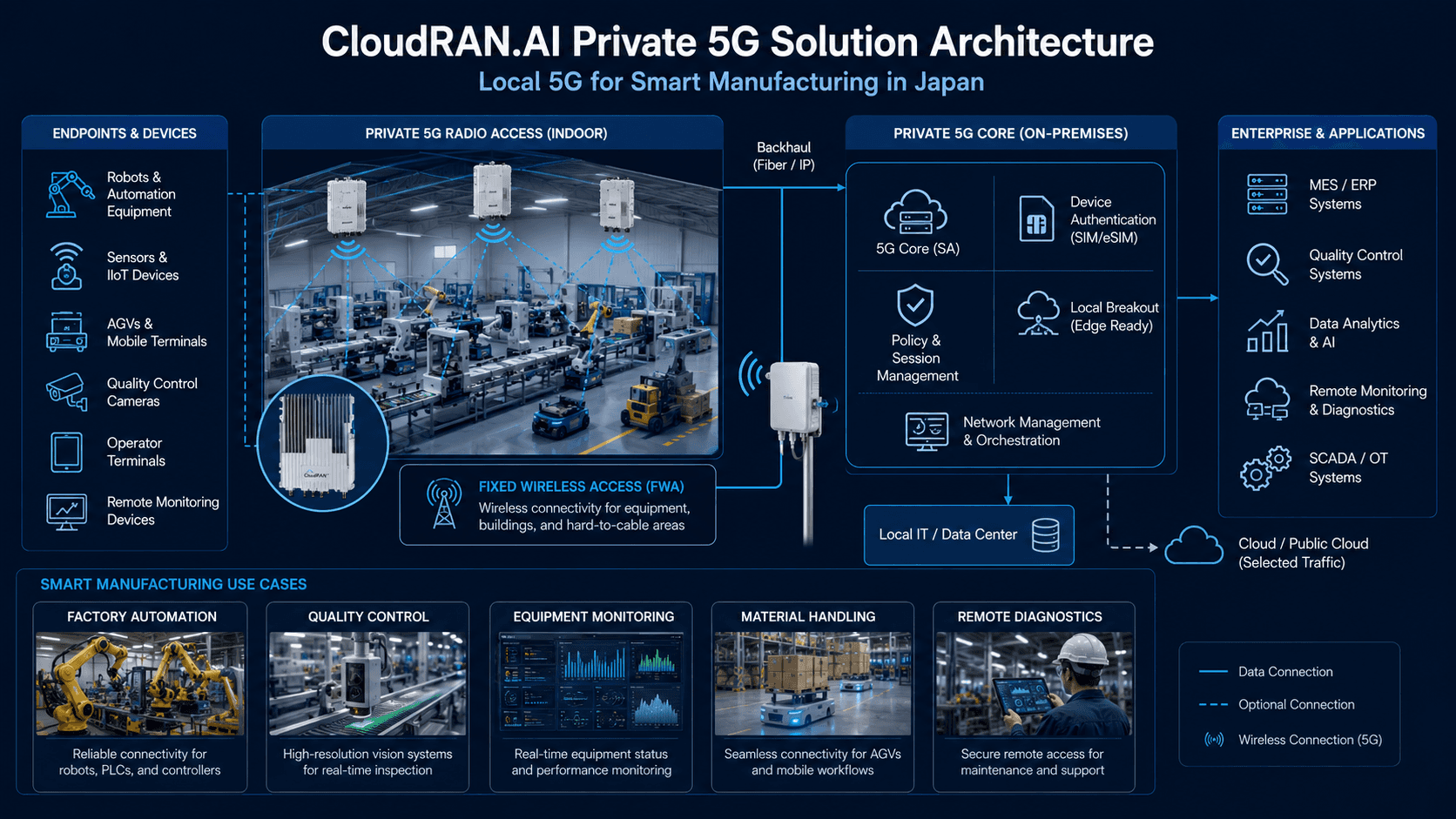
A CloudRAN.AI private 5G architecture for smart manufacturing typically includes:
Private 5G radio units for indoor factory coverage
5G SA core for dedicated local network control
Fixed Wireless Access endpoints or CPEs for equipment connectivity
SIM/eSIM-based device access control
Local breakout for factory systems and low-latency applications
Backhaul connectivity to enterprise IT, cloud platforms, or operational systems
Centralized operations and management tools
Support for production, logistics, monitoring, and quality-control applications
The network creates a dedicated wireless layer inside the factory. Devices and applications can connect through a private 5G environment rather than relying solely on shared Wi-Fi or fixed cabling.
5G Radio Coverage
The radio layer provides controlled indoor coverage across production and logistics areas. In factories, radio coverage must account for metal structures, machine layout, line-of-sight limitations, moving equipment, and dense operational zones.
Private 5G allows the factory to plan coverage around production requirements, not just general office connectivity. This makes it suitable for industrial zones where coverage consistency and device mobility matter.
Fixed Wireless Access
FWA is a key part of the solution. Instead of installing new wired connections for every production area, the factory can use 5G-enabled connectivity to reach equipment, workstations, and sensors.
This improves layout agility. If a production cell is moved or a new line is introduced, connectivity can be reconfigured more quickly than traditional cabling.
For manufacturing sites that frequently adjust production layouts, FWA can reduce both deployment friction and long-term infrastructure complexity.
Private 5G Core
The private 5G core provides network control functions such as device authentication, session management, mobility management, user-plane routing, and policy control.
For industrial environments, this is important because the factory needs predictable and secure access for approved devices. Unlike open or shared wireless networks, private 5G can use SIM/eSIM provisioning to control which devices connect to the network.
Local Breakout and Edge Readiness
Local breakout allows selected factory traffic to remain close to the production environment instead of routing unnecessarily through remote cloud paths. This is important for applications that benefit from lower latency, such as monitoring dashboards, quality-control systems, equipment diagnostics, and local industrial platforms.
The architecture is also edge-ready, meaning it can support future integration with edge computing, AI inspection, or real-time production analytics.
Management and Operations
Manufacturing networks must be operationally manageable. CloudRAN.AI’s solution supports centralized network management, configuration, monitoring, and lifecycle operations.
For the customer, this provides a foundation for operating private 5G as part of the factory’s production infrastructure rather than as a standalone experimental network.
Performance Comparison
The deployment helped improve several key connectivity dimensions compared with the customer’s legacy network environment.
Indicator | Legacy Network | After Private 5G | Impact |
|---|---|---|---|
Coverage | Limited indoor Wi-Fi | Full indoor + FWA coverage | Improved operational range |
Network flexibility | Wired connections | Wireless, reconfigurable | Greater layout agility |
Reliability | Unstable in dense areas | Industrial-grade stability | Fewer interruptions |
Deployment cost | Extensive cabling | Simplified infrastructure using FWA + Private 5G | Reduced setup and O&M cost |
The result was not just better wireless access. It was a more flexible manufacturing connectivity model.
Why Coverage Matters in Smart Manufacturing
In a factory environment, coverage gaps are operational blind spots.
If a quality-control terminal, sensor, or mobile workstation loses connectivity, production visibility is reduced. If a logistics device cannot stay connected while moving through the factory, material flow becomes harder to track. If monitoring equipment drops offline, faults may not be detected quickly.
Consistent indoor private 5G coverage supports a stronger operational baseline. It gives production teams more confidence that connected devices can remain online across the areas where they are needed.
For factories with dense equipment and difficult RF conditions, this is a major advantage over best-effort wireless connectivity.
Why Flexibility Matters for Industrial Wiring Manufacturing
Industrial wiring systems are often produced through complex workflows involving cutting, routing, assembly, inspection, testing, packaging, and logistics. Production lines may need to adapt to different product types, order volumes, or customer requirements.
A wired-only network model can slow down layout changes. Moving equipment may require new cable runs, switch capacity planning, physical installation, and downtime coordination.
Private 5G with FWA gives the factory a more flexible connectivity layer. Production cells, inspection stations, and monitoring devices can be connected or repositioned with less dependence on fixed wiring.
For a manufacturer that needs to improve production agility, this can directly support faster line reconfiguration and more scalable automation.
Why Reliability Matters for Automation and Quality Control
Automation depends on predictable connectivity. When factory devices communicate intermittently or lose connection in dense areas, automated workflows become harder to trust.
Private 5G supports more stable industrial connectivity through controlled spectrum use, managed device access, stronger mobility support, and centralized network control.
For quality-control workflows, reliability is particularly important. Inspection data, test results, machine status, and process information must be captured consistently. Missing or delayed data can affect traceability and defect prevention.
By improving network stability, private 5G helps support data-driven quality control and more reliable production visibility.
Reducing Cabling Complexity with FWA
Cabling is reliable, but it is not always flexible.
In manufacturing sites, cabling can become expensive and operationally disruptive when production areas change. New cable routes may require downtime, physical installation, safety planning, and coordination with production teams.
Fixed Wireless Access gives the factory an alternative for selected use cases. Instead of extending cable to every new location, the factory can use private 5G connectivity to support equipment, sensors, or workstations.
This can reduce setup cost, shorten deployment timelines, and simplify operations and maintenance.
FWA is especially valuable in:
Temporary production areas
Reconfigurable assembly zones
Logistics and warehouse areas
Hard-to-cable indoor spaces
Mobile or semi-mobile equipment
Sensor and monitoring deployments
Factory expansion projects
For the Japanese manufacturer, this helped create a more agile smart factory network architecture.
Smart Manufacturing Applications Enabled
The CloudRAN.AI private 5G deployment supports a range of manufacturing applications.
Factory Automation
Connected automation equipment can use private 5G as part of a controlled industrial network. This supports greater flexibility for automated production equipment, especially where wired installation is difficult or where layout changes are frequent.
Remote Equipment Monitoring
Equipment status, alarms, utilization data, and maintenance indicators can be transmitted to monitoring systems through the private 5G network. This improves visibility and supports faster response to issues.
Data-Driven Quality Control
Inspection systems, sensors, and production terminals can send quality data through a dedicated network layer, supporting better traceability and process control.
Logistics and Material Flow
Factory logistics areas can benefit from wireless connectivity for handheld terminals, scanners, mobile devices, warehouse tools, and material tracking systems.
Industrial IoT
The network provides a platform for connecting sensors, monitoring devices, environmental systems, and future industrial IoT endpoints.
Remote Diagnostics
Maintenance teams can use connected devices and monitoring platforms to support remote troubleshooting and diagnostics, reducing the need for manual inspection in every case.
Event and Large-Site Relevance
Although this deployment is focused on manufacturing, the technical pattern is relevant to other large-site environments, including events, venues, logistics hubs, ports, and temporary operational sites.
Manufacturing sites and event venues share several connectivity challenges:
Many connected devices across a defined physical area
Operational workflows that depend on reliable network access
Need for rapid deployment or reconfiguration
Coverage challenges in complex environments
Mixture of fixed, mobile, and semi-mobile devices
Requirement for secure access control
Need to separate critical operational traffic from best-effort public connectivity
In a factory, the key workflows may be automation, quality control, and monitoring. In a large event, they may be payments, access control, staff communications, and production systems. In logistics, they may be scanners, vehicles, cameras, and warehouse platforms.
The underlying need is similar: a dedicated private wireless network that supports operational continuity.
CloudRAN.AI’s private 5G architecture is therefore applicable across multiple verticals, from smart manufacturing to large events and industrial campuses.
CloudRAN.AI Product Fit
CloudRAN.AI’s private 5G portfolio is designed to help enterprises deploy dedicated wireless networks in production environments.
For smart manufacturing, the relevant capabilities include:
Private 5G radio access for indoor and industrial coverage
5G SA core for dedicated local network control
Fixed Wireless Access for flexible equipment connectivity
SIM/eSIM onboarding for secure device access
Local breakout for responsive factory systems
Centralized monitoring and operations management
Compact base station and radio deployment models
Support for production, logistics, IoT, and monitoring workflows
Edge-ready architecture for future AI and analytics use cases
The solution is designed to make private 5G practical for industrial sites that need reliable connectivity without excessive deployment complexity.
From Connected Factory to Future-Ready Manufacturing Platform
The Japanese manufacturing deployment shows how private 5G can support the evolution from traditional factory connectivity to a future-ready smart manufacturing platform.
At the first level, private 5G improves coverage. It gives production and logistics areas more consistent wireless access.
At the second level, it improves flexibility. Equipment, workstations, and sensors can be connected with less dependence on fixed cabling.
At the third level, it improves reliability. Industrial workflows become less vulnerable to unstable wireless coverage in dense areas.
At the fourth level, it creates a platform for future applications. Once the private 5G foundation is in place, the factory can add more IoT devices, automation systems, quality-control tools, monitoring applications, and edge analytics.
This progression is central to smart manufacturing. Connectivity is not the final outcome. It is the infrastructure that enables the next layer of operational transformation.
Conclusion
The Japanese smart manufacturing deployment demonstrates how CloudRAN.AI Private 5G can help industrial enterprises modernize factory connectivity.
By combining indoor private wireless coverage with Fixed Wireless Access, the customer improved operational range, increased network flexibility, enhanced reliability, and reduced dependence on extensive cabling.
For manufacturers, this matters because production environments are becoming more dynamic, more automated, and more dependent on real-time data. A factory network must be able to support that shift.
CloudRAN.AI Private 5G provides a dedicated, secure, and scalable connectivity layer for smart manufacturing — helping industrial sites move toward more flexible, connected, and future-ready operations.