Case Study
Private 5G for Smart Hospitals in the Netherlands: Reliable Indoor Mobility, Voice-Grade Connectivity, and Scalable Digital Care Infrastructure
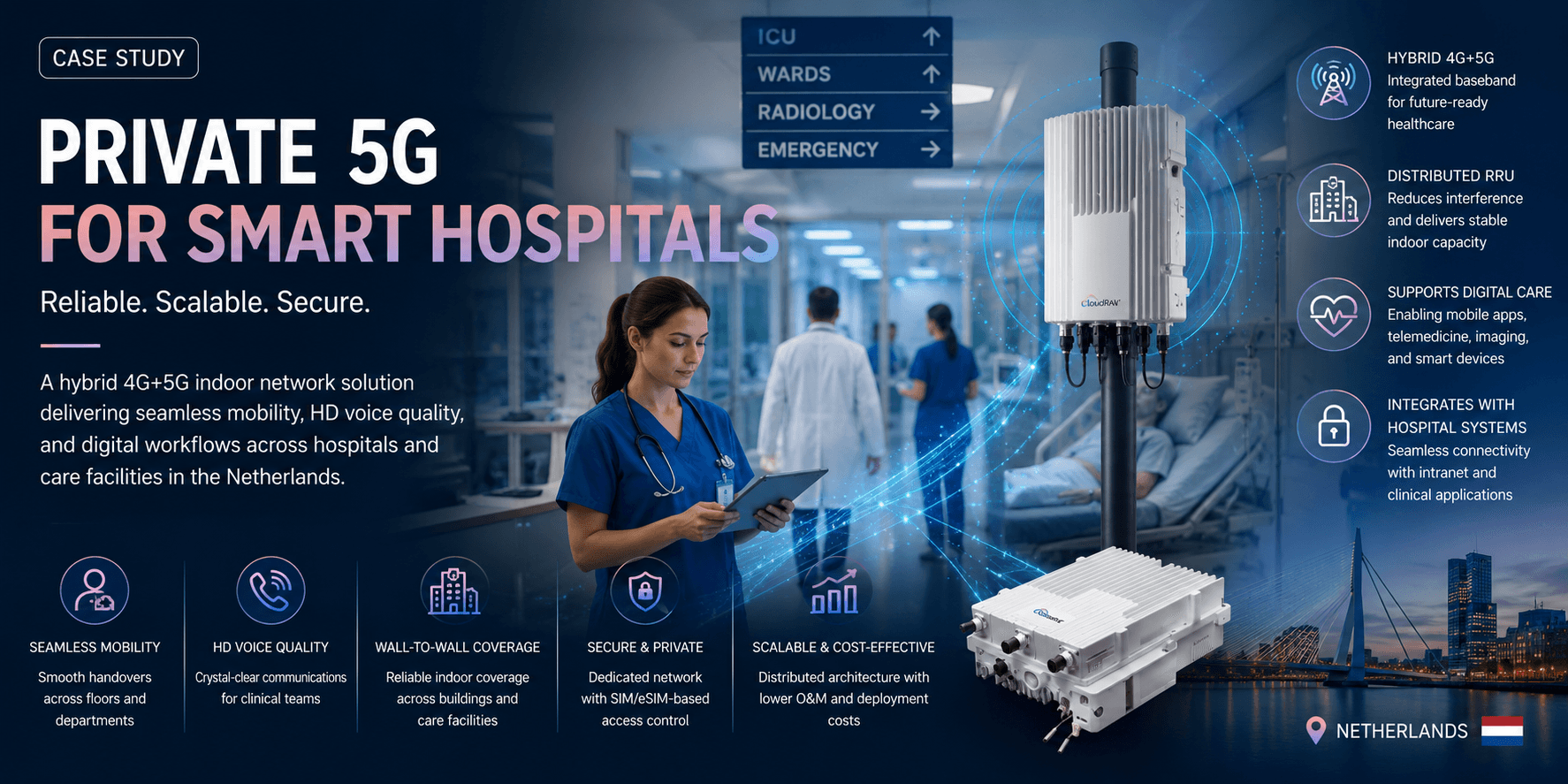
How CloudRAN.AI Private 5G Helped a Netherlands-Based Hospital Customer Deploy Reliable 4G+5G Indoor Coverage Across Healthcare Facilities
Hospitals are among the most demanding indoor connectivity environments. Clinical teams move continuously across rooms, corridors, wards, imaging areas, operating spaces, emergency zones, and administrative departments. Medical devices, mobile apps, communications systems, digital workflows, imaging platforms, and patient-care applications all depend on reliable connectivity. At the same time, hospitals are dense, interference-sensitive, heavily regulated environments where network downtime or poor indoor coverage can directly affect operational efficiency and care delivery.
A Netherlands-based hospital customer partnered with CloudRAN.AI to deploy a hybrid 4G+5G indoor private network solution across hospitals and care facilities. The objective was to provide stable indoor coverage, seamless mobility and handover, HD voice-grade call quality, and scalable connectivity across buildings and floors — while reducing interference and simplifying deployment compared with traditional distributed indoor systems.
CloudRAN.AI’s distributed small-cell solution provided a cost-effective private wireless layer designed for healthcare environments where reliable indoor mobility, wall-to-wall coverage, and integration with hospital systems are essential.
Customer Profile
Industry: Healthcare
Customer type: Hospitals and care facilities
Location: Netherlands
Deployment environment: Indoor hospital and healthcare facility coverage
Technology model: Hybrid 4G+5G indoor private network
Core use cases: Clinical communications, mobile workflows, hospital intranet access, indoor mobility, HD voice, digital care applications, scalable coverage across buildings and floors
The customer operates in a healthcare environment where connectivity is no longer a background IT service. It is part of the clinical and operational infrastructure.
Hospitals increasingly depend on digital systems for:
Clinical communication
Nurse and doctor mobility
Patient-care coordination
Medical records access
Imaging and diagnostics workflows
Telemedicine and remote consultation
Asset tracking and indoor operational visibility
Mobile apps and hospital intranet access
Emergency response coordination
Facility operations and security
In this environment, unstable indoor connectivity creates friction across the care workflow. A dropped voice call, delayed message, disconnected mobile app, or coverage gap inside a care area can reduce productivity and create avoidable operational risk.
Healthcare Connectivity Challenge
Hospital connectivity is difficult for several reasons.
First, hospitals are physically complex. Thick walls, reinforced structures, multiple floors, medical rooms, elevators, basements, treatment areas, imaging zones, and equipment-dense environments all make indoor RF planning challenging.
Second, mobility is continuous. Doctors, nurses, technicians, patients, visitors, and operational staff move across floors and departments. Network handover must be smooth enough to support voice, communications, and mobile workflows without interruption.
Third, capacity requirements are growing. Hospitals are adding more connected devices, mobile workstations, patient systems, cameras, sensors, and clinical applications. The network must scale without becoming unstable in high-density areas.
Fourth, hospitals require strong reliability. Healthcare environments cannot accept the same best-effort assumptions as ordinary office Wi-Fi. Connectivity must support mission-relevant workflows, especially communications, imaging access, critical care coordination, and mobile clinical applications.
Fifth, the network must integrate with existing hospital systems. A private wireless solution needs to connect with hospital intranet, enterprise applications, security systems, and operational platforms without creating unnecessary complexity.
The customer required a private indoor wireless network that could deliver:
Seamless indoor mobility and handover
HD voice call quality
Scalable coverage across buildings and floors
Reduced interference in dense environments
Reliable wall-to-wall indoor coverage
Lower deployment and O&M costs
Integration with hospital intranet and systems
Support for current 4G devices and future 5G healthcare applications
Why Private 5G Matters in Healthcare
Healthcare facilities have historically relied on Wi-Fi, DECT systems, public mobile coverage, wired infrastructure, or distributed antenna systems to support indoor connectivity. Each has value, but each also has limits.
Wi-Fi can provide general connectivity, but it may struggle with mobility, roaming, interference, and predictable voice performance in large hospital environments. Public mobile coverage may not penetrate all indoor areas consistently and is not controlled by the hospital. Wired infrastructure is essential for fixed systems, but it cannot support mobile clinical workflows. Traditional distributed antenna systems can improve coverage but may require complex deployment and operational cost.
Private 4G/5G creates a dedicated mobile network layer inside the hospital. It gives the healthcare provider more control over coverage, device access, mobility, quality of service, and integration with internal systems.
For hospitals, private 5G is valuable because it supports:
Reliable clinical mobility
Stronger indoor coverage
SIM/eSIM-based device access
Better handover behavior than Wi-Fi in mobile scenarios
Voice-grade communications
Controlled network policies
Integration with hospital applications
Scalable digital health infrastructure
Future support for imaging, telemedicine, robotics, and IoT
Private 5G does not necessarily replace all hospital networks. Instead, it provides a dedicated connectivity layer for workflows where reliability, mobility, security, and coverage matter most.
Service Requirements
The hospital customer had four major service requirements.
1. Seamless Indoor Mobility and Handover
Clinical staff move continuously across hospital environments. A doctor may move from a patient room to a corridor, then to an imaging area, then to a consultation room. A nurse may move across wards while using a voice or messaging application. A technician may move equipment between floors and departments.
The network must support mobility without repeated disconnection, authentication delay, or voice interruption.
CloudRAN.AI’s integrated 4G+5G baseband architecture was designed to support seamless handover and reduce interruptions as users and devices move across indoor coverage zones.
2. HD Voice Call Quality
Voice remains critical in hospitals. Even as messaging and apps become more common, real-time voice communication is still essential for clinical coordination, urgent requests, emergency response, and staff collaboration.
Hospitals need voice-grade reliability: stable connectivity, consistent call quality, and minimal interruption. A poor-quality call in a hospital is not merely inconvenient. It can disrupt care coordination.
The private 4G+5G network was designed to support HD voice-grade call quality across indoor areas.
3. Scalable Coverage Across Buildings and Floors
Hospitals are multi-building and multi-floor environments. Coverage expansion must be practical. The solution needed to scale across different care facilities, departments, and indoor zones without requiring excessive cabling, hardware duplication, or complex RF redesign.
CloudRAN.AI’s distributed small-cell model supports smooth capacity expansion and scalable indoor deployment across buildings and floors.
4. Reduced Interference in High-Density Environments
Hospitals can contain many wireless systems operating in close proximity. Interference management is important, especially where dense device usage and multiple indoor coverage zones overlap.
The distributed RRU design reduces co-frequency interference and supports more controlled indoor network planning. This is important for maintaining stable performance as the network scales across larger facilities.
CloudRAN.AI Private 5G Solution
CloudRAN.AI deployed a hybrid 4G+5G indoor private network solution for hospitals and care facilities in the Netherlands.
The solution was designed to provide reliable indoor coverage, smooth mobility, scalable capacity, and integration with existing hospital systems.
The core solution components included:
Integrated 4G+5G baseband
Distributed RRU network
Indoor small-cell coverage design
Wall-to-wall indoor coverage architecture
Support for seamless handover
HD voice-grade connectivity
Integration with hospital intranet and systems
Lower-cost scalable deployment model
The network was deployed as a private wireless layer supporting current 4G workflows while preparing the hospital for future 5G use cases.
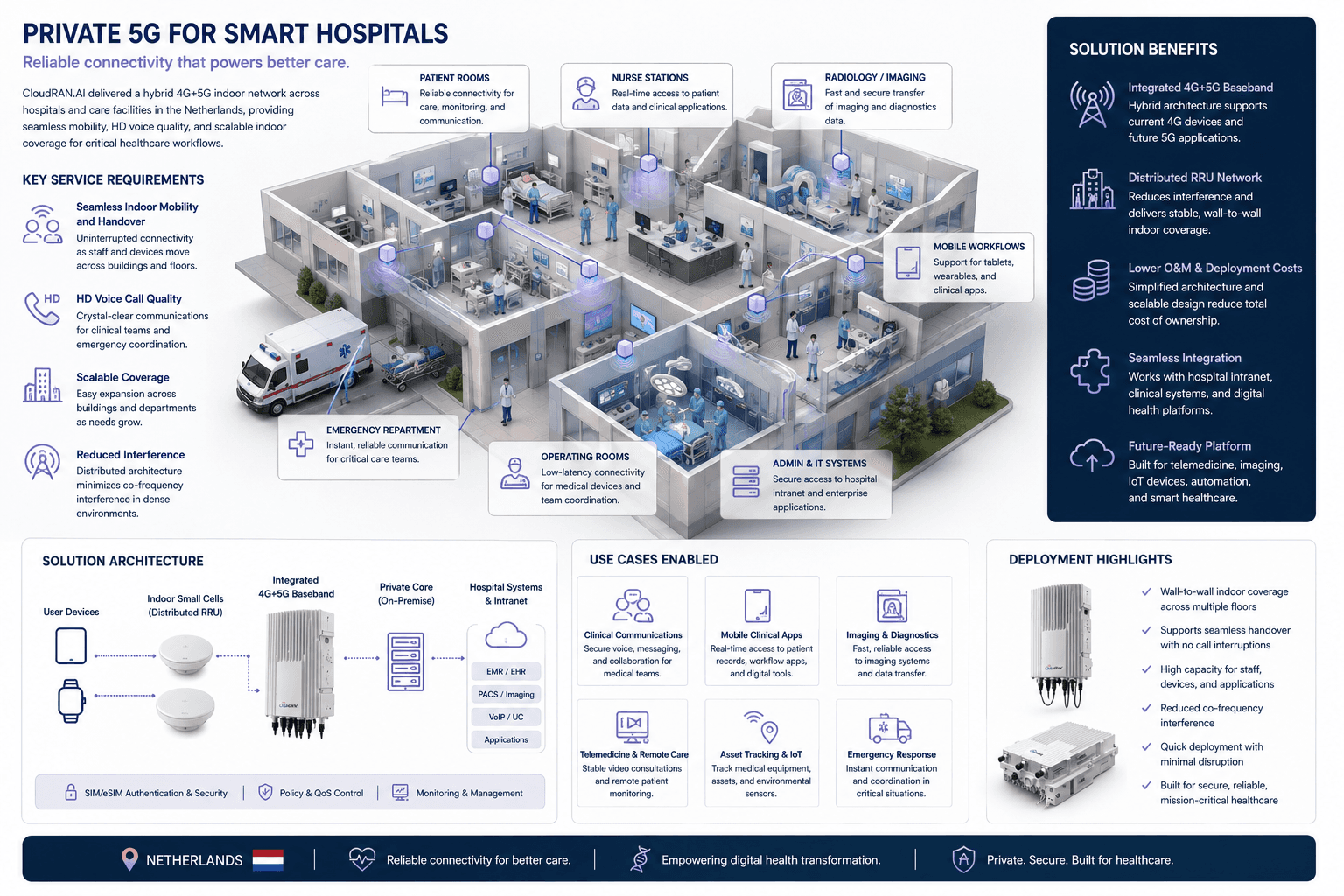
Solution Architecture
A CloudRAN.AI smart hospital private 5G architecture typically includes:
Indoor distributed radio units / small cells
Integrated 4G+5G baseband
Private core network functions
SIM/eSIM-based device authentication
Local breakout to hospital intranet and internal applications
Hospital IT and clinical system integration
Centralized operations and network management
Scalable coverage design across floors and buildings
The architecture gives hospitals a controlled wireless layer that can support both clinical and operational workflows.
Integrated 4G+5G Baseband
The integrated 4G+5G baseband allows the hospital to support existing 4G-compatible devices while preparing for 5G-capable healthcare applications. This is important because hospitals rarely replace all devices at once.
A hybrid architecture protects existing investments while allowing future migration.
It also helps reduce handover interruptions by creating a more integrated mobile coverage environment.
Distributed RRU Network
The distributed RRU network provides indoor coverage across rooms, corridors, wards, and public areas. This model supports flexible placement and better coverage control than relying on a small number of high-power indoor access points.
Distributed radios can improve signal availability in difficult indoor areas while reducing co-frequency interference through better radio planning.
For hospitals, this helps deliver reliable wall-to-wall coverage without excessive deployment complexity.
Private Core and Local Connectivity
A private core network provides device registration, authentication, session control, policy management, and traffic handling. For hospital environments, this supports secure device access and controlled routing into internal systems.
Local connectivity to hospital intranet and systems is essential. Clinical applications, internal communication tools, medical systems, and operational dashboards often need access to internal networks rather than public cloud services only.
CloudRAN.AI’s architecture supports integration with hospital intranet and systems, allowing private 5G traffic to serve real clinical workflows.
Indoor Mobility and Handover
Seamless mobility is one of the most important differentiators of private cellular networks in hospitals. Devices can move across radio zones while maintaining connectivity.
This is especially relevant for:
Voice calls
Staff communication devices
Mobile clinical apps
Workstations on wheels
Emergency response teams
Asset tracking devices
Connected medical carts
Security and facility operations
The goal is to make connectivity follow the clinical workflow.
Technical Advantages
Seamless Mobility Across Indoor Environments
Private 4G/5G is designed for mobility. Unlike Wi-Fi, where roaming performance can vary depending on client behavior and access point configuration, cellular handover is part of the core mobility design.
For hospitals, this supports a more reliable mobile experience across wards, corridors, operating areas, and multi-floor environments.
HD Voice-Grade Reliability
Clinical communication requires more than raw bandwidth. It requires low interruption, stable quality, and predictable handover.
The hybrid 4G+5G indoor network supports voice-grade service quality across indoor areas, making it suitable for hospital communication workflows.
Reduced Co-Frequency Interference
The distributed small-cell architecture helps reduce co-frequency interference, especially in dense indoor environments. This supports stable coverage and capacity expansion as more hospital departments or buildings are added.
Scalable Capacity Expansion
Hospitals need networks that can expand over time. A distributed indoor solution allows the hospital to add coverage and capacity where needed without redesigning the entire network.
This makes the deployment model suitable for phased hospital rollouts.
Integration with Hospital Intranet and Systems
The solution supports integration with existing hospital systems, making it possible to connect private wireless workflows to internal applications, databases, communication platforms, and operational systems.
This is essential because healthcare networks must support controlled, secure, and compliant access to internal infrastructure.
Healthcare Use Cases Enabled
The deployment supports multiple smart hospital use cases.
Clinical Communications
Doctors, nurses, and operational staff can use mobile communication tools across the facility with stronger indoor coverage and smoother mobility.
This supports faster coordination and fewer interruptions during care delivery.
Mobile Clinical Applications
Clinical teams increasingly use mobile apps for patient data access, task management, care coordination, medication workflows, and internal communication. Private 5G provides a more reliable wireless foundation for these mobile tools.
Imaging and Diagnostics Workflows
Hospitals generate and consume large volumes of imaging and diagnostic data. While fixed networks remain important for imaging systems, private 5G can support mobile viewing, image-related workflow coordination, and future wireless diagnostic applications.
Telemedicine and Remote Consultation
Private 5G supports stable video and communications for telemedicine, remote consultation, specialist support, and distributed care workflows.
In healthcare, stable video communication is particularly important because poor network quality affects both clinical experience and patient confidence.
Connected Medical Devices and Carts
Medical carts, monitoring devices, diagnostic equipment, and mobile workstations can benefit from reliable indoor connectivity. Private 5G helps keep these devices connected as they move across departments.
Asset Tracking and Facility Operations
Hospitals manage large numbers of mobile assets: beds, carts, equipment, wheelchairs, devices, and supplies. A private wireless layer can support tracking and operational visibility, especially when combined with IoT systems.
Emergency Response and Critical Care Coordination
In urgent care scenarios, communication and mobility matter. Reliable indoor coverage supports faster coordination between clinical staff, emergency teams, and operational departments.
Why Hospitals Need More Than Wi-Fi
Wi-Fi remains useful in hospitals, but it may not be sufficient for all workflows.
Hospital Wi-Fi networks often support staff devices, patient access, guest connectivity, medical equipment, administration, and facility systems at the same time. This can create congestion, management complexity, and inconsistent roaming performance.
Private 5G can complement Wi-Fi by taking on mobility-sensitive, reliability-sensitive, or operationally critical workflows.
The two networks can coexist:
Wi-Fi for general internet access and non-critical applications
Private 5G for clinical mobility, voice, critical communications, and managed devices
Wired networks for fixed medical systems and high-capacity infrastructure
Private 5G local breakout for hospital intranet-connected workflows
This layered network approach gives hospitals more control over service quality and operational reliability.
Cost and Deployment Considerations
Healthcare networks must be reliable, but they also need to be cost-effective and practical to deploy.
Traditional indoor coverage systems can involve heavy cabling, complex radio planning, and high O&M requirements. CloudRAN.AI’s distributed small-cell architecture is designed to simplify deployment and reduce operational complexity.
Key cost and deployment advantages include:
Lower O&M and deployment costs
Distributed coverage with scalable expansion
Reduced need for excessive hardware density
Simplified integration with existing systems
Support for phased deployment across buildings
Efficient indoor coverage design
Hybrid 4G+5G support to protect existing device investments
For hospitals, this matters because network modernization must often happen without disrupting care operations.
Security and Compliance Considerations
Healthcare environments require strong security and operational control. Patient data, clinical systems, and internal workflows must be protected.
Private 5G supports a controlled access model through SIM/eSIM authentication, dedicated network policies, and integration with hospital IT systems.
Potential security advantages include:
Managed device access
Separation of clinical and guest traffic
Controlled routing to hospital intranet
Support for private network policies
Reduced reliance on uncontrolled public networks
Centralized monitoring of private wireless devices
Better alignment with hospital IT governance
For healthcare providers, private wireless must not only be reliable; it must also fit within clinical security and compliance expectations.
Event and Large-Facility Relevance
Although this deployment focuses on hospitals, the technical pattern is relevant to many large-building and event environments.
Hospitals, convention centers, large events, stadiums, airports, and campuses share several connectivity challenges:
High-density indoor usage
Mobility across large physical areas
Need for reliable voice and video communications
Multiple user groups and device types
Requirement for secure operational networks
Need for scalable capacity expansion
Integration with internal systems
Coverage across rooms, corridors, floors, and public areas
In a hospital, the critical workflows include clinical communications, imaging, telemedicine, and care coordination. In an event environment, the workflows may include staff communication, payments, access control, broadcast operations, and public safety.
The underlying requirement is similar: reliable private wireless connectivity for operationally important workflows in a complex physical environment.
CloudRAN.AI’s private 5G architecture is therefore relevant not only to smart hospitals, but also to smart venues, enterprise campuses, major events, and mission-critical facilities.
CloudRAN.AI Product Fit
CloudRAN.AI’s private 5G portfolio is designed for enterprise and mission-critical environments where stable wireless connectivity is essential.
For smart hospital deployments, relevant capabilities include:
Hybrid 4G+5G private network support
Indoor small-cell and distributed RRU architecture
Integrated 4G+5G baseband
Private core network capabilities
SIM/eSIM device authentication
Seamless mobility and handover
HD voice-grade connectivity
Local breakout and hospital intranet integration
Centralized management and monitoring
Scalable coverage across buildings and floors
Reduced interference in dense environments
This makes the solution suitable for hospitals, care facilities, large campuses, and other indoor environments where connectivity supports critical workflows.
From Indoor Coverage to Smart Hospital Infrastructure
The Netherlands hospital deployment demonstrates how private 5G can support the evolution from basic wireless coverage to smart hospital infrastructure.
At the first level, private 5G improves indoor coverage and mobility.
At the second level, it supports reliable voice and clinical communications.
At the third level, it integrates with hospital systems and internal workflows.
At the fourth level, it creates a foundation for future applications such as telemedicine, mobile imaging access, connected medical devices, asset tracking, and AI-assisted hospital operations.
In this sense, private 5G is not only a network upgrade. It is a platform for healthcare digital transformation.
Conclusion
The Netherlands smart hospital deployment shows how CloudRAN.AI Private 5G can help healthcare providers build reliable, scalable, and secure indoor connectivity for modern care environments.
By deploying a hybrid 4G+5G indoor network with distributed RRUs, integrated baseband, and hospital-system integration, the customer improved indoor mobility, voice-grade call quality, scalable coverage, and interference management across healthcare facilities.
For hospitals, reliable connectivity is now part of the care infrastructure. It supports communication, imaging, telemedicine, mobile workflows, and future digital health applications.
CloudRAN.AI Private 5G helps hospitals move toward a more connected, mobile, and intelligent healthcare environment — built for reliable care, scalable operations, and secure digital workflows.