News & Insights
Private 5G for Live Sports Broadcasting: Latency, Architecture and Deployment

Private 5G for Live Sports Broadcasting: Latency, Architecture and Deployment
Live sports production is fundamentally a data-movement challenge.
Camera feeds, audio, telemetry, control signals and communications must travel from wherever the action is happening to an on-site or remote production environment. At the same time, cameras, vehicles and production teams may be moving across stadiums, racecourses, city streets or multiple venues.
Fibre remains central to professional broadcasting, while satellite, microwave, Wi-Fi, public mobile networks and bonded cellular systems each address different production requirements. Private 5G adds another option: a locally controlled wireless network that can be designed specifically around the coverage, mobility, uplink and operational requirements of an event.
Its role is not necessarily to replace every cable or contribution technology. Its value is in providing a dedicated wireless layer where mobility, rapid deployment, traffic control and reliable uplink performance matter.
What Is a Private 5G Contribution Network?
A contribution network transports live video, audio and associated data from the point of capture to the production environment.
In a Private 5G deployment, cameras and production equipment connect through a dedicated or restricted cellular network rather than relying entirely on public mobile coverage or venue Wi-Fi.
A typical workflow may include:
Cameras, microphones, drones or other production sources
A video encoder or IP production interface
A 5G router, modem or integrated user device
One or more indoor or outdoor 5G radio units
A local 5G Core controlling identity, sessions, traffic and mobility
An on-site edge or production environment
Fibre, satellite, microwave or internet backhaul to a remote production centre
Decoding, switching, processing and distribution systems
The resulting path might look like this:
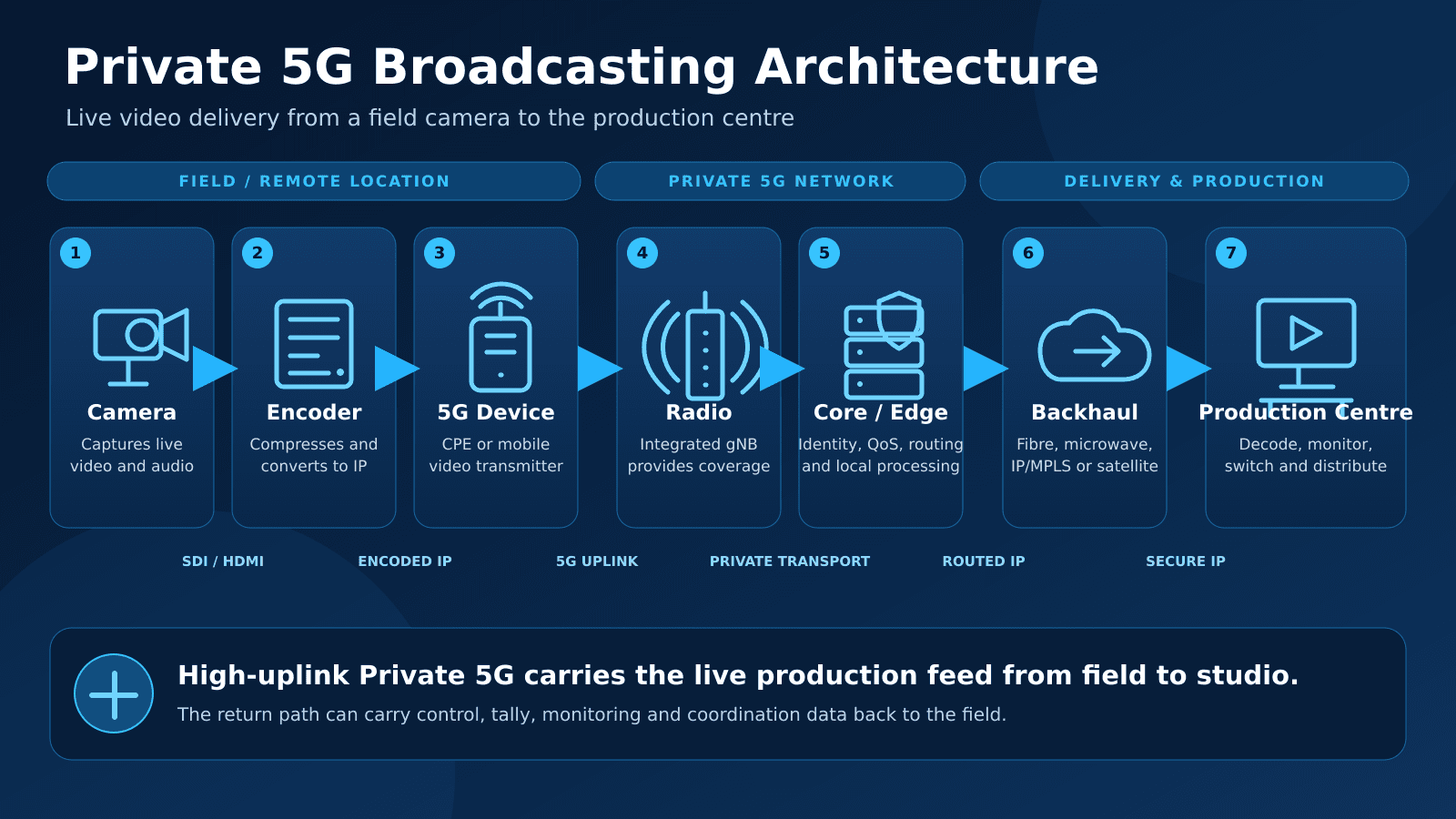
The private network may be completely independent or integrated with a mobile operator’s network. The appropriate model depends on spectrum availability, venue requirements, existing infrastructure and who will operate the service.
The Media Connectivity Association’s overview of non-public networks identifies dedicated uplink capacity, QoS, device onboarding, spectrum and time-sensitive communication as important considerations for media-production networks.
How Does Private 5G Latency Compare with Fibre, Public 5G and Satellite?
There is no single latency number that describes an entire broadcast workflow.
A statement such as “Private 5G delivers 5–10 milliseconds of end-to-end latency” is incomplete unless it defines the two endpoints and everything included in the measurement.
Complete glass-to-glass latency can include:
Camera capture and internal processing
Video encoding
The local radio connection
Routing through the 5G Core
On-site switching or edge processing
Backhaul to a remote production centre
Video decoding and production processing
Final encoding and distribution
Playback on the viewer’s device
Private 5G primarily influences the local wireless contribution component. It cannot remove delays introduced by encoding, remote transport, cloud processing or content distribution.
Private 5G
A properly engineered Private 5G network can provide low and comparatively consistent local access latency. Because the network is controlled for the production, radio resources, traffic policies and routing can be configured around video, audio and control requirements.
Local breakout can also keep traffic on-site when the production environment is located at the venue, avoiding unnecessary routing through an external operator network.
Fibre
Fibre generally provides extremely high capacity and consistent performance. It remains the preferred option for many fixed production positions and permanent venue connections.
Its limitation is operational rather than technological: cameras and production teams lose mobility when every position requires physical cabling. Temporary fibre installation can also take time and may be impractical across public roads, racecourses, historic buildings or changing event layouts.
Private 5G therefore often complements fibre. Wireless cameras may connect through Private 5G, while fibre carries the aggregated production traffic from the venue.
Public 5G
Public 5G provides broad coverage without requiring the production team to deploy its own complete network. However, capacity is shared with other subscribers, and the broadcaster may have limited control over uplink allocation, local coverage, device admission, routing and QoS.
Mobile operators may offer dedicated slices, priority services or temporary event infrastructure. These options should be evaluated on their own merits rather than assuming every public network will perform the same way.
Private 5G becomes particularly relevant when the production requires a locally controlled network with defined coverage and traffic policies.
Satellite
Satellite is commonly used for wide-area contribution and remote backhaul rather than as the local wireless connection between cameras and the venue network.
Latency varies considerably by satellite architecture. Geostationary satellites operate much farther from Earth and consequently introduce greater propagation delay, while low-Earth-orbit systems reduce that component. The International Telecommunication Union distinguishes between these architectures and their latency characteristics.
Private 5G and satellite can also work together. Private 5G may connect cameras and operational equipment across the event site, while satellite provides backhaul when terrestrial connectivity is unavailable.
The correct comparison is therefore not simply “Private 5G versus satellite.” It is whether each technology is being used for local access, venue transport, remote contribution or resilience.
Can Private 5G Replace Traditional Broadcast Cabling?
Private 5G can reduce cabling, but it does not make all physical infrastructure disappear.
Its strongest role is replacing or supplementing cables between mobile production sources and a local aggregation or production point.
This may include:
Roaming cameras
Cameras mounted on vehicles
Drones and robotic systems
Presenter and field-reporting positions
Temporary camera locations
Production teams working across a venue
Return video and equipment-control traffic
This can give directors and camera teams greater freedom to reposition equipment without installing a new cable path for every change.
However, power, backhaul and fixed production infrastructure are still required. Fibre may remain preferable for permanent positions, uncompressed high-capacity workflows, critical backbone links or systems that already have proven wired connectivity.
The practical objective is usually a hybrid production architecture:
Use fibre where fixed capacity and permanence are most important.
Use Private 5G where mobility and rapid deployment create operational value.
Use satellite, microwave or terrestrial IP backhaul where the event location requires it.
Maintain an independent contribution path when the production cannot tolerate a single point of failure.
Private 5G should therefore be evaluated as part of the complete production design—not as an automatic replacement for every existing connection.
What Infrastructure Is Required at a Venue?
The necessary infrastructure depends on the venue, production format, number of devices and required resilience.
1. Defined Production Requirements
Planning should begin with the workflow rather than the radio equipment.
The production team should document:
Number and location of cameras
Expected movement of cameras, vehicles and crews
Resolution, frame rate, codec and bitrate per feed
Audio, return video, tally and control requirements
Maximum acceptable latency and jitter
On-site or remote production location
Required service availability
Primary and backup contribution paths
2. Spectrum
The network needs authorized spectrum suitable for the country and event location.
Available models may include locally licensed enterprise spectrum, shared spectrum, temporary event assignments or spectrum provided through a mobile operator. Band availability, permitted power levels and licensing procedures vary by market.
Spectrum planning should be addressed early because it influences radio selection, device compatibility, coverage and deployment timing.
3. Radio Access Infrastructure
Indoor or outdoor radios provide coverage across the production area.
The design must account for:
Venue size and layout
Indoor and outdoor areas
Grandstands, tunnels, buildings and obstructions
Required uplink capacity
Camera and vehicle movement
Cell boundaries and handover
Mounting positions
Interference and neighbouring networks
A stadium, marathon route and motorsport circuit will require very different radio designs.
4. 5G Core and Local Routing
The 5G Core manages device authentication, sessions, mobility, traffic policies and routing.
For latency-sensitive workflows, a local user-plane function or integrated core can keep traffic close to the production environment. Cloud-managed functions may still provide remote configuration, monitoring and operational support.
5. 5G Devices and CPE
Each connected production source needs a compatible 5G interface.
This may be:
A 5G router connected to an encoder
An indoor or outdoor CPE
A portable 5G modem
An integrated camera or encoder with cellular support
A gateway connecting multiple local devices
A smartphone or tablet used for auxiliary production
Devices must support the selected spectrum band, SIM configuration and required throughput.
6. Production and Edge Systems
The private network must connect cleanly with the broadcaster’s existing environment.
This may include:
Video decoders
Production switchers
Monitoring systems
Recording and replay platforms
Media gateways
Edge-processing servers
Cloud-production platforms
Intercom, tally and camera-control systems
7. Backhaul
If production occurs remotely, the venue still needs a path to the production centre.
Possible backhaul options include:
Fibre
Managed IP connectivity
Microwave
Public internet with resilient transport
Satellite
Multiple independent links
The private radio network cannot compensate for an undersized or unreliable backhaul connection.
8. Power, Monitoring and Resilience
A production deployment should also include:
Stable power and appropriate backup
Network and device monitoring
Spare devices and replacement procedures
Redundant backhaul where required
Defined technical ownership
Pre-event testing and operational support
A documented fallback workflow
These elements determine whether a successful demonstration can become a production-ready service.
What Cameras, Encoders and Contribution Equipment Can Connect?
Private 5G is an IP transport layer. It does not normally require one particular camera or encoder brand.
A common configuration connects the camera to a professional encoder using SDI, HDMI or an IP interface. The encoder then connects to a 5G router or modem through Ethernet. The encoded stream crosses the private network and is received by an on-site or remote decoder, gateway or production platform.
Suitable encoding equipment should be evaluated for:
Supported camera inputs
Codec and resolution
Encoding latency
Configurable bitrate
Packet-loss recovery
Jitter handling
Encryption
Stream monitoring
Return video
Tally and intercom integration
Path redundancy
Compatibility with the receiving platform
Protocols such as SRT and RIST are designed to improve resilient low-latency video transport across IP networks. For managed production environments, SMPTE ST 2110 provides a standards-based framework for professional video, audio and data over IP, although bandwidth, synchronization and gateway requirements must be assessed carefully. SMPTE describes ST 2110 as a suite for accurately timed professional media flows over managed IP networks.
A bonded cellular encoder can also operate over Private 5G. In that arrangement, the private network may become one controlled contribution path alongside public mobile, wired or satellite connectivity.
The best encoder is therefore not determined by the words “Private 5G” on a specification sheet. It is the encoder that meets the production’s latency, quality, protocol, monitoring and resilience requirements within the sustainable uplink capacity of the network.
Before an event, the complete camera-to-decoder workflow should be tested under realistic radio load and movement—not only on an idle network.
Why Use Private 5G Instead of Public 5G at a Crowded Event?
Public 5G and Private 5G solve related but different problems.
A public network is designed to serve a large and changing population across a broad area. A Private 5G network is designed around a defined organization, site or production.
For live events, Private 5G can offer several operational advantages.
Dedicated Site Coverage
The network can be planned around the places where production work actually happens, including camera positions, mixed zones, tunnels, service areas, race routes and temporary compounds.
Controlled Device Access
SIM-based authentication limits network access to approved cameras, routers, production systems and staff devices.
Uplink-Oriented Design
Consumer networks often carry considerably more downlink than uplink traffic. A production network can be dimensioned and, where supported, configured around sustained video contribution from multiple devices.
Defined Traffic Priorities
QoS policies can distinguish between critical camera feeds, control traffic, communications and routine operational data.
This does not create unlimited capacity. It helps ensure that available resources are applied according to production priorities.
Local Processing and Routing
Traffic can remain within the venue when production and edge systems are on-site. This can reduce unnecessary external routing and provide greater control over the workflow.
Operational Visibility
The network team can monitor connected devices, radio conditions, traffic use and service performance from the perspective of the production.
These advantages do not mean Private 5G is automatically the right choice. It introduces its own requirements for spectrum, radio planning, equipment, integration and technical support. Public 5G may remain sufficient where coverage is strong, capacity is available and the production does not need dedicated control.
How Can Private 5G Improve Work at Large Live Events?
The potential benefit is not limited to picture quality.
A controlled wireless layer can simplify several parts of event operations:
Camera positions can be changed with less recabling.
Production teams can deploy temporary locations more quickly.
Multiple venues can use a consistent connectivity model.
Cameras, vehicles and field teams can remain connected while moving.
Production and network teams gain greater visibility into device performance.
Video, communications and operational systems can share infrastructure while retaining different policies.
The same network may support cameras, security, staff devices, sensors and temporary operational systems.
These benefits should be translated into measurable operational outcomes, such as installation time, cabling requirements, number of mobile camera positions, staffing, setup complexity and recovery time when a link fails.
How Should Broadcasters Evaluate Private 5G as a Primary or Backup Link?
A successful trial is not sufficient evidence that a network is ready to become a primary contribution path.
Evaluation should cover the complete production workflow.
Establish an End-to-End Latency Budget
Measure every major component separately:
Camera processing
Encoding
5G radio and core
Local routing
Backhaul
Decoding
Production processing
This reveals where delay is actually being introduced.
Test Sustainable Uplink Capacity
Add the planned bitrate of every simultaneous feed, protocol overhead and operating headroom. Then test the network under realistic movement and interference conditions.
A short speed test is not an adequate substitute for sustained multi-camera testing.
Test Mobility
Move cameras and vehicles through the actual production area. Examine cell transitions, signal variation, packet loss, bitrate adaptation and recovery behaviour.
Test Failure Scenarios
Disconnect power, backhaul, a radio, an encoder or a network path during rehearsal. Confirm whether the production switches automatically, degrades gracefully or stops completely.
Define the Backup Path
A primary Private 5G contribution network may be protected by:
A second private radio path
Fibre
Public mobile connectivity
Microwave
Satellite
Local recording for later recovery
The backup should not depend on the same power, routing or backhaul component as the primary path.
Assign Operational Ownership
The broadcaster, venue, integrator, mobile operator and network supplier must understand who is responsible for spectrum, setup, monitoring, first-line support and incident resolution.
Begin with a Bounded Use Case
Rather than moving the entire production at once, a broadcaster can begin with selected mobile cameras, auxiliary feeds or a defined venue area. Performance and workflow data from that deployment can then support a larger production decision.
Private 5G can serve as a primary link when the architecture, capacity, resilience and support model justify it. It can serve as a backup or complementary path when flexibility is more important than replacing the existing contribution backbone.
Private 5G in Live Sports: What Has Been Demonstrated?
Private 5G has moved beyond laboratory demonstrations into real production and event environments.
FISU World University Games in Germany
During the Rhine-Ruhr 2025 FISU World University Games, CloudRAN.AI Private 5G infrastructure supported live broadcasting workflows across outdoor and indoor sporting environments.
The deployments included coverage for a half-marathon and mobile video contribution from basketball venues in different German cities. The network provided dedicated wireless connectivity for production equipment and uplink-heavy live video workflows.
Read the FISU Private 5G broadcasting case study.
High-Speed Motorsport in Brazil
At a motorsport deployment in Brazil, CloudRAN.AI’s HyperCell architecture supported live onboard video from eight race cars travelling at speeds of up to 250 kilometres per hour.
The project demonstrated how coordinated radio coverage and mobility-aware network design can support high-uplink applications across a large, fast-moving event environment.
Explore the HyperCell motorsport case study.
BBC Coronation Contribution Network
For the coronation of King Charles III, the BBC worked with industry partners on a dedicated 5G contribution network used by multiple broadcasters. More than 60 SIMs were connected, and the deployment included network monitoring and dynamic QoS for production cameras.
The EBU’s account of the project demonstrates the importance of device coordination, production-specific monitoring and traffic prioritization in a high-profile live environment.
These deployments used different architectures and addressed different production requirements. Together, they show that Private 5G can support live contribution when it is engineered as part of the complete broadcast workflow.
Frequently Asked Questions
How does Private 5G contribution latency compare with fibre or satellite?
Fibre normally provides highly consistent, low-latency fixed transport. Private 5G adds mobility and can provide a low-latency local wireless contribution layer, but total delay also includes encoding, routing, backhaul and decoding. Satellite latency depends heavily on the orbit and network architecture. The comparison should therefore use complete glass-to-glass measurements rather than comparing only one network segment.
Can Private 5G replace traditional broadcast cabling at a major venue?
It can replace or reduce cabling for mobile cameras and temporary production positions. Fixed fibre will often remain appropriate for backbone connections, permanent camera positions and very high-capacity production systems. Most venues will benefit from a hybrid architecture rather than a completely wireless design.
What infrastructure is required for a Private 5G contribution network?
A deployment generally requires authorized spectrum, radio coverage, a 5G Core, compatible SIMs and devices, camera or encoder connectivity, production integration, backhaul, power, monitoring and an operational support model. The exact configuration depends on the venue and production.
What are the advantages over public 5G for stadium broadcasting?
Private 5G can provide dedicated coverage, controlled device access, uplink-oriented capacity, configurable QoS, local routing and greater operational visibility. Public 5G may still be suitable where sufficient coverage and service assurance are available.
Which encoding platforms work with Private 5G?
Private 5G does not require a specific encoder brand. The encoder should provide appropriate camera inputs, codec support, low-delay operation, rate control, monitoring and resilient IP transport. Compatibility with SRT, RIST or the broadcaster’s existing contribution workflow may be more important than the underlying access network.
How can Private 5G make event-production teams more efficient?
It can reduce temporary cabling, make camera positions easier to change, support mobile teams and equipment, shorten deployment time and provide centralized visibility into connected production devices. These improvements should be measured against the existing workflow during a trial.
How should Private 5G be tested as a primary or backup contribution link?
Test the complete camera-to-production path under realistic load, movement and failure conditions. Measure sustained throughput, latency, jitter, packet loss, recovery and failover. A primary deployment should also include appropriate redundancy in power, radio coverage, core functions and backhaul.
Plan a Private 5G Broadcast Deployment
A useful assessment starts with the production—not a generic network package.
CloudRAN.AI can work with broadcasters, venues, production companies and integration partners to evaluate:
Venue coverage
Camera and device requirements
Uplink capacity
Mobility
Spectrum
Backhaul
QoS
Edge integration
Deployment time
Resilience and fallback requirements
Discuss a Private 5G broadcasting or live-event deployment.
Related Resources
Share This Event