Case Study
Connectivity for Manufacturing: Deterministic Private 5G for Factory Operations in the UK
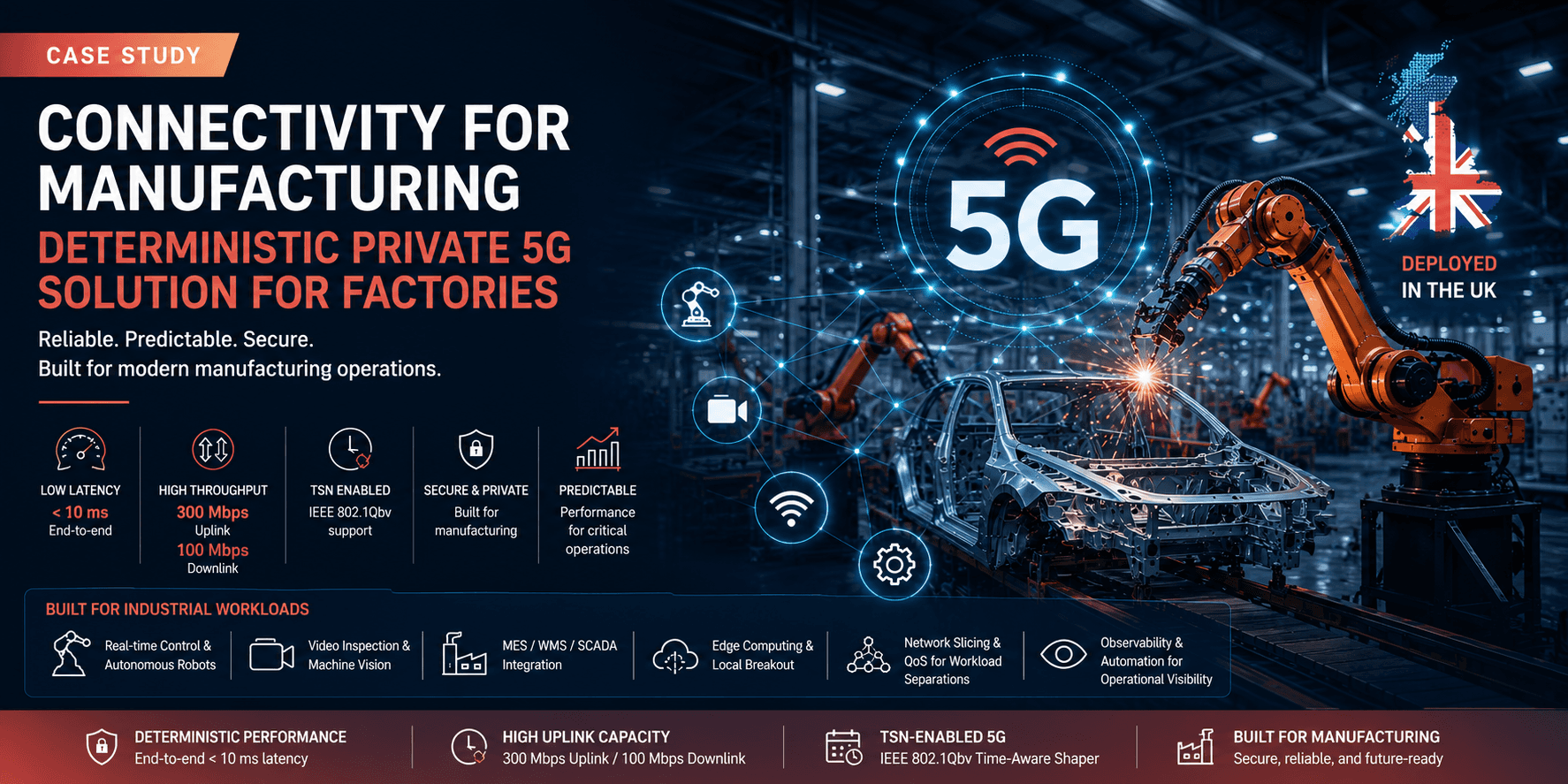
How CloudRAN.AI Delivered TSN-Enabled Private 5G for Predictable, Low-Latency Manufacturing Connectivity
Manufacturing environments are moving toward highly connected, software-defined, and automation-driven operations. Factory floors increasingly depend on autonomous robots, machine vision, industrial control systems, video inspection, mobile devices, sensors, and real-time production applications. As these systems become more connected, network performance becomes part of the production process itself.
For manufacturers, “wireless connectivity” is no longer only about coverage. The real requirement is deterministic performance: predictable latency, stable throughput, secure device connectivity, traffic separation, and integration with industrial applications such as MES, WMS, SCADA, machine vision, and automation systems.
In the United Kingdom, CloudRAN.AI delivered a deterministic private 5G solution for manufacturing environments. The deployment combined CloudRAN.AI’s private 5G RAN, 5G SA core, edge/local breakout, QoS profiles, TSN integration, and observability capabilities to support advanced factory workloads.
The solution was designed for production environments where downtime, jitter, and unpredictable wireless behavior are unacceptable.
Customer Profile
Customer: An enterprise manufacturing connectivity provider
Location: United Kingdom
Industry: Manufacturing connectivity / enterprise industrial networks
Role: Enterprise provider supporting manufacturing connectivity
Technology model: CloudRAN.AI Private 5G for deterministic factory connectivity
Core use cases: Real-time control, autonomous robots, video inspection, secure industrial connectivity, low-latency edge applications, TSN-enabled manufacturing operations
The customer supports manufacturing environments that require reliable wireless connectivity across complex production sites. These environments often contain dense equipment, high interference, mixed operational workloads, and strict service-level requirements.
The goal was to deliver private 5G connectivity that could support manufacturing operations with predictable performance and integration into industrial systems, rather than offering only best-effort wireless access.
Manufacturing Context: Why Deterministic Connectivity Matters
Modern manufacturing is increasingly dependent on connected operational technology.
A single factory may operate:
Autonomous mobile robots and AGVs
Robotic arms and production cells
PLC-connected systems
Machine vision inspection
Video analytics
Industrial cameras
Safety systems
Environmental sensors
Mobile operator terminals
MES and WMS platforms
SCADA and OT systems
Edge computing workloads
Quality-control systems
Digital twin and production monitoring tools
Each workload places different requirements on the network.
Video inspection requires high uplink throughput. Mobile robots require low latency and reliable mobility. Industrial control traffic requires predictability and traffic prioritization. Sensors require scalable device connectivity. Enterprise applications require integration with IT systems. Some workloads can tolerate delay; others cannot.
This is why manufacturing networks need more than generic broadband. They need performance segmentation, predictable QoS, low jitter, and deterministic traffic handling.
Private 5G is especially relevant because it can combine wide-area wireless coverage, mobility, secure device access, QoS control, local breakout, and integration with industrial Ethernet/TSN architectures.
The Challenge
Manufacturing facilities create one of the most difficult operating environments for wireless networks.
Dense Factory Floors with High Interference
Factories contain metal machinery, moving equipment, production lines, vehicles, racks, safety structures, and electrical systems. These elements can create reflections, shadowing, interference, and variable propagation conditions.
Wi-Fi may struggle in this environment, especially where many devices compete for shared spectrum or where roaming behavior varies by device. Public networks lack the site-specific control required for production systems.
The customer needed a private wireless architecture designed for dense factory floors and predictable service behavior.
Strict SLA Requirements for Latency, Throughput, and QoS
Manufacturing workloads often require strict service-level guarantees.
A robot control workflow may require low latency and low jitter. A machine vision system may require high sustained uplink throughput. A monitoring application may require reliable device availability. A production execution workflow may require secure connectivity to MES or SCADA systems.
The network had to support differentiated traffic treatment and predictable behavior across workloads.
Mixed Workloads
The deployment needed to support multiple workload types at the same time:
Real-time control
Autonomous robots
Video inspection
Industrial monitoring
Edge computing
Enterprise application integration
OT system connectivity
These workloads cannot all be treated the same. The network must separate and prioritize traffic according to operational requirements.
Manufacturing Operations Cannot Tolerate Network Disruption
In consumer or office connectivity, a short disruption may be inconvenient. In manufacturing, it can stop a workflow, interrupt quality inspection, delay production, or affect safety.
The network therefore had to support reliability, observability, and operational visibility, not just radio coverage.
Service Requirements
The manufacturing environment required a private 5G solution designed around deterministic performance and industrial integration.
Key requirements included:
Predictable low-latency connectivity
Stable uplink and downlink throughput
QoS profiles for workload separation
Network slicing for logical traffic segmentation
Support for real-time control and automation
High uplink capacity for video inspection
Integration with MES, WMS, SCADA, video, and enterprise applications
Edge computing and local breakout
TSN integration for industrial Ethernet bridging
Observability and automation/orchestration for operational visibility
Secure device connectivity
Simplified deployment and management
CloudRAN.AI Powered Private 5G Solution
CloudRAN.AI delivered a private 5G solution designed to support deterministic manufacturing connectivity.
The solution included:
5G SA core with edge computing / local breakout
Network slicing and QoS profiles for workload separation
Private 5G RAN and radios for site coverage and capacity
Integration with enterprise applications such as MES, WMS, SCADA, and video systems
Observability plus automation/orchestration for operational visibility
TSN-enabled 5G networking
DS-TT and NW-TT integration for TSN bridging
Ethernet PDU session support between UE and 5G core
SIB9-enabled RAN for time synchronization support
The result was a private wireless architecture designed for predictable manufacturing performance.
Solution Architecture
A deterministic private 5G manufacturing architecture must bridge the gap between mobile wireless connectivity and industrial production systems.
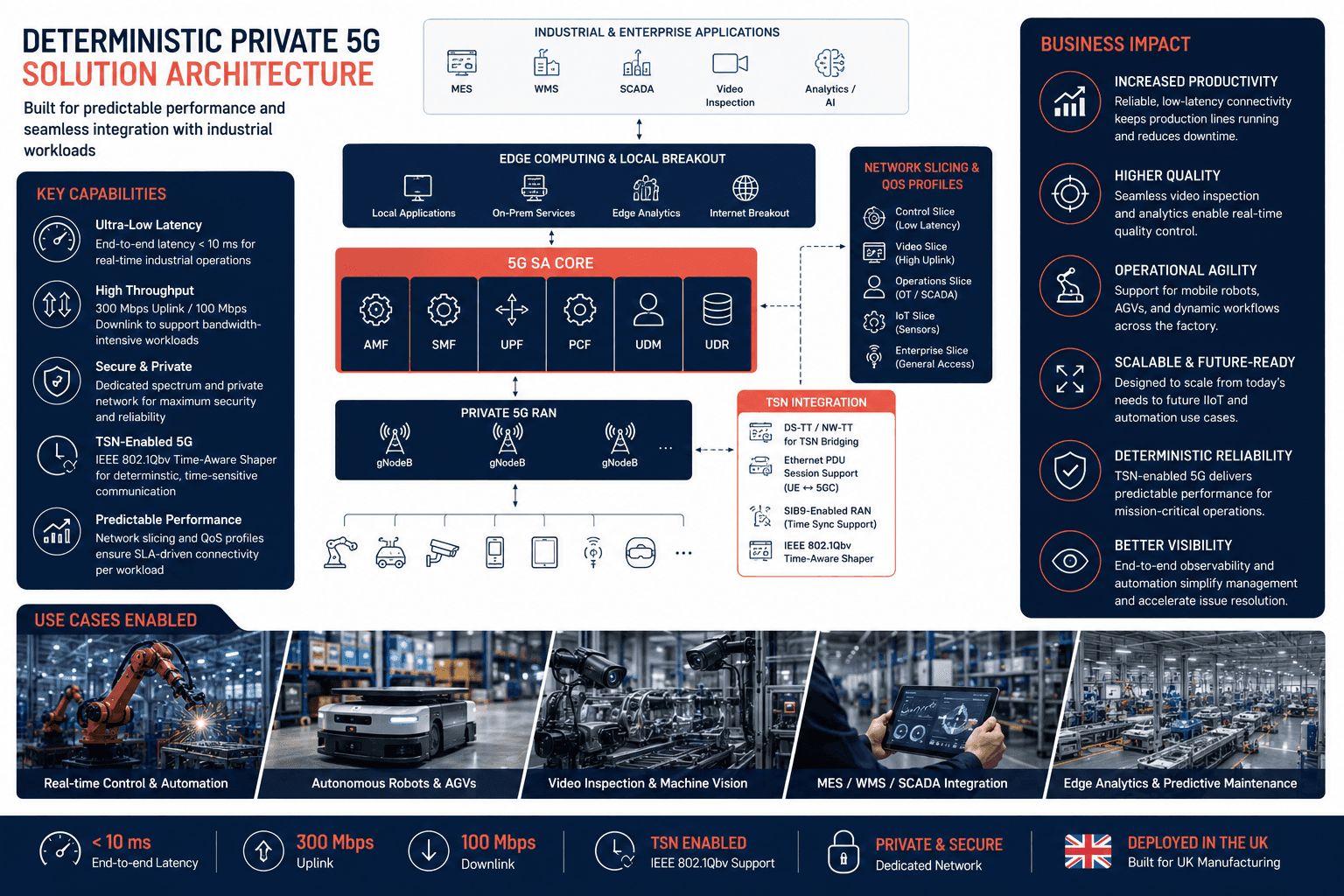
CloudRAN.AI’s architecture can be understood across six layers.
1. Private 5G RAN and Radios
The private 5G RAN provides site coverage and wireless capacity across the factory floor.
In manufacturing, radio planning must consider:
Production line layout
Machine density
Metal structures
Mobility paths
Robot or AGV routes
Camera placement
Interference zones
Uplink-heavy applications
Coverage requirements for critical operations
CloudRAN.AI private 5G radios provide a dedicated wireless layer for the site, giving the manufacturer more control than public networks or best-effort Wi-Fi.
2. 5G Standalone Core
The 5G SA core provides the control and user-plane functions required for private 5G operation. It enables device registration, authentication, session management, policy control, user-plane routing, and integration with application systems.
For manufacturing, 5G SA is important because it provides a stronger foundation for low-latency, QoS-controlled, and slice-aware operation than legacy architectures.
3. Edge Computing and Local Breakout
Local breakout allows critical factory traffic to remain on-site or close to the production environment.
This is important for:
Real-time control
Video inspection
Local analytics
SCADA integration
MES/WMS access
Low-latency application workflows
Edge AI inference
Operational dashboards
Instead of sending every data flow through a remote network path, local breakout keeps latency-sensitive traffic close to the production systems that need it.
4. Network Slicing and QoS Profiles
Manufacturing workloads have different performance requirements. Network slicing and QoS profiles allow the private 5G network to logically separate traffic and assign policies based on workload type.
Example workload segmentation:
Control slice: low-latency control traffic for automation and robots
Video slice: high-uplink traffic for machine vision and inspection cameras
Operations slice: MES/WMS/SCADA connectivity
IoT slice: sensors and monitoring devices
Enterprise slice: non-critical applications and staff devices
This structure helps prevent one workload from degrading another. Video inspection traffic, for example, should not interfere with real-time control traffic.
5. TSN Integration
Time-Sensitive Networking is critical for deterministic industrial communication. TSN provides standards-based mechanisms for time synchronization, scheduled traffic, and bounded latency in Ethernet-based industrial networks.
CloudRAN.AI’s solution supports end-to-end TSN-enabled 5G networking with IEEE 802.1Qbv support.
IEEE 802.1Qbv, also known as the Time-Aware Shaper, allows scheduled traffic transmission based on time gates. In industrial environments, this helps ensure that high-priority traffic can be transmitted within predictable time windows.
The solution also supports DS-TT and NW-TT integration for TSN bridging.
DS-TT: Device-Side TSN Translator
NW-TT: Network-Side TSN Translator
Together, these functions allow the 5G network to participate in TSN-based industrial Ethernet architectures, bridging wireless 5G segments with deterministic wired industrial networks.
6. Enterprise and OT Application Integration
The private 5G network integrates with enterprise and operational applications, including:
MES
WMS
SCADA
Video inspection systems
Industrial monitoring platforms
Edge computing platforms
Production analytics systems
Automation and orchestration tools
This is essential because manufacturing value is not created by connectivity alone. The network must connect production data, machines, and applications into operational workflows.
Technical Feature: TSN-Enabled Private 5G
The strongest technical differentiator in this deployment is the TSN-enabled private 5G capability.
Traditional wireless networks are usually probabilistic. They may provide good average performance, but they do not always guarantee deterministic behavior.
Manufacturing control systems, however, often need bounded latency and predictable timing. This is where TSN becomes important.
IEEE 802.1Qbv Support
The deployment supports IEEE 802.1Qbv, which enables time-aware scheduling of traffic. This allows critical traffic to be transmitted during scheduled windows, reducing contention and improving predictability.
In a factory, this matters for control loops, coordinated machine operations, and time-sensitive automation tasks.
DS-TT and NW-TT Integration
DS-TT and NW-TT allow the 5G system to bridge TSN domains.
This means 5G can be integrated into industrial Ethernet environments rather than existing as a disconnected wireless overlay.
For manufacturers, this is important because many production systems still rely on Ethernet-based industrial communication. The value of private 5G increases when it can interwork with those systems in a deterministic way.
Ethernet PDU Session Support
Ethernet PDU session support allows the UE and 5G core to carry Ethernet traffic through the 5G system.
This is important for industrial devices and systems that depend on Ethernet-based communication models.
Instead of forcing all applications into IP-only models, Ethernet PDU sessions support better compatibility with industrial networking requirements.
SIB9-Enabled RAN
SIB9 is related to time information broadcast in the radio network. A SIB9-enabled RAN can support time synchronization functions that are important for coordinated industrial applications and TSN-related use cases.
For manufacturing, time synchronization is not a minor feature. It is part of the foundation for deterministic communication.
Performance Results
The deployment achieved strong technical outcomes for manufacturing connectivity.
Latency
End-to-end latency: <10 ms
This level of latency supports time-sensitive manufacturing workflows, including real-time control, robot coordination, and edge-assisted automation.
For factory operations, the importance is not only low latency but predictable low latency. Private 5G with TSN support helps move the network closer to deterministic behavior.
Throughput
300 Mbps uplink / 100 Mbps downlink
This throughput profile is particularly relevant because manufacturing use cases are often uplink-heavy. Video inspection, machine vision, sensor data, and monitoring streams frequently require upstream capacity from the factory floor to edge or enterprise systems.
The 300 Mbps uplink capacity supports high-bandwidth industrial video and inspection workflows.
TSN-Enabled Networking
End-to-end TSN-enabled 5G network with IEEE 802.1Qbv support
This enables the solution to support deterministic industrial communication and integration with time-sensitive factory systems.
Manufacturing Use Cases Enabled
Real-Time Control
Low-latency private 5G supports real-time control workflows where machines, robots, or mobile assets require responsive communication.
While not every control loop should be moved over wireless, private 5G can support selected control and supervisory workflows where mobility and flexibility are required.
Autonomous Robots and AGVs
Autonomous robots and AGVs require reliable coverage, mobility, and consistent communication across the factory floor.
Private 5G supports mobility better than many Wi-Fi-based deployments, especially in environments where robots move across wide or obstructed production zones.
Video Inspection and Machine Vision
Video inspection requires high uplink throughput and stable connectivity. Industrial cameras may send continuous video streams to edge computing systems or quality-control platforms.
The 300 Mbps uplink capacity in the deployment is especially valuable for this use case.
MES/WMS Integration
Manufacturing execution and warehouse management systems depend on reliable data exchange from production and logistics areas.
Private 5G supports mobile terminals, scanners, workstations, robots, and connected equipment that interact with MES and WMS workflows.
SCADA and OT Connectivity
SCADA systems require reliable communication with field devices, equipment, and monitoring systems. Private 5G can support secure wireless access for selected SCADA-related workflows, especially where wiring is difficult or where mobility is required.
Edge AI and Analytics
With local breakout and edge computing support, the network can support edge AI workloads such as video analytics, defect detection, predictive maintenance, and real-time production monitoring.
Operational Visibility
Observability and automation/orchestration provide visibility into network performance, connected devices, traffic behavior, and service health.
This is important for manufacturing because network issues can become production issues. Operational teams need to see what is happening before it affects the factory floor.
Why QoS and Slicing Matter in Factories
Factories run mixed workloads, and mixed workloads create risk.
A high-bandwidth video inspection stream can consume significant uplink capacity. A mobile robot requires stable low-latency communication. A sensor network may generate many small data flows. Staff tablets may use general enterprise applications.
Without workload separation, one application can affect another.
Network slicing and QoS profiles allow the factory to apply different policies to different traffic classes.
For example:
Video inspection can receive high uplink capacity
Robot control can receive low-latency treatment
IoT sensors can receive scalable low-bandwidth connectivity
Enterprise traffic can be separated from production traffic
Critical operations can be prioritized over non-critical applications
This makes private 5G more suitable for industrial environments than generic wireless networks.
Why Private 5G Is Better Suited Than Wi-Fi for Deterministic Manufacturing
Wi-Fi has a role in factories, but it is not always suitable for deterministic manufacturing use cases.
Private 5G offers several advantages:
SIM/eSIM-based secure access
Better mobility and handover behavior
QoS control through 5G architecture
Network slicing support
Local breakout and edge integration
Wide-area coverage with fewer radio sites
Stronger support for uplink-heavy industrial applications
Better alignment with TSN and industrial networking evolution
Centralized control and observability
The goal is not to replace every Wi-Fi network. The goal is to use private 5G for the workloads where reliability, mobility, QoS, and deterministic behavior matter.
Solution Benefits
Predictable Performance
The deployment delivered <10 ms end-to-end latency and TSN-enabled networking, supporting factory applications that require consistent performance.
High Uplink Capacity
With 300 Mbps uplink throughput, the network can support bandwidth-intensive industrial workloads such as video inspection and machine vision.
Workload Separation
Network slicing and QoS profiles allow different traffic types to be separated and prioritized according to production needs.
Secure Connectivity
Private 5G provides a dedicated network layer for manufacturing operations, reducing dependence on public networks and uncontrolled wireless environments.
Enterprise Integration
The solution integrates with manufacturing systems such as MES, WMS, SCADA, video systems, and other enterprise applications.
Operational Visibility
Observability and automation/orchestration provide network and service visibility, helping operational teams manage the private 5G environment as part of production infrastructure.
Future-Ready Industrial Platform
TSN support, Ethernet PDU sessions, and 5G SA architecture create a foundation for future industrial automation, robotics, and edge AI use cases.
Strategic Value for Manufacturing
This UK manufacturing deployment demonstrates how private 5G can become a production-grade connectivity layer for manufacturing environments.
The strategic value is not only better wireless access. It is the ability to create a deterministic, integrated, and observable network for factory operations.
This supports several broader manufacturing priorities:
Flexible production layouts
Reduced dependence on cabling
More mobile automation
Higher-quality inspection workflows
Faster deployment of connected equipment
Improved operational visibility
Better integration between OT and IT systems
Foundation for Industry 4.0 and smart manufacturing
Scalable architecture for future robots, cameras, sensors, and edge workloads
For manufacturers, the network becomes part of the production system.
CloudRAN.AI Product Fit
CloudRAN.AI’s private 5G portfolio is designed for enterprise and industrial environments where performance, reliability, and deployment simplicity matter.
For deterministic manufacturing, relevant capabilities include:
Private 5G RAN and radios
5G SA core
Edge computing and local breakout
Network slicing and QoS profiles
TSN integration
DS-TT and NW-TT support
Ethernet PDU session support
SIB9-enabled RAN
Enterprise application integration
Observability and operations management
Automation and orchestration
Compact deployment models
Support for industrial workloads such as robots, video inspection, and real-time control
Together, these capabilities allow CloudRAN.AI to support manufacturing customers that require more than generic connectivity.
Conclusion
CloudRAN.AI delivered deterministic private 5G connectivity for manufacturing environments in the UK.
The solution addressed the core challenges of modern factory networking: dense RF environments, strict SLA requirements, mixed workloads, real-time control, autonomous robots, video inspection, and the need for secure integration with enterprise and OT systems.
By deploying a 5G SA private network with local breakout, network slicing, QoS profiles, TSN support, Ethernet PDU sessions, and SIB9-enabled RAN, CloudRAN.AI enabled predictable factory connectivity with <10 ms end-to-end latency and 300 Mbps uplink / 100 Mbps downlink throughput.
For manufacturers, this is not just a wireless upgrade. It is a foundation for deterministic, software-defined, and future-ready production operations.
CloudRAN.AI Private 5G helps factories move toward secure, predictable, and intelligent connectivity for the next generation of manufacturing.