Case Study
Private 5G for Robotics Fieldlab Innovation: CloudRAN.AI Polaris10 Supports RoboHouse Testbed for Industrial Robots, AGVs, and Remote Control in the Netherlands

How CloudRAN.AI Private 5G enables low-latency, deterministic wireless connectivity for robotics, mobile automation, and production-grade proof-of-concept testing
Industrial robotics is moving from fixed, cabled production cells toward more flexible, mobile, and software-defined automation environments. Modern factories, research labs, and innovation fieldlabs increasingly depend on collaborative robots, autonomous mobile robots, AGVs, high-speed manipulators, machine vision systems, remote control platforms, and multi-robot coordination.
As robots become more mobile and more connected, wireless connectivity becomes part of the automation architecture itself.
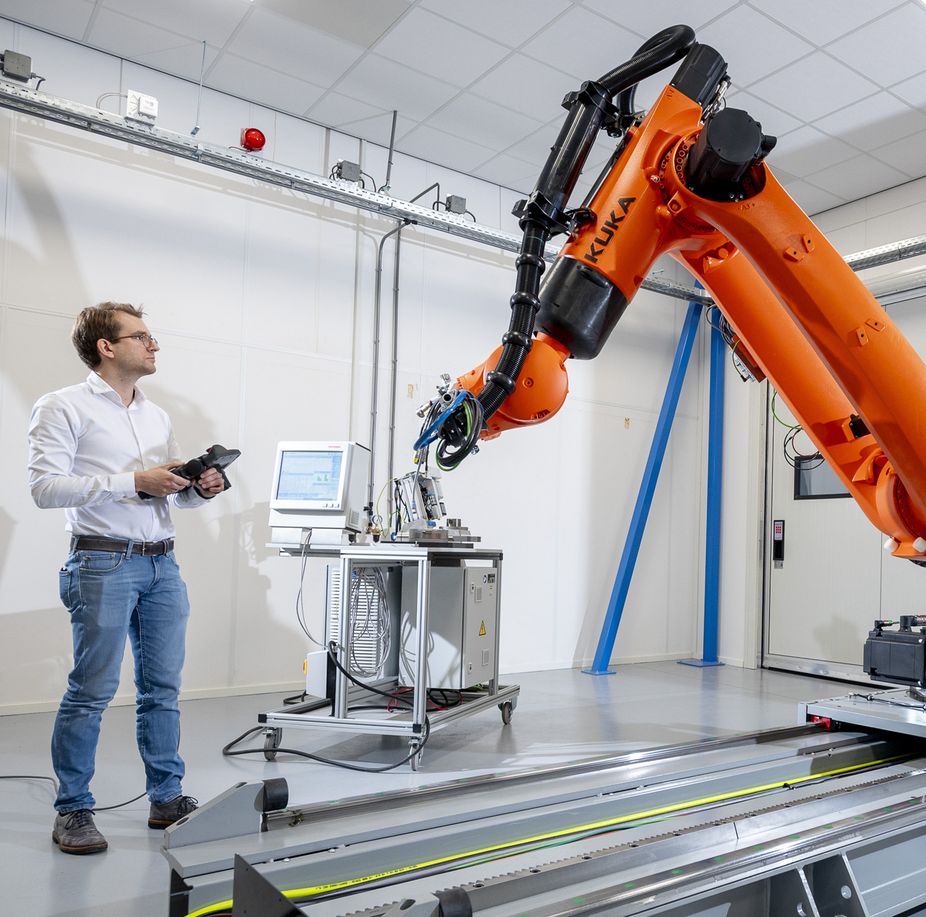
RoboHouse, located in the Netherlands and operated as a robotics fieldlab by TU Delft, provides a real-world innovation environment for validating next-generation robotic systems. The site is used to explore industrial robotics, autonomous systems, human-robot collaboration, AGV workflows, and remote machine-control scenarios.
CloudRAN.AI Private 5G technology, including Polaris10, has been deployed in the RoboHouse campus environment to support private 5G testbed usage. The testbed provides a dedicated wireless environment for validating how private 5G can support low-latency, high-determinism connectivity for robots, AGVs, remote control, and portable private 5G proof-of-concept deployments.

The goal is not simply to connect robots wirelessly. The goal is to validate whether private 5G can provide a reliable, predictable, and operationally controlled wireless layer for industrial automation workloads that require mobility, bounded latency, traffic prioritization, device synchronization, and integration with production systems.
Customer / Site Profile
Site: RoboHouse
Location: Netherlands
Institutional context: Robotics fieldlab operated by TU Delft
Industry: Industrial robotics, smart manufacturing, automation, research and innovation
Environment: Robotics fieldlab / campus testbed
Technology model: CloudRAN.AI Private 5G testbed using Polaris10
Use case focus: Industrial robots, AGVs, remote control, multi-robot coordination, mobile private 5G test rigs, and deterministic wireless proof-of-concept testing
RoboHouse provides a practical fieldlab environment where robotic technologies can be tested under realistic conditions before being transferred into factories, greenhouses, logistics sites, and industrial production environments.
This makes the site highly relevant for private 5G validation. Robotics testbeds require more than basic network access. They need wireless connectivity that can support real-time feedback, machine coordination, video streams, mobile robot movement, remote control workflows, and controlled experimentation.
CloudRAN.AI, part of the Cloudnet.ai portfolio, delivers private 4G/5G solutions for enterprise and industrial deployments, complementing Cloudnet.ai’s broader focus on AI-powered telecom operations, BSS modernization, and network automation.

Why Private 5G Matters for Robotics
Industrial robots and AGVs place different demands on wireless networks than general enterprise devices.
A tablet, laptop, or handheld terminal can often tolerate short network fluctuations. A robot, mobile platform, or remote-control workflow may not. If connectivity becomes unstable, the impact can affect motion, safety, process continuity, visual feedback, and synchronization with other machines.
Robotics environments may require:
• Low-latency communication
• Predictable packet delivery
• Reliable mobility across indoor zones
• Stable uplink for video and sensor streams
• Secure device authentication
• Traffic separation between control, video, sensor, and enterprise workloads
• Integration with edge computing and local control systems
• Support for multiple robots operating at the same time
• Deterministic behavior for time-sensitive automation tasks
This is why private 5G is highly relevant for robotics fieldlabs and industrial automation environments. It provides a dedicated wireless layer that can be configured for operational workloads rather than general-purpose connectivity.
The Robotics Connectivity Challenge
Robotics labs and industrial automation environments are challenging wireless environments.
They often include metal structures, machinery, moving robots, reflective surfaces, cameras, sensors, mobile platforms, safety zones, test rigs, and changing layouts.
A robotics fieldlab may also need to support multiple proof-of-concept configurations in the same space, with different partners testing different robots, machines, and applications.
Traditional wireless technologies such as Wi-Fi can support many general applications, but robotics proof-of-concept testing often requires more predictable behavior. In many environments, Wi-Fi performance can be affected by shared spectrum, interference, roaming behavior, congestion, and variable device performance.
For robotics and AGV testing, the core challenge is not only whether a robot can connect. The real question is whether the network can support predictable, repeatable, and controlled behavior under demanding conditions.
Common connectivity challenges include:
• Maintaining stable communication while robots move
• Supporting low-latency remote control
• Carrying real-time video feedback from robot cameras
• Coordinating multiple robots or AGVs in shared spaces
• Preventing video traffic from affecting control traffic
• Supporting portable test setups in different locations
• Integrating with edge computing and local applications
• Providing secure access for different devices and partners
• Supporting deterministic or near-deterministic wireless behavior for time-sensitive use cases
A dedicated private 5G testbed helps address these challenges by giving fieldlab teams a controlled network environment for experimentation and validation.
RoboHouse Private 5G Testbed
The RoboHouse private 5G testbed uses CloudRAN.AI Polaris10 to support campus testbed usage for robotics and automation scenarios.
Polaris10 is part of the CloudRAN.AI private 5G product portfolio and is designed to support compact, deployable, and enterprise-ready private 5G environments.
In a fieldlab setting, this type of deployment is especially valuable because it allows teams to validate private 5G use cases before moving into larger industrial environments.
The RoboHouse testbed supports validation around several important use-case categories:
• Remote control of robots
• AGV and mobile robot connectivity
• Real-time visual feedback
• Multi-robot coordination
• High-speed sorting and manipulation
• 5G-TSN bounded-latency testing
• Portable private 5G proof-of-concept setups
• Closed-loop robot control scenarios
• External factory POC support through mobile private 5G test rigs
The testbed can help operators, system integrators, industrial technology teams, and research partners understand how private 5G behaves in robotics environments where deterministic wireless performance is important.
Key Use Cases Enabled
Remote Control of Greenhouse and Industrial Robots
Remote control is one of the most demanding robotics use cases for wireless connectivity.
In the RoboHouse context, one important scenario is remote control of agricultural greenhouse robots through on-site private 5G. This type of use case requires real-time visual feedback, responsive control communication, and synchronized movement between the operator interface and the robot.
A remote-control robot workflow may include:
• Camera video from the robot to the operator
• Control commands from the operator to the robot
• Sensor telemetry from robot systems
• Safety-state monitoring
• Local edge processing
• Connection to robot management software
• Real-time status dashboards
The network must support both uplink-heavy traffic and low-latency command flows. Video streams must be stable enough for operators to understand the environment, while control traffic must be prioritized and predictable.
Private 5G can support this by providing:
• Dedicated wireless coverage
• Reliable mobility
• QoS control for control and video traffic
• Secure device access
• Local breakout to keep traffic close to the site
• Integration with edge systems for low-latency workflows
For greenhouse robotics, this is especially important because robots may operate in narrow aisles, around crop rows, and near delicate plants. Network interruptions or unstable visual feedback can affect operational accuracy and safety.
AGV and Mobile Robot Connectivity
AGVs and autonomous mobile robots depend on stable connectivity as they move across a site.
In factories, labs, warehouses, and field environments, AGVs may support material transport, inspection, logistics, picking, delivery, or mobile sensing. These systems need predictable coverage across mobility paths and must maintain communication while moving between zones.
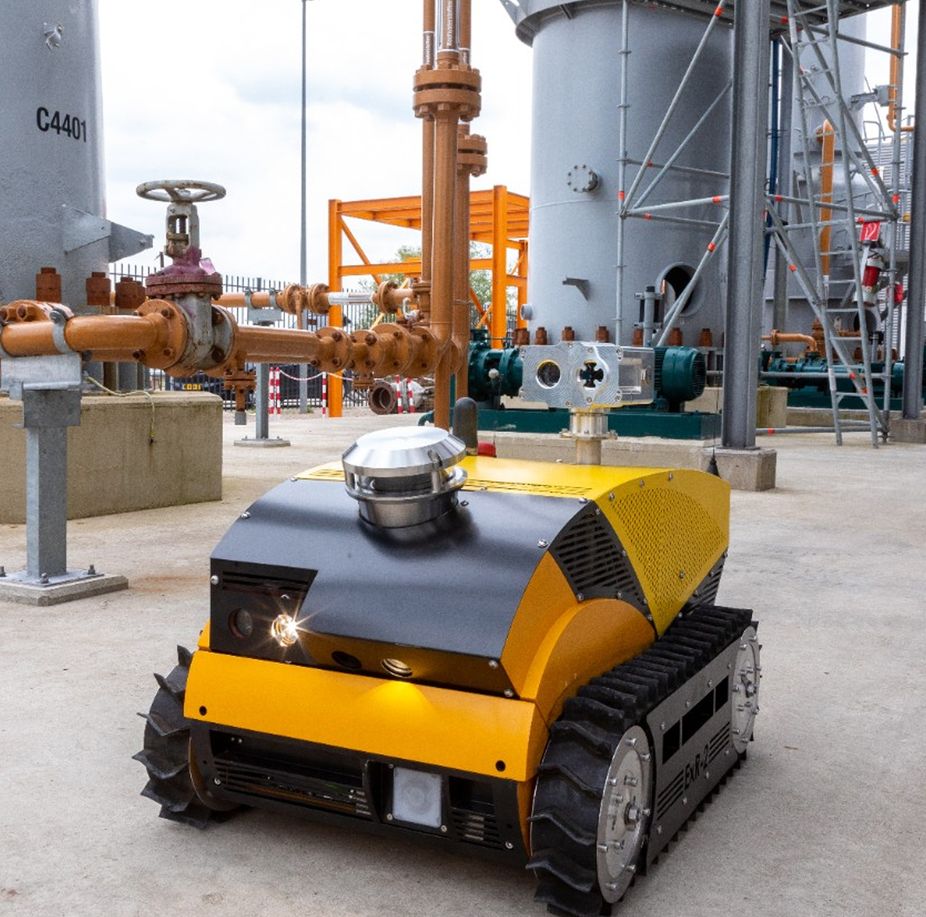
Private 5G can support AGV connectivity through:
• Wide-area indoor coverage
• Better mobility and handover behavior
• Secure SIM/eSIM-based access
• Stable uplink and downlink performance
• Support for fleet management systems
• Integration with local edge applications
• Traffic separation between AGV control, video, and general network traffic
In a fieldlab environment like RoboHouse, AGV testing can help validate how mobile robots behave under private 5G coverage before similar use cases are deployed into external production sites.
High-Speed Sorting Manipulators
High-speed sorting and manipulation systems require precise timing, rapid feedback, and coordination between robot controllers, sensors, cameras, and application software.
These systems may be used in discrete manufacturing, logistics automation, quality control, or production-line handling. A sorting manipulator may need to receive object-recognition data, coordinate with conveyor systems, process camera input, and execute rapid mechanical actions.
For this type of workflow, wireless connectivity must support predictable behavior. Even small variations in latency or jitter can affect the reliability of closed-loop workflows.
Private 5G can help support these systems by providing:
• Low-latency communication paths
• Traffic prioritization for control traffic
• Uplink capacity for machine vision
• Integration with edge computing
• Network slicing or QoS profiles for different application classes
• Potential support for TSN-related industrial networking scenarios
In the RoboHouse context, high-speed sorting manipulators can be used to test how private 5G supports automation scenarios where multiple devices and systems must operate together.
Multi-Robot Coordination
Multi-robot environments are more complex than single-robot deployments.
When several robots, AGVs, cameras, sensors, and control systems operate in the same space, network performance becomes a shared operational resource. One robot’s video stream should not degrade another robot’s control traffic. Sensor traffic should not interfere with time-sensitive robot coordination. Operator dashboards should remain responsive.
Private 5G can support multi-robot coordination by enabling:
• Device-level access control
• Traffic separation
• QoS profiles for different workload types
• Dedicated capacity for operational systems
• Local breakout for on-site coordination
• Reliable connectivity across mobility zones
• Better observability of connected devices and traffic behavior
For fieldlab testing, this is critical. Multi-robot coordination is one of the areas where private 5G can demonstrate clear value over generic shared wireless networks.
5G-TSN Bounded-Latency Testing
Time-Sensitive Networking is an important direction for industrial automation because many industrial systems require bounded latency, synchronization, and deterministic communication behavior.
In manufacturing, robotics, and machine-control environments, some workloads require more than low average latency. They require predictable timing behavior and coordination with industrial Ethernet architectures.
Private 5G combined with TSN-related capabilities can help bridge wireless connectivity with deterministic industrial communication requirements.
At RoboHouse, test scenarios can include validation of:
• 5G-TSN bounded-latency behavior
• Multi-device synchronization
• Industrial robot coordination
• Wireless integration with production-line systems
• Closed-loop control feasibility
• Interaction between robot controllers, edge systems, and wireless devices
This is especially relevant for advanced manufacturing environments where operators want the flexibility of wireless systems without giving up the predictability expected from industrial networks.

Portable Private 5G Test Rigs
One of the most practical testbed scenarios is the use of portable mobile private 5G rigs.
A portable private 5G test rig can be rapidly deployed inside RoboHouse or moved into external factories for proof-of-concept testing. This is important because industrial customers often want to validate private 5G in their own environment before making larger deployment decisions.
A portable private 5G setup can support:
• Temporary robot-control POCs
• Factory-floor wireless validation
• AGV route testing
• Machine vision trials
• Video uplink testing
• Edge computing validation
• Partner demonstrations
• Customer workshops
• Pre-deployment radio and application testing
This aligns well with CloudRAN.AI’s broader value proposition: making private 5G more practical, deployable, and accessible for enterprises, system integrators, and operators.
Technical Architecture Considerations
A robotics private 5G fieldlab requires careful architecture design.
Private 5G RAN
The private 5G RAN provides site-level wireless coverage and capacity for robots, AGVs, cameras, terminals, and other connected devices.
In a robotics lab, radio planning must consider:
• Robot movement paths
• Test cells and demonstration zones
• Metal structures and machinery
• Camera locations
• Controller locations
• Safety zones
• Interference conditions
• Mobile robot routes
• Temporary test setups
• Future external factory POC requirements
CloudRAN.AI Polaris10 supports compact private 5G deployment for environments where flexible testbed coverage and rapid setup are important.
5G Core
A private 5G core provides the control and user-plane functions required for private network operation.
In robotics environments, the core is important because it supports:
• Device registration and authentication
• Session management
• Policy control
• Traffic routing
• QoS management
• Integration with local applications
• Secure device connectivity
A dedicated private 5G core gives the fieldlab more control than public network access or general enterprise Wi-Fi.
Local Breakout and Edge Integration
Robotics workloads often benefit from local traffic handling.
Remote control, video feedback, edge analytics, machine vision, and robot coordination may require traffic to stay on-site or close to the control application. Sending all data through a distant network path can add unnecessary latency and reduce predictability.
Local breakout and edge integration can support:
• Robot-control applications
• Video analytics
• Machine vision processing
• AGV fleet management
• Local dashboards
• Safety monitoring
• Closed-loop test applications
• AI-assisted robotics workflows
For fieldlab experimentation, edge integration is especially important because it allows teams to test different architectures quickly.
QoS and Workload Separation
Robotics environments include mixed workloads.
A single testbed may include robot control, HD video, sensor telemetry, AGV coordination, enterprise access, demonstration devices, and monitoring dashboards. These workloads should not all receive the same treatment.
Example traffic classes may include:
• Control traffic: low latency and high reliability
• Video traffic: high uplink capacity
• Sensor traffic: scalable low-bandwidth access
• AGV fleet traffic: mobility and reliability
• Enterprise traffic: general access
• Demonstration traffic: visitor or partner use
Private 5G allows the network to apply policies and QoS profiles based on operational requirements, helping prevent one workload from degrading another.
Device and Terminal Ecosystem
A robotics private 5G testbed depends on a diverse device ecosystem.
Relevant devices may include:
• 5G routers and CPEs
• Robot-mounted 5G terminals
• AGV communication modules
• Industrial cameras
• Tablets and operator terminals
• Sensor gateways
• Edge servers
• Test rigs
• Remote-control consoles
• Future RedCap devices for lower-complexity connected equipment
As private 5G adoption grows, the device ecosystem becomes a critical part of fieldlab validation. RoboHouse provides a useful environment for testing how different devices connect, move, and interact with applications over private 5G.
Observability and Testbed Management
For robotics validation, it is not enough for the network to operate. Teams need to observe how it behaves.
A testbed should support visibility into:
• Connected devices
• Session behavior
• Traffic flows
• Latency-sensitive workloads
• Uplink-heavy applications
• Mobility behavior
• Coverage patterns
• QoS performance
• Application interaction
• Faults and service status
Operational visibility is especially important for fieldlabs because test teams need to understand whether an issue comes from the robot, application, device, radio layer, core network, or external integration.
CloudRAN.AI Product Fit
CloudRAN.AI’s private 5G portfolio is designed for enterprise and industrial environments where performance, reliability, and deployment simplicity matter.
For RoboHouse, the relevant CloudRAN.AI capabilities include:
• Polaris10-based private 5G testbed deployment
• Private 5G RAN
• 5G core integration
• Compact deployment model
• Support for robotics and AGV use cases
• Local breakout and edge-ready architecture
• QoS and workload separation
• Support for uplink-heavy workloads such as video
• Enterprise-grade private wireless architecture
• Deployment-ready model for fieldlabs, campuses, and external factory POCs
• Pathway toward future RedCap, positioning, and advanced industrial use cases
Polaris10 is especially relevant for testbed environments because it supports compact private 5G deployment where fieldlabs, operators, system integrators, and industrial customers need to validate use cases before scaling to production.
Expected Benefits
The RoboHouse private 5G testbed can support several technical and strategic benefits.
Reliable Wireless for Robotics
Private 5G provides a dedicated wireless layer for robots, AGVs, and remote-control systems that require more predictable connectivity than general-purpose wireless networks.
Low-Latency Remote Control
Remote-control use cases require responsive communication between operator, robot, camera, and control application. Private 5G can support low-latency connectivity with local breakout and QoS configuration.
Strong Uplink for Video Feedback
Many robotics use cases depend on video. Robot cameras, inspection systems, and remote operator views require stable uplink capacity. Private 5G is well suited for uplink-heavy industrial workloads.
Better Multi-Robot Coordination
Private 5G can support multiple robots and AGVs operating in the same environment by separating traffic classes and supporting more controlled network behavior.
Portable Proof-of-Concept Testing
Portable private 5G test rigs can help operators and system integrators validate robotic use cases inside RoboHouse or at external factories before larger commercial deployments.
Stronger Industrial Ecosystem Validation
A robotics fieldlab gives technology vendors, operators, universities, and industrial partners a shared environment for testing private 5G in realistic automation scenarios.
Foundation for Production-Grade Private 5G
The testbed helps move private 5G from concept to production readiness by validating network behavior against real automation workloads.
Strategic Value for CloudRAN.AI
The RoboHouse deployment demonstrates how CloudRAN.AI Private 5G can support advanced robotics and automation environments.
Robotics fieldlabs are important because they sit between research and industrial deployment. They allow new systems to be tested, refined, and validated before being introduced into production environments.
For CloudRAN.AI, RoboHouse supports several strategic messages:
• Private 5G can support robotics and AGV workloads beyond standard connectivity
• Polaris10 can be used for compact private 5G testbed deployments
• Fieldlabs help validate industrial 5G use cases before production rollout
• Private 5G can support remote control, video feedback, mobility, and multi-device synchronization
• Portable test rigs can help system integrators and operators accelerate private 5G POCs
• Robotics is a strong vertical for demonstrating low-latency, deterministic wireless potential
As part of the Cloudnet.ai portfolio, CloudRAN.AI also supports the broader group strategy of enabling AI-powered, connected, and automation-ready digital operations. Robotics fieldlabs such as RoboHouse show how private 5G can become a practical infrastructure layer for that future.
Conclusion
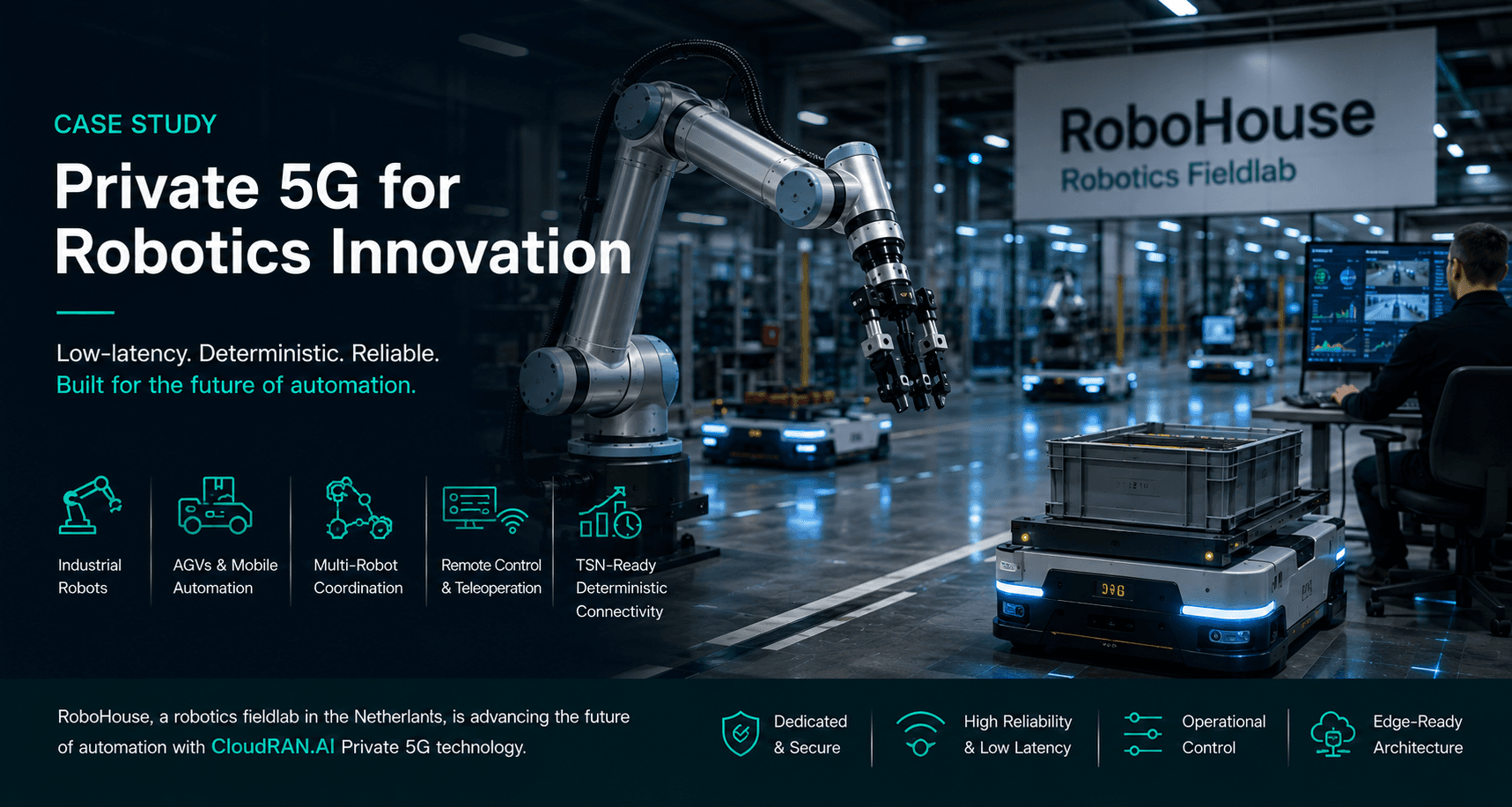
RoboHouse represents an important private 5G robotics testbed in the Netherlands.
By using CloudRAN.AI Polaris10 in the campus testbed environment, the project explores how dedicated private 5G connectivity can support industrial robots, AGVs, remote control, real-time visual feedback, multi-robot coordination, and portable proof-of-concept deployments.
The deployment is especially relevant because robotics environments require more than general wireless coverage. They need reliable mobility, low latency, strong uplink, traffic prioritization, secure device access, and the ability to support multiple workloads at the same time.
Private 5G provides a dedicated, controllable, and scalable network architecture for these requirements.
For RoboHouse, the testbed supports robotics innovation and industrial automation validation. For CloudRAN.AI, it demonstrates how private 5G can support advanced automation environments and help move robotic use cases from lab validation toward production deployment.
As industrial automation continues to evolve, private 5G, edge computing, robotics, AGVs, machine vision, TSN-related networking, and portable testbed architectures will become increasingly important building blocks for flexible, connected, and software-defined production systems.